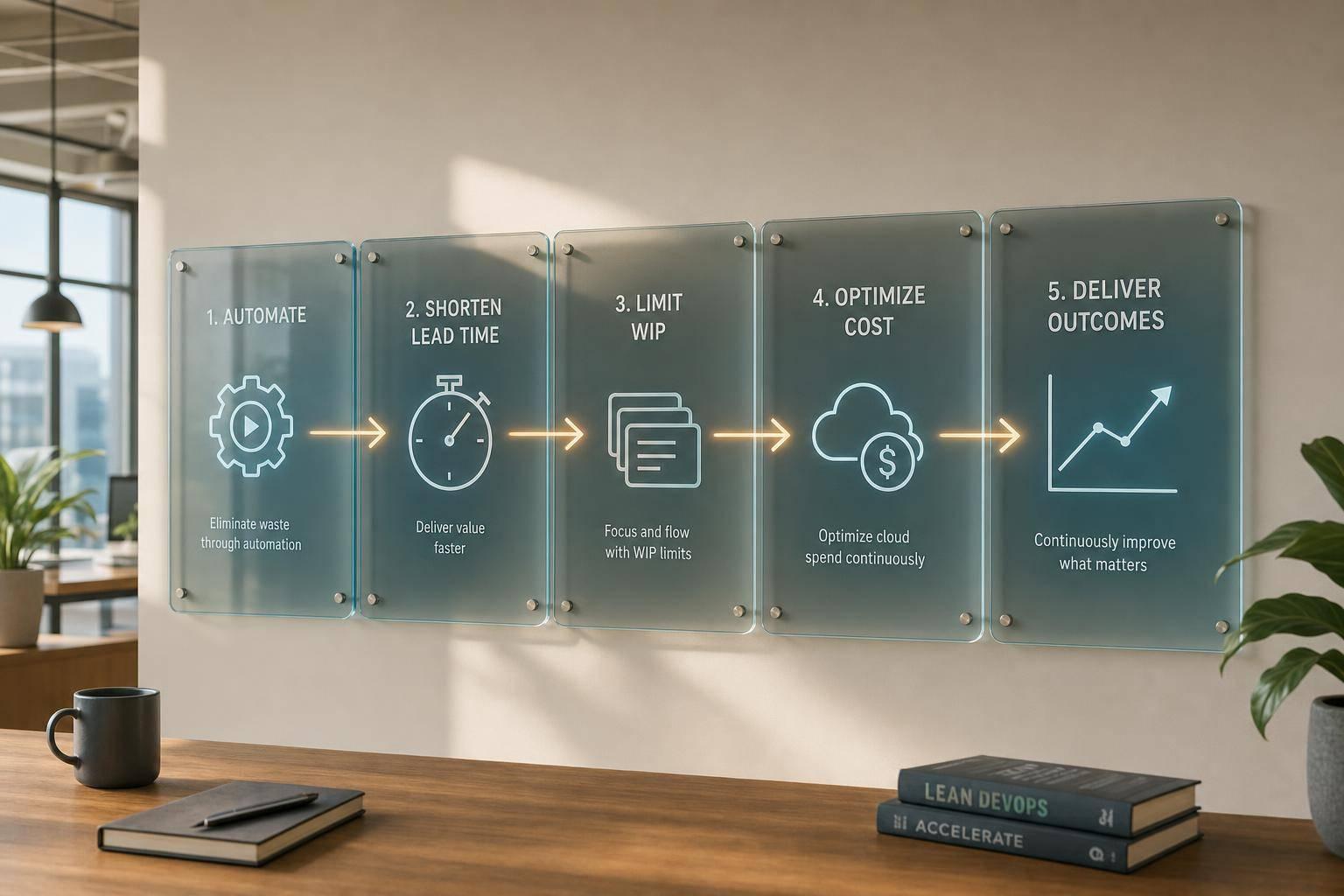
If I want Lean DevOps to work, I need to cut waiting, shrink batch size, build checks into the pipeline, and track flow with a small set of metrics.
In simple terms, this article shows me how to move from slow, queue-heavy delivery to a system with less waste, shorter lead times, and tighter control of cloud spend. It ties lean ideas to day-to-day DevOps work: CI/CD, testing, IaC, release methods, Kanban, DORA metrics, and cost control.
Here’s the full picture in plain English:
- I cut waste by removing manual approvals, hand-offs, and idle queues
- I ship in small batches with trunk-based development and feature flags
- I build quality in with automated tests, static checks, and policy-as-code
- I map the path from idea to production to spot delays and cost leaks
- I limit WIP so teams finish work instead of starting too much at once
- I track lead time, deployment frequency, change failure rate, MTTR, throughput, and wait ratio
- I treat cloud cost as a delivery metric, not just a finance line
- I reduce non-production spend with scheduled shutdowns, tagging, ephemeral environments, and spot instances
- I support the system with shared ownership, blameless postmortems, and guardrail-based governance
A few numbers stand out:
- One case in the article cut lead time from 60 days to 28 days
- Flow efficiency can sit as low as 2.5% when work spends most of its time waiting
- Non-production compute costs can drop by up to 65% with scheduled shutdowns
- Many firms still run at just 15–20% CPU utilisation while paying for near-full capacity
- Spot instances can cut some compute costs by 60% to 90%
- A sound starting point is 1–5% change failure rate and under 15 minutes MTTR for critical services
If I had to boil the article down to one line, it would be this: map the work, remove the biggest delay, automate the repeatable parts, measure the result, and repeat.
::: @figure 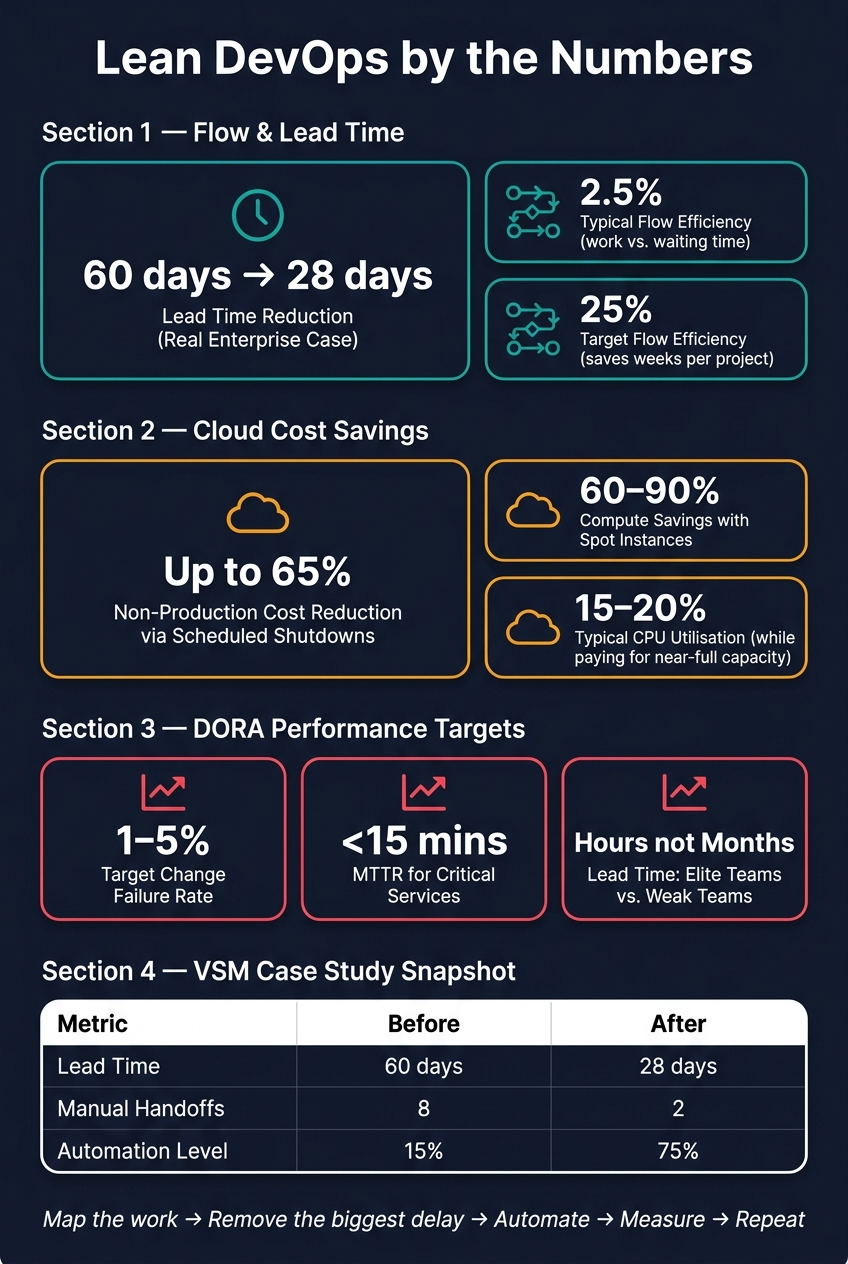 {Lean DevOps by the Numbers: Key Metrics & Impact Stats}
:::
{Lean DevOps by the Numbers: Key Metrics & Impact Stats}
:::
Applying Lean Principles to the DevOps Pipeline
Cutting waste in CI/CD workflows
Lean delivery starts with one simple move: cut delay inside the pipeline. In most DevOps setups, the waste isn't the work itself. It's the time between steps - queues, approvals, and hand-offs. Value stream mapping helps teams see that delay from commit to release.
| Waste Type | Common Causes | Lean DevOps Countermeasure |
|---|---|---|
| Handoffs | Siloed teams, manual sign-offs | Cross-functional pairing, unified CI process |
| Waiting | Approval bottlenecks, unavailable environments | Infrastructure as Code, automated provisioning |
| Inventory | Large backlogs, long-lived branches | Kanban boards, WIP limits, small batch sizes |
| Defects/Rework | Manual configuration, poor test coverage | Automated testing, Infrastructure as Code, shift-left practices |
A practical fix is to start long-lead-time requests at the beginning of the sprint, so they don't stall the critical path later on. That includes security approvals, service account provisioning, and access controls. If those items start moving early, teams are less likely to hit a wall halfway through delivery.
When queues get smaller, small batches start to pay off. They lower risk and make rollback much easier.
Faster delivery through small batches and release automation
Large releases come with large risk. Smaller, more frequent changes are easier to test and simpler to roll back [2]. That's why trunk-based development works well here: branches stay short-lived, and changes merge into the main line often.
Feature flags add another layer of control. Teams can deploy incomplete work safely, separate release from deployment, and decide what users see - and when they see it [6]. It takes some pressure off the release process because code can ship without being turned on for everyone at once.
Release strategy matters too. Each option has its own trade-off between risk, speed, and day-to-day effort.
| Strategy | Risk Level | Speed | Operational Complexity | Best-Fit Use Case |
|---|---|---|---|---|
| Blue-Green | Low | Fast | High (requires 2× environments) | Mission-critical apps requiring instant rollback |
| Canary | Lowest | Slow | High (requires traffic routing) | Testing new features on a subset of real users |
| Rolling | Medium | Medium | Low | Standard updates where brief version mixing is acceptable |
Building quality into reduce defects and recovery time
Finding defects early costs less than finding them in production. Shifting quality left means running automated tests, static analysis, and policy checks inside the pipeline, not after deployment [2][6].
Policy-as-code helps here too. Instead of waiting for manual approval, teams can run automated checks that still satisfy governance rules [6].
| Practice | Defect Rate | Deployment Frequency | Change Failure Rate | Operational Effort |
|---|---|---|---|---|
| Automated Testing | Significant decrease | Increases | Decreases | High initially, low long-term |
| Observability | No direct change | No direct change | Decreases (faster detection) | Medium, requires continuous tuning |
| Policy-as-Code | Decreases | Increases (faster approvals) | Decreases | Medium, automation setup required |
Observability and fast rollback paths help teams spot issues sooner and cut MTTR.
The next step is to map the full value stream and cap work in progress.
Designing a Lean Delivery System
Using value stream mapping to find delays and cost leaks
After cutting waste in the pipeline, map the full path from idea to production. Value stream mapping (VSM) shows where work gets stuck.
Skip the official process maps. Follow a real deployment instead. Watch for stalls, handoffs, and idle time. Used this way, VSM can also show cloud cost leaks during the As-Is mapping phase, such as idle resources or over-provisioning [5]. Once the bottlenecks are out in the open, you can control how much work enters the system.
In one 2024 enterprise DevOps case, a single queue took up about half of the total deployment lead time. The team asked for access earlier, added a deployment checklist, and put an Infrastructure as Code (IaC) pipeline in place. That cut lead time from 60 days to under 30 and also reduced idle environment spend [3].
| Metric | Current State (As-Is) | Future State (To-Be) | Estimated Impact (£) |
|---|---|---|---|
| Lead Time | 60 days | 28 days | ~£45,000 (reduced idle dev time) |
| Handoffs | 8 manual handoffs | 2 automated/self-service | ~£8,000 (reduced context switching) |
| Automation Level | 15% (manual provisioning) | 75% (IaC pipelines) | ~£15,000 (cloud resource optimisation) |
Track flow efficiency too: active work time divided by total lead time. A team might add only 180 minutes of value across five days, which works out at 2.5% efficiency [7]. Move that figure to 25%, and you can cut weeks or even months across the life of a project [7].
Once the biggest delays are clear, WIP limits help stop those same queues from building up again.
Managing work in progress with Kanban and flow metrics
Use Kanban to keep flow visible and inside the team’s actual capacity.
Limit work in progress (WIP). Without WIP limits, teams start more work than they can finish. That leads to context switching and longer cycle times [4].
Track a small set of flow metrics:
- Lead time
- Cycle time
- Throughput
- WIP
- Wait ratio
Wait ratio matters because it shows queue time divided by processing time. If it’s above 1, the system is spending more time waiting than working [8].
Cutting flow waste also lowers idle cloud spend and over-provisioning.
Lean, Agile & DevOps How To Make Them Play Well Together presented by Mike Orzen
Lean DevOps and Cloud Cost Optimisation
Once waste in flow is visible, the next step is simple: show the spend that waste creates.
Treating cloud cost as a delivery metric
Cloud cost should sit next to flow metrics, not off in a finance report no one reads. If queues shrink and work in progress drops, teams should also see less money wasted on idle environments and unused capacity.
A practical way to do that is to show per-pull-request cost impact before merge, so engineers can see the spend effect of a change early [9][11]. It also helps to make tags mandatory for team, environment, service, and cost centre, then look at the biggest cost movers in a short monthly check [9][11].
One of the easiest wins is automated environment scheduling. Stopping development and staging instances outside business hours - for example, from 8pm to 8am and over weekends - can cut non-production compute costs by up to 65% [9][11].
That matters because many UK enterprises still pay for close to full capacity while CPU utilisation sits at only 15–20% [10]. In plain terms, they're paying for a full train while most of the seats are empty.
Architecture patterns that reduce waste
Once cost is visible, architecture choice becomes the next lever.
| Architecture Pattern | Waste Reduction | Flexibility | Operational Overhead | Typical running cost (£) |
|---|---|---|---|---|
| Serverless (Lambda/Fargate) | Very high | High | Low | Pay-per-use; low when idle |
| Containers (Kubernetes/EKS) | High | High | High | Scalable; medium baseline |
| Ephemeral environments | High | Medium | Medium | Low; short-lived by design |
| Autoscaling VMs | Medium | Medium | Medium | Dynamic; depends on min/max limits |
| VM-based (fixed) | Low | Low | Medium | High; fixed monthly spend |
The pattern you pick should match the workload.
- Serverless works well for bursty demand, where paying only when code runs keeps idle spend down.
- Kubernetes makes sense when teams need tighter control over scale and deployment behaviour.
- Ephemeral environments are a good fit for short-lived branches, where keeping environments temporary stops waste from piling up.
For teams running CI/CD workloads, spot instances can also make a big dent in spend. They offer 60% to 90% discounts compared with on-demand pricing and suit fault-tolerant jobs such as CI/CD runners and batch processing [11].
Where Hokstad Consulting fits
Teams that need help putting these controls in place often need support with CI/CD, tagging, and environment automation.
Hokstad Consulting helps teams add cost gates to CI/CD, enforce tagging, and cut cloud spend through DevOps transformation, IaC, and environment automation.
Sustaining Lean DevOps Through Metrics, Culture, and Governance
Metrics that show real delivery improvement
Once you've cut queues and trimmed cloud waste, you need a small scorecard to check that delivery is moving in the right direction.
Use the four DORA metrics as that scorecard: lead time, deployment frequency, change failure rate, and MTTR [4][1][6]. They give you a plain view of how work moves through the system. A sensible starting point is a Change Failure Rate of 1% to 5% and an MTTR of under 15 minutes for critical services [6]. Elite teams track lead time in hours, while weaker teams still track it in months [3].
It also helps to track toil hours and cost per service. If spend is climbing faster than usage, drift has started.
Metrics can be bent out of shape if people chase the number instead of the problem. So don't use them as performance targets. Use them in retrospectives to find system faults and fix what's slowing the team down.
| Metric | What it Tells You | Starting Target |
|---|---|---|
| Lead Time for Changes | Time from commit to production | < 1 day (small teams); < 1 week (large orgs) |
| Deployment Frequency | How often code is deployed | Multiple times per day/week |
| Change Failure Rate | % of changes causing incidents | 1–5% |
| MTTR | Time to restore service after failure | < 15 mins (critical); < 2 hours (non-critical) |
| Toil Hours | Manual operational work | Decrease month-over-month |
| Cost per Service | Cloud spend relative to value | Trend aligned with user growth |
Building a culture of shared ownership and continuous improvement
Metrics only matter when teams own the whole delivery path.
Shared ownership cuts the handoffs, waiting, and rework that lean DevOps is meant to remove. That usually starts with cross-functional teams, where development and operations share responsibility for the full delivery pipeline instead of guarding one step each [1][2]. When something breaks, the first question shouldn't be who messed up. It should be what in the system let the failure happen.
Blameless postmortems help make that shift real. They bring process gaps into the open before those same issues crop up again [6].
In larger UK organisations, especially those with compliance demands, psychological safety matters for a simple reason: people need to feel able to flag bottlenecks or process failures early [1][6]. If they stay quiet, delays pile up and risk grows. That's where Policy-as-Code can help. It swaps manual approval gates for automated compliance checks, which means governance acts more like a guardrail than a roadblock [6][2].
Lean DevOps works best when teams fix the system together, not when they point fingers. That's how Kaizen becomes part of day-to-day work instead of a slogan.
Conclusion: Lean DevOps as a Path to Faster, Lower-Waste Delivery
Lean principles give teams a practical way to cut waste, shorten lead times, build quality in from the start, and keep cloud spend tied to the value being delivered. It doesn't call for a full overhaul.
Map the flow, fix the biggest bottleneck, measure the result, and repeat [4].
Properly applying Lean Principles and the Theory of Constraints helps you to always work on the right things, get more done, deliver more value to customers, and expend less resources relative to the value created while doing it.- Chris Hurst, StratusGrid [4]
FAQs
How do I start Lean DevOps?
Start by defining what your customer values. Then map your value stream from idea to production so you can spot bottlenecks and waste.
Next, improve flow with automation, such as CI/CD pipelines. Use a pull-based approach so work moves in line with demand, not guesswork. And keep improving through performance reviews and team retrospectives.
Hokstad Consulting supports these DevOps changes with tailored automation and cloud strategy.
Which metrics matter most first?
Start by defining value from the customer’s point of view, then map the value stream from idea to production. That makes bottlenecks and waste much easier to see.
Next, set a baseline for cycle time, lead time, error rates, and toil. These metrics show where work slows down, where manual hand-offs pile up, and where teams spend time waiting, so you can focus on changes that matter instead of vanity data.
How can Lean DevOps reduce cloud costs?
Lean DevOps helps cut cloud spend by stripping out waste and getting more from the resources you already pay for. In practice, that means right-sizing infrastructure so teams aren’t running oversized services, using ephemeral environments that switch off on their own, and setting lifecycle policies to archive build artefacts that no one needs day to day.
Cost control also gets easier when teams automate governance and tagging. That gives a clearer view of where money is going and which systems are driving spend. On top of that, spot instances can lower costs for interruptible tasks, while savings plans can trim spend for predictable workloads.
Hokstad Consulting supports this work with tailored DevOps and automation strategies.