
If you run a hybrid estate, AI can cut detection and response time - but only if you keep it on a tight leash.
I’d boil the research down like this: AI is most useful for finding odd activity, sorting alerts, checking cloud posture, and running low-risk response steps across on-premises systems, AWS, Azure, Google Cloud, and Kubernetes. The upside is clear in the numbers: some teams saw MTTR drop by up to 70%, UK firms using security AI found and contained breaches 106 days sooner, and average breach costs were £1.06 million lower.
But I wouldn’t treat AI as a free pass. The same research shows clear risks: hallucinated outputs, biased detections, bad automated actions, prompt injection, model poisoning, and data leaks. In plain terms, AI helps most when people still control high-impact actions, logging is in place, and every rollout starts small.
If you only need the short version, here it is:
- Where AI helps: anomaly detection, alert triage, posture checks, policy checks, and SOAR workflows
- Where it works best first: read-only reviews, enrichment, and low-risk automated actions
- What causes most cloud failures: misconfiguration, with analyst estimates pointing to 99% through 2027
- What UK teams should watch: UK GDPR, NCSC guidance, audit trails, identity sprawl, and data location controls
- What not to do: give AI broad permissions and let it make high-stakes changes on its own
A simple rule runs through the whole piece: use AI to extend your security team, not replace it.
What Recent Research Shows About AI Security Automation
Threat Detection and Anomaly Analysis Across Hybrid Estates
Hybrid cloud detection is difficult because data is spread across on-premises systems, Kubernetes and cloud platforms. Logs often sit in different formats, which makes it harder to spot patterns that cut across the whole estate. AI helps by normalising that telemetry into a single schema, so models can link activity across environments.[1][4] Research points to both supervised and unsupervised methods as strong options here, including deep learning, clustering and anomaly detection.[9][5]
The results are hard to ignore. One framework using Isolation Forests and autoencoders on Kubernetes telemetry delivered 0.92 precision, 0.95 recall and an F1-score of 0.94 for container escape detection, with AUC above 0.95 across multiple attack scenarios.[13] For resource abuse, it reached 0.91 precision and 0.93 recall.[13] That’s a clear step up from rule-based systems, which often flood teams with static alerts and still miss quieter, multi-stage attacks.[13][14]
There’s a practical upside too. AI-driven security operations centres can investigate almost all alerts, while more standard setups tend to review only about 60%, simply because people run out of time.[6]
That matters most when detection doesn’t stop at finding the issue, but moves it into a fast, controlled response.
Automated Incident Response and Orchestration
Research on AI-assisted SOAR platforms shows they can cut mean time to respond (MTTR) by up to 70% for common threat types. They do this by enriching alerts, correlating signals and triggering standard containment steps without waiting on an analyst to handle each task by hand.[2][6]
In hybrid estates, those steps often cross system boundaries. A response might isolate a compromised virtual machine in a public cloud, disable a suspicious account in on-premises Active Directory, revoke OAuth tokens, or quarantine an affected container in Kubernetes.[10] AI can choose playbooks based on incident type and asset criticality. Studies also show that organisations using AI and automation shorten the breach lifecycle by 80 days and save about £1.9 million per breach compared with organisations that don’t use these tools.[10]
The rollout tends to work best in stages:
- Start with AI-powered alert triage and enrichment, where analysts still make the final call.
- Then add automated investigation and partial response for lower-risk assets.
- Keep more autonomous containment for well-understood, high-confidence cases with strong audit logging in place.[6][10]
That phased approach gives teams room to build trust in the system without handing over too much too soon.
Posture Management, Policy as Code, and Zero Trust
Analyst projections suggest that 99% of cloud security failures through 2027 will come from configuration errors.[3]
That’s where AI-enhanced cloud security posture management, or CSPM, comes in. Instead of just flagging single misconfigurations, it adds graph analysis and machine learning on top of standard configuration scanning to map full attack paths.[7][11] So rather than spotting one bad setting in isolation, it can connect the dots - say, a developer account with too many permissions in one cloud tenant plus a misconfigured VPN into an on-premises network segment.[7][11]
Studies of CSPM in multi-cloud estates report:
- a 60–80% drop in misconfiguration incidents
- a 75% cut in threat detection time, from weeks to hours
- a 50% drop in overall security operations costs when AI analytics are used[15]
For Zero Trust, AI supports continuous verification by building behavioural profiles for users and services across on-premises and cloud assets. It can then apply risk-based access control in real time, triggering step-up authentication or tighter permissions when behaviour shifts from the baseline.[8][12] When this is tied into CI/CD pipelines, every infrastructure change can be checked against security policy before it reaches production.
Those gains depend on keeping the AI layer tightly controlled, watched and easy to audit.
Building a Cloud Security Strategy with AI & Threat Intelligence
Measured Benefits for UK Organisations
::: @figure 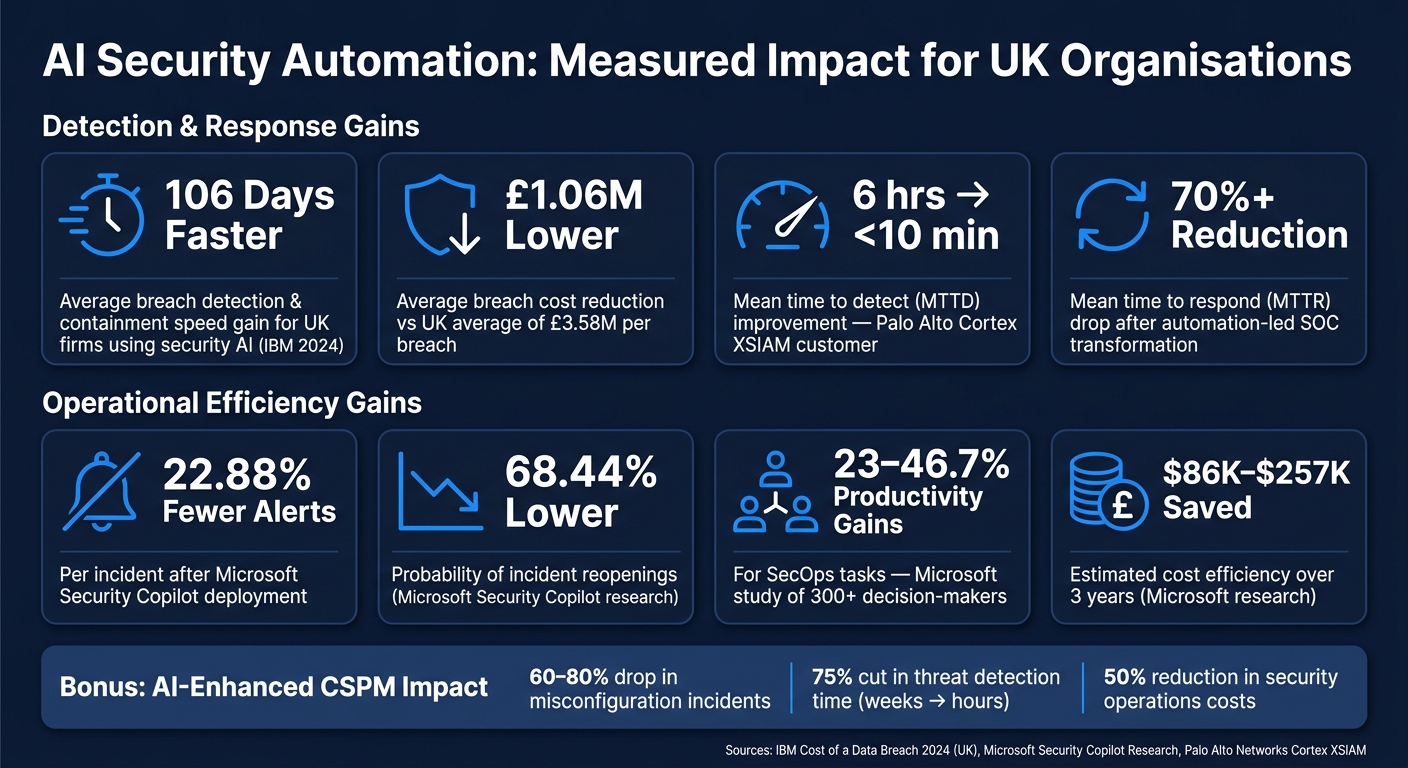 {AI Security Automation: Key Stats & Benefits for Hybrid Cloud}
:::
{AI Security Automation: Key Stats & Benefits for Hybrid Cloud}
:::
Detection Speed, Coverage, and Error Reduction
Recent UK data puts the impact in plain terms. IBM’s 2024 UK breach-cost data found that organisations using security AI and automation at scale detected and contained incidents 106 days faster on average than those not using these tools. They also saw £1.06 million less in breach costs on average, compared with a UK average breach cost of £3.58 million.[25]
You can see the same pattern at tool level. A Palo Alto Networks Cortex XSIAM customer said mean time to detect (MTTD) fell from 6 hours to under 10 minutes, while MTTR dropped by more than 70% after an automation-led SOC change.[23] Microsoft’s live-operations research on Security Copilot found 22.88% fewer alerts per incident and a 68.44% lower probability of incident reopenings. It also reported an 18.38% shorter time to classify a DLP alert.[24]
That matters because false positives eat up a lot of analyst time. AI triage cuts that workload, which can consume nearly 2 hours a day.[20] So the gain isn’t just faster detection. It also means less friction across the SOC and less time lost to low-value alert handling.
Efficiency and Cost Control
AI security automation also helps with DevSecOps. Research on DevSecOps shows that putting security automation into CI/CD pipelines leads to faster pipelines than older approaches.[16][17] Security checks happen inside the delivery flow instead of being bolted on later.
Microsoft’s research with over 300 decision-makers found 23–46.7% productivity gains for SecOps tasks, with estimated cost efficiencies of US$86,000 to US$257,000 over three years.[21] IBM’s UK data also shows that 71% of UK organisations in the study were already deploying security AI and automation across their SOC in 2024.[25]
That points to a simple shift: this is starting to look like standard practice, not a niche capability. For UK firms paying cloud bills in pounds, fewer severe incidents and shorter investigations can cut indirect costs in a very practical way:
- less unplanned downtime
- fewer emergency engagements
- better use of tools already in place
There’s another piece to it. When AI security automation is tied to cloud cost engineering, telemetry and automation services can stay right-sized instead of adding avoidable overhead.
Those savings tend to improve when automation is applied in a steady way across the estate.
Comparison Table: Manual Security Operations vs AI-Driven Automation
| Dimension | Manual / Legacy Operations | AI-Driven Automation |
|---|---|---|
| Detection speed | Slower, more reactive; relies on analyst availability | Near real-time; materially faster detection |
| False-positive handling | Analysts spend nearly 2 hours daily investigating false positives[20] | Fewer alerts per incident; 68.44% lower reopening probability[24] |
| Policy consistency | Inconsistent across teams and sites | Consistent policy checks and drift detection across the hybrid estate |
| Scalability | Coverage limited by headcount; harder to extend to hybrid assets | Scales to more telemetry and alerts without proportional hiring[18][22] |
| Staffing pressure | High manual burden; alert fatigue is common | Routine triage automated; analysts focus on complex investigations |
| Incident response coordination | Slower hand-offs across cloud and on-premises | Automated orchestration across environments; faster remediation |
These gains only hold when automation is governed tightly, which becomes critical in the risks and limits that follow.
Risks, Limits, and Governance Requirements
As AI shifts from detection to response, the hard part changes too. It’s no longer just about spotting threats. It’s about using automation without making your security weaker.
Hallucinations, Bias, and Over-Automation
Hallucinations can make up threat context that simply isn’t there, which can send analysts down the wrong path and let real attacks pass by unnoticed.[41] In a hybrid cloud setup, that might mean an AI assistant invents correlation paths across cloud and on-premises logs. The team wastes time chasing noise while actual lateral movement carries on somewhere else.[26][32]
Bias creates a different kind of problem. If training data leans too heavily towards certain geographies, workloads, or user groups, anomaly detection can skew with it. That leads to blind spots and unfair outcomes.[32][36] For UK organisations, that has clear compliance concerns, especially in access control and fraud detection.
Over-automation is one of the most serious failure modes. One bad action can knock out critical services and trigger an outage straight away.[28][35] And if an agent has too many permissions, it can do more damage, and do it faster, than a person making a mistake.
Integration Complexity and Securing the AI Layer
Hybrid estates are difficult to integrate. Legacy systems, cloud APIs, and uneven logging often produce patchy telemetry.[29][32] If one part of the estate is much better instrumented than another, the AI may lean too heavily on signals from that environment and miss threats in less visible segments.
The AI layer also adds a new attack surface.
- Prompt injection lets an attacker hide malicious instructions inside a log entry or configuration file. That can push an AI agent to disable controls or send sensitive data outside the UK.[27][33][35][37]
- Model poisoning can plant backdoors that make the AI keep marking known malicious traffic as benign.[27][30][32][35][37]
- Data leakage happens when staff use unapproved AI tools, or when model outputs expose proprietary settings or personal data by accident.[27][32][35][36]
UK government research points to misconfigured AI cloud services as a major attack path.[40] There’s another weak spot that often gets missed: intermediate AI artefacts. Embeddings, processed logs, and temporary datasets may sit in the background, but they often contain sensitive information and are easy to overlook in security design.[32]
Risk Assessment Table and Governance Controls
These risks need clear controls. Informal oversight won’t do the job.
| Risk | Likelihood | Impact | Mitigation |
|---|---|---|---|
| Hallucinated threat assessments leading to mis-prioritisation | Medium | High | Continuous evaluation against curated test datasets; confidence scores and traceable rationales in AI outputs |
| Biased anomaly detection creating blind spots or unfair outcomes | Medium | High | Diverse, representative training data; formal bias assessments; red-teaming with realistic hybrid-cloud workloads |
| Over-aggressive automated remediation causing outages | Low | Critical | Human-in-the-loop approval for high-impact actions; tiered automation levels; rollback mechanisms and strict change windows |
| Prompt injection leading to unauthorised security-control changes | Medium | Critical | Input validation and content filtering around AI interfaces; segregation of duties so AI can draft but not execute high-risk changes |
| Model poisoning reducing detection accuracy | Low | Critical | Treat pre-trained models as supply-chain assets; adversarial testing; secured model registries with audit logs and access controls |
| Data leakage via AI outputs or unapproved AI tools | Medium | High | Strict controls over data used for training and inference; output filtering; policies on approved AI tooling |
| Model drift degrading performance over time | Medium | Medium | Quarterly model review cycles; ongoing monitoring of output distributions and error rates |
| Incomplete audit trails undermining incident investigations | Medium | High | Immutable logging of AI inputs, outputs and actions; version-controlled datasets and model artefacts |
The organisations furthest along don’t leave this to one team. They set up cross-functional AI governance boards that bring together Security, Risk, Legal, and Data Protection to review deployment decisions and keep a dedicated AI risk register under review at least every quarter.[28][31][34][38] That register should include every AI asset across the estate: models, agents, prompts, and datasets, whether they sit in public cloud or on-premises.[39][29][32]
A sensible starting point is to use AI for enrichment and correlation first, while people stay in charge of containment and remediation. In practice, that means beginning with enrichment and triage, then only extending automation when controls, logging, and rollback are in good shape.
Implementation Priorities and Conclusion
How to Adopt AI Security Automation Safely
Start with a phased rollout. Measure MTTD, MTTR, and the false-positive rate against a pre-deployment baseline, then expand automation only when each phase shows better results.[49][6][51][53]
A sensible path looks like this:
- begin with read-only checks on IaC templates and Kubernetes manifests
- move into vulnerability prioritisation
- then introduce tightly scoped automated actions, such as revoking dormant accounts or quarantining a confirmed compromised workload[49][51][54][56]
Once that rollout plan is in place, the next step is to lock the AI layer into the delivery pipeline.
Embed AI in CI/CD pipelines. Treat AI models and the infrastructure around them as critical services: version-controlled, tested, and gated.[43][45][46][48][50][52][55][57] Use policy as code to assess every cloud and on-premises change before deployment, and block AI-generated configurations that fail baseline controls.
Ownership matters here. Security defines policy and risk appetite. Platform teams handle integration. Operations own the runbooks. If that split isn't clear, gaps in accountability show up fast.[50][52][55][57]
| Implementation Phase | Focus Area | Human Oversight Level |
|---|---|---|
| Phase 1: Discovery | Visibility, telemetry centralisation, risk assessment | High - manual validation |
| Phase 2: Advisory | AI-assisted IaC scanning, policy suggestions, alert enrichment | Moderate - peer review |
| Phase 3: Automation | Low-risk workflows: dormant account revocation, compliance checks | Low - exception-based |
| Phase 4: Orchestration | Automated isolation and tightly scoped response | Moderate - human-in-the-loop for high-stakes actions |
Where Specialist Support Can Help
The same controls that make security automation safe also make outside implementation support useful.
Hokstad Consulting can help connect security automation to CI/CD, IaC, identity, and observability while keeping cost and complexity under control.
Conclusion: Key Findings from the Research
Taken together, the research points to a narrow, controlled adoption path.
AI can improve hybrid security by spotting anomalies, speeding up triage, and applying policy more consistently. The main risks are over-reliance, weak data quality, and integration complexity. A staged rollout with strong governance is the safest route.[42][40][47][51]
The best results come from organisations that use AI to extend existing security capability, not swap it out. Human expertise, clear ownership, and well-instrumented hybrid estates still form the base.[44][19][40][47][51][53] AI speeds up the kind of work that sound security practice already depends on.
FAQs
How do we start using AI safely in a hybrid cloud?
Start with a structured, risk-based approach built around visibility, governance and human oversight.
First, identify your critical assets and map where sensitive data lives. Then line that up with UK rules such as GDPR, bring identity management into one place, and apply Zero Trust across every environment.
From there, bring AI security tools into your CI/CD pipeline so you can scan in real time, spot threats early and enforce policy as code. Keep data governance tight, treat AI models like code with versioning and testing, and make sure people stay involved when decisions get complex.
Which security tasks should remain human-led?
AI can take care of data analysis, pattern spotting, and routine fixes. But people should stay in charge when the work needs broader judgement or when the stakes are high.
That covers things like overseeing major changes, giving final compliance sign-off for UK rules such as GDPR, and reviewing vulnerabilities tied to complex interactions across whole systems.
How do we measure whether AI security automation is working?
Measure it using day-to-day and compliance metrics, such as:
- faster breach detection and response
- better audit compliance scores
- fewer unauthorised access incidents
- accurate anomaly detection with low false-positive rates
Regular security audits also help confirm that automated policies are cutting risk and keeping systems resilient.