
Managing risks in multi-cloud setups is tough, but AI is changing the game. Companies using multiple cloud providers face challenges like security gaps, compliance issues, rising costs, and operational errors. AI simplifies this by monitoring systems, detecting threats, and automating responses in real time.
Key takeaways:
- Security: AI detects misconfigurations, identity sprawl, and
Shadow AI
risks. - Compliance: AI tools ensure adherence to regulations like GDPR and the EU AI Act.
- Cost savings: AI-powered FinOps can cut cloud expenses by 20–40%.
- Efficiency: AI reduces human error and manages complex cloud environments seamlessly.
Whether it's spotting vulnerabilities, optimising resources, or automating compliance, AI helps businesses stay secure and efficient across their cloud platforms.
::: @figure 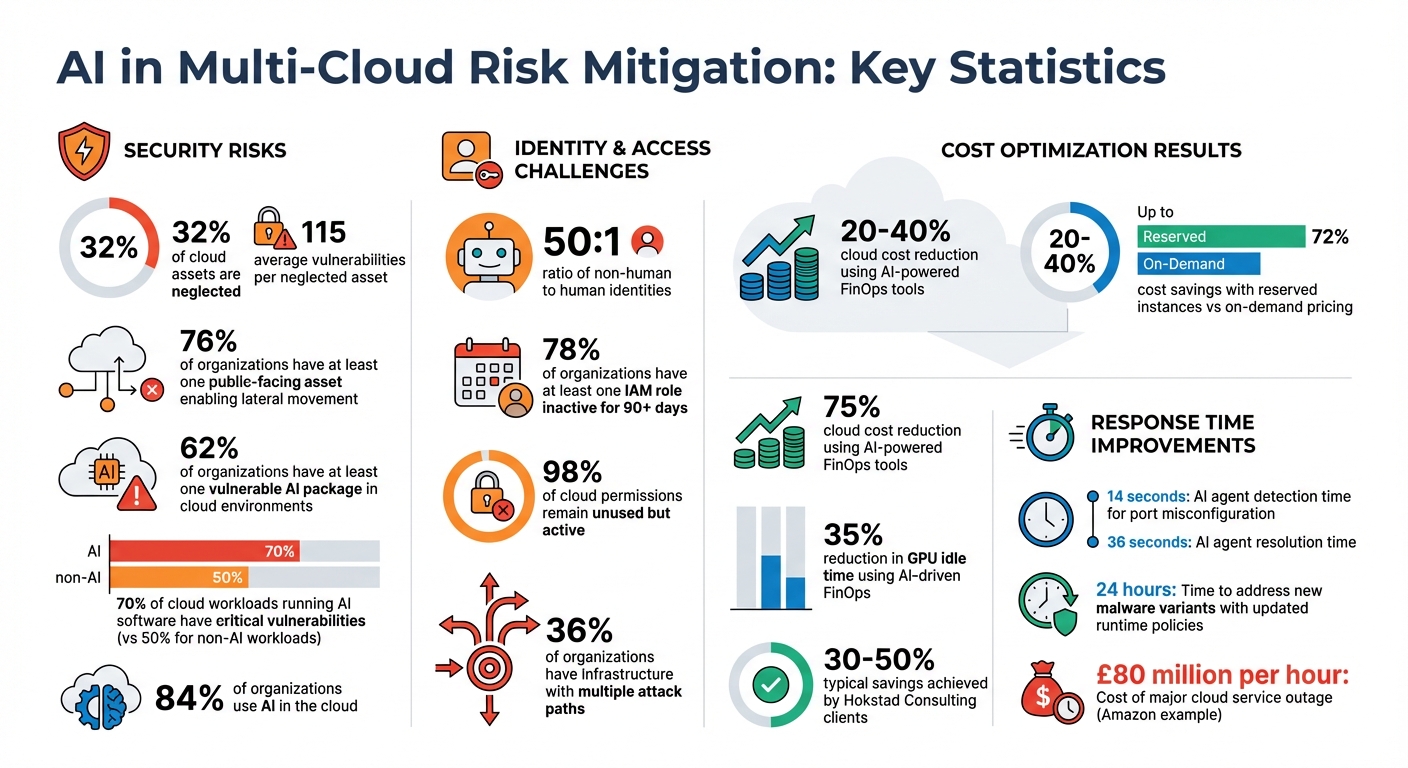 {AI-Driven Multi-Cloud Risk Mitigation: Key Statistics and Cost Savings}
:::
{AI-Driven Multi-Cloud Risk Mitigation: Key Statistics and Cost Savings}
:::
AI Data Access Governance for Multi-Cloud & AI Workloads | Walkthrough
Main Risks in Multi-Cloud Deployments
While multi-cloud strategies bring flexibility and resilience, they also come with certain risks that require careful management. This section delves into the primary challenges associated with multi-cloud deployments, ranging from security and compliance issues to operational errors and rising costs. Each of these risks demands tailored strategies to minimise their impact.
Security and Compliance Gaps
Maintaining consistent security across multiple cloud providers is no small feat. Each vendor has its own set of tools, terminologies, and security frameworks, which can lead to misconfigurations and access control issues - leaving organisations open to potential breaches [3].
Recent studies reveal some concerning trends: 32% of cloud assets are neglected, with an average of 115 vulnerabilities per asset. Moreover, 76% of organisations have at least one public-facing asset that could enable attackers to move laterally within their systems [2].
Melinda Marks, Practice Director for Cybersecurity at Enterprise Strategy Group, highlights the growing risks:
Traditional exposures, like neglected cloud assets and exposed sensitive data, continue to grow. At the same time, new challenges are emerging - from the rapid rise of non-human identities to a growing number of AI-related vulnerabilities[2].
The problem is worsened by unmonitored AI components, often referred to as Shadow AI, which introduce additional risks. A staggering 62% of organisations already have at least one vulnerable AI package in their cloud environments [2]. On top of this, evolving regulatory requirements across different regions make compliance even harder to manage [1].
Operational Complexity and Human Error
Handling multiple cloud platforms introduces operational complexity, which increases the chances of human error. Each provider has unique configurations, interfaces, and best practices, making it easy to misstep when setting up access permissions, network rules, or deploying services [1].
AI services add another layer of complexity, as their behaviour can sometimes blur the line between normal operations and actual anomalies [1]. When visibility is fragmented - due to a mix of externally managed platforms and custom-built services - unmonitored systems, including Shadow AI deployments, can go unnoticed [1].
The consequences of such errors can be severe. Misconfigurations or overly permissive accounts, when combined with existing vulnerabilities, can expose organisations to attacks like LLMjacking
or unauthorised execution of tools at the compute level [1]. Frameworks like MITRE ATLAS or OWASP AI guidelines can help standardise risk management, but implementing them requires collaboration across teams [1].
Rising Costs and Resource Wastage
Multi-cloud environments often lead to financial inefficiencies due to poor visibility and control. Training large language models or running real-time inference consumes significant compute, memory, and storage resources, and without proper monitoring, these costs can spiral out of control [5].
The complexity of managing multiple providers also results in fragmented billing across thousands of SKUs, making manual tracking a daunting task [5]. Common issues like over-provisioning, idle resources (e.g., unused GPU clusters or forgotten virtual machines), and redundant backups all contribute to wasted spending [5]. Additional expenses, such as high data egress fees and inconsistent resource allocation across regions, further inflate costs [4].
AI-driven FinOps tools are proving to be a game-changer. These tools can standardise billing data across cloud providers, automatically identify waste, and initiate corrective actions [5]. Organisations using such solutions report cloud cost reductions of 20–40% [5]. Additionally, committing to reserved instances or savings plans can cut costs by up to 72% compared to on-demand pricing, though this requires accurate forecasting of long-term workload needs [4].
AI Techniques for Risk Identification in Multi-Cloud Environments
AI plays a critical role in monitoring and analysing patterns within multi-cloud systems, helping to identify risks before they escalate. Here’s a closer look at some of the key techniques used to manage risks in these environments.
Predictive Analytics for System Outages
Predictive analytics uses historical data and traffic trends to anticipate potential system failures. In multi-cloud setups, this means integrating observability across platforms like AWS, Azure, and GCP into a single, unified dashboard [7]. By doing so, AI can spot performance bottlenecks, such as capacity issues or traffic spikes, before they cause disruptions [8].
Laurent Gil from Cast AI explains:
A multi-cloud solution is only as strong as its visibility and control mechanisms[7].
This centralised visibility allows AI to identify Goldilocks Zones
- where resources are perfectly balanced, avoiding over-provisioning or strain. When systems show signs of trouble, automated failover mechanisms can seamlessly replicate and shift workloads to healthier cloud providers, ensuring users remain unaffected by potential outages [7].
Anomaly Detection in Security and Performance Logs
AI-powered anomaly detection moves beyond static checks to continuous, real-time monitoring of behaviour. This is particularly important given that 70% of cloud workloads running AI software have critical vulnerabilities, compared to 50% of non-AI workloads [9]. AI sifts through vast amounts of security data, including cloud audit logs like AWS CloudTrail, and monitors compute-level activities in containers and virtual machines. This helps identify threats that traditional rule-based systems might miss [1].
Dan Belmonte from Sysdig highlights:
Effective AI security requires more than static posture assessments - it demands real-time awareness of how components behave at runtime[1].
This method is especially useful for detecting emerging threats, such as unauthorised access to resources. With non-human identities now outnumbering human ones by a ratio of 50 to 1 [10], anomaly detection also uncovers Shadow AI
- unregulated AI components that may introduce hidden vulnerabilities in multi-cloud environments.
Dynamic Risk Scoring Models
Dynamic risk scoring evaluates cloud assets based on exposure, permissions, and potential attack paths. Instead of treating all vulnerabilities equally, AI assigns scores that reflect an asset’s specific risk factors. For example, it considers whether an asset is public-facing, overly permissive, or part of an infrastructure with multiple attack paths - an issue affecting 36% of organisations [10].
These models also incorporate runtime behaviour and identity risks, such as unused IAM roles - 78% of organisations have at least one role inactive for over 90 days [10].
Melinda Marks from Enterprise Strategy Group notes:
The increased software development productivity that comes with using cloud services creates challenges of scale for security teams... new challenges are emerging - from the rapid rise of non-human identities to a growing number of AI-related vulnerabilities[2].
AI-Powered Strategies for Risk Mitigation
Once AI identifies risks in multi-cloud environments, the next step is to act. AI-powered strategies can automate responses, enforce policies, and optimise resources at machine speed, significantly easing the workload on security and operations teams.
Automated Compliance Monitoring
AI-driven tools continuously monitor and enforce compliance across cloud environments. This approach, often called AI Security Posture Management (AI-SPM), focuses on runtime behaviour instead of relying solely on static checks. For example, if there’s a misconfiguration or an unauthorised access attempt, AI tools can automatically apply custom controls to specific components like AWS Bedrock. This ensures best practices are maintained and global regulations, such as the EU AI Act, are met [6].
Given that 62% of organisations have at least one vulnerable AI package and 84% use AI in the cloud [10], continuous monitoring is absolutely essential. Automated compliance tools also shine a light on ungoverned AI components deployed without proper oversight. Managed rule feeds, such as Falco rules, are regularly updated by threat research teams to detect suspicious activity - whether in cloud audit logs or at the compute level in containers and virtual machines. Impressively, these tools can identify new malware variants within just 24 hours [6].
While automated compliance ensures systems remain secure and compliant, the ability to respond quickly to threats is equally important.
Real-Time Threat Response with Machine Learning
Machine learning enables organisations to react to threats in seconds rather than hours. In a 2024 study published on ArXiv, researchers tested an AI agent powered by GPT-4 on a Kubernetes-deployed microservices application. When a port misconfiguration was introduced, the AI agent detected the issue in just 14 seconds and resolved it in 36 seconds using automated shell commands [11]. This kind of speed is critical, especially when you consider that a major cloud service outage can cost companies like Amazon around £80 million per hour [11].
To achieve this level of responsiveness, Cloud Detection and Response (CDR) combines cloud-level audit logs with compute-level monitoring. This layered approach is vital because AI-driven services often exhibit unpredictable behaviour, making static assessments inadequate for spotting anomalies or breaches. Modern AIOps agents use an Observe-Thought-Action
model: they observe system states, analyse potential causes, and implement solutions autonomously or with minimal human guidance [11].
While real-time threat response safeguards system integrity, AI also plays a pivotal role in cutting costs and improving resource efficiency.
Cost and Resource Optimisation Algorithms
AI-powered cost optimisation is a game-changer for reducing cloud expenses. By deploying AI agents for FinOps, organisations can cut cloud costs by 20% to 40% [5]. For instance, a global financial institution reduced GPU idle time by approximately 35% using AI-driven FinOps agents to automate tasks like rightsizing and scheduling [5].
Karan Sachdeva from IBM notes:
Traditional FinOps was built for dashboards and decisions made by humans. Today, cloud environments generate billions of cost signals... manual optimisation quickly reaches its ceiling[5].
AI algorithms consolidate billing and usage data across multiple cloud providers, offering a unified view of costs that are often fragmented. These algorithms dynamically create and adjust portfolios of commitment plans, such as Reserved Instances and Savings Plans, to maximise savings based on real-time usage patterns. They also pinpoint underutilised resources - like overprovisioned GPUs, idle virtual machines, or unnecessary data egress costs - and trigger automated workflows to scale down or shut down these resources based on pre-set policies [5]. In containerised environments, specialised algorithms handle bin packing
and automated scaling, ensuring Kubernetes clusters are configured for peak cost efficiency [13].
Need help optimizing your cloud costs?
Get expert advice on how to reduce your cloud expenses without sacrificing performance.
How Hokstad Consulting Applies AI to Multi-Cloud Environments
Hokstad Consulting combines AI-driven automation with hands-on expertise to help organisations navigate the challenges of managing risks in multi-cloud setups. Instead of relying solely on standardised tools, they create bespoke solutions tailored to each client’s unique infrastructure - whether that’s public cloud platforms, private data centres, or hybrid models. This custom approach ensures that AI recommendations lead to actual operational improvements, aligning seamlessly with the advanced AI risk detection methods previously mentioned.
AI Agents for DevOps and Cloud Management
Hokstad Consulting utilises AI-powered systems that can detect and resolve operational issues on their own. For example, if an application crashes or a database connection fails, these intelligent agents step in to restart services and fix configurations automatically. This reduces downtime and allows teams to focus on strategic initiatives rather than firefighting.
Additionally, these AI agents enhance security by constantly monitoring for anomalies and triggering automated responses to potential threats before they escalate.
What sets Hokstad apart is how these agents are embedded directly into DevOps workflows. They integrate financial awareness into every deployment, flagging costly configurations before they go live. This proactive approach helps organisations avoid unexpected cloud bills, keeping costs under control from the outset.
Custom Solutions for Risk Mitigation
Hokstad Consulting takes a tailored approach to addressing multi-cloud vulnerabilities, offering solutions that cater to both modern and legacy systems. For businesses with older infrastructures, they deploy custom monitoring and AI analysis tools that can bridge the gap between outdated and current technologies. This ensures a unified view of operations, even in fragmented setups.
Their implementation process is methodical, starting with a full infrastructure assessment to spot inefficiencies. From there, they establish unified monitoring across environments, enable real-time performance tracking, deploy AI-based anomaly detection, and implement automated remediation. This step-by-step approach ensures that AI tools are used where they can make the biggest difference, avoiding a generic, one-size-fits-all strategy.
Proven Track Record in Cloud Cost Engineering
Hokstad Consulting is known for delivering tangible results in cloud cost reduction, often helping clients achieve savings of 30% to 50%. They operate on a No Savings, No Fee
model, meaning clients only pay when measurable savings are realised.
Their approach shifts organisations from manual monitoring to AI-driven systems that provide real-time alerts for cost spikes and security risks. Beyond cutting costs, this also reduces inefficiencies, which in turn lowers the overall risk profile. Human experts complement these AI systems, turning automated alerts into actionable strategies for long-term savings and architectural improvements. This ensures that AI-driven recommendations are not only technically sound but also practical for everyday business operations.
| Dimension | Manual Monitoring | AI-Based Monitoring (Hokstad Approach) |
|---|---|---|
| Coverage | Periodic/Quarterly; leaves gaps | Real-time; monitors all resources 24/7 |
| Labour Intensity | High; requires manual effort | Low; automates repetitive tasks |
| Audit Readiness | Fragmented documentation | Automated, standardised audit trails |
Best Practices for Implementing AI in Multi-Cloud Risk Mitigation
Start with a Complete Risk Assessment
Before introducing any AI-driven solution, it’s crucial to identify and define the assets you aim to protect. This involves gaining a clear understanding of all AI components within your infrastructure. These might include large language models, custom-built services, or externally managed platforms. Without this clarity, there’s a real chance that some components might go unmonitored and unmanaged, leaving your organisation vulnerable [1].
A thorough risk assessment should serve as the backbone of your strategy. This process involves categorising risks into key areas such as regulatory compliance, security, operational challenges, costs, data management, and AI-specific concerns like biased decision-making or flawed training data [12]. To maintain accountability, document every identified risk in a structured risk register. Include details such as a unique ID, probability score, impact analysis, and the individual responsible for managing each risk. Microsoft advises conducting these assessments during the initial governance setup and revisiting them regularly, especially after significant changes like new projects, emerging threats, audits, or incidents [12].
Once risks are clearly identified and documented, the focus should shift to selecting AI tools that can adapt to your organisation’s evolving needs.
Choose Scalable and Customisable AI Solutions
In multi-cloud environments, flexibility is key. AI solutions must not only scale with your infrastructure but also adapt to its unique requirements. One effective approach is adopting Policy as Code (PaC), which enforces consistent controls while reducing the likelihood of human error [14]. This ensures that your security measures grow alongside your organisation, rather than becoming rigid obstacles.
Tailored controls are equally important. By creating custom policies tied to specific AI components, you can address vulnerabilities unique to your environment [1]. This approach avoids the pitfalls of one-size-fits-all protections, which may leave critical gaps unaddressed.
With scalable and adaptable solutions in place, the next step is to ensure that these measures remain effective through ongoing monitoring.
Maintain Continuous Monitoring and Improvement
In the fast-changing world of multi-cloud systems, static assessments can quickly lose relevance. Continuous monitoring plays a critical role in proactively identifying zero-day vulnerabilities and advanced attacks that might bypass traditional defences [1]. Real-time threat detection and response are essential for maintaining a strong security posture.
Dan Belmonte from Sysdig emphasises,
Continuous monitoring and behavior-based detection are critical to identify when workloads deviate from expected patterns or enter undesired states[1].
To stay ahead, risks should be reviewed quarterly or biannually, depending on the pace of change [12]. Reviews should also be triggered by events such as adopting new technologies or uncovering new threats [12]. For example, security research teams now have the ability to address new malware variants within 24 hours by maintaining and updating runtime policies [1]. This highlights the tangible benefits of an ongoing monitoring strategy in keeping your defences sharp.
Conclusion: The Future of AI in Multi-Cloud Risk Management
Key Takeaways
AI is reshaping how organisations handle risks in multi-cloud setups. By offering a clear view of all deployed components, it effectively tackles the challenge of Shadow AI [1]. AI-powered behavioural threat detection now spots zero-day attacks that traditional security systems might miss. On top of that, AI-driven FinOps agents are cutting cloud costs by an impressive 20–40% through automated optimisation [5]. With 84% of organisations already using AI in the cloud [10], this technology has evolved from being a novelty to an indispensable tool. It not only identifies issues but resolves them in real time, shifting security from a reactive approach to a proactive one. However, unlocking these benefits requires thoughtful strategic planning.
The Value of Expert Guidance
Successfully implementing AI for risk management isn't without its hurdles. Organisations must navigate challenges like a staggering 50-to-1 ratio of non-human to human identities [10] and the fact that 98% of cloud permissions remain unused but active [15]. This is where expertise becomes critical. Hokstad Consulting specialises in AI strategies tailored for DevOps and cloud management, helping businesses overcome these complexities. By combining cloud cost engineering with customised automation, expert guidance transforms AI from a mere tool into a strategic advantage. This not only addresses current risks but also equips organisations to handle future challenges.
Looking Ahead
The next chapter in risk management is already taking shape. Building on integrated AI strategies, the future lies in agentic AI - systems that can observe, analyse, and act independently, all while staying within predefined policies.
Karan Sachdeva from IBM highlights:
The next phase of enterprise AI will not only be measured in model performance or compute scale - but in financial intelligence, automation and partnership-driven value creation[5].
Organisations are now consolidating their security tools into Cloud-Native Application Protection Platforms (CNAPP), which link threats across identities, workloads, and data. The response time to vulnerabilities is shrinking rapidly, with organisations needing to act within just 24 hours [1]. Those who adapt continuously and treat AI as a dynamic partner rather than a fixed solution will lead the way in managing multi-cloud complexities.
FAQs
How can AI help detect and manage Shadow AI risks in multi-cloud environments?
Shadow AI refers to the unauthorised use of AI tools, custom models, or third-party services that operate outside an organisation’s established security and governance frameworks. In multi-cloud environments, this can lead to serious issues like data leaks, non-compliant model training, and unexpected spikes in costs.
AI plays a critical role in identifying Shadow AI activities by analysing data from cloud providers. This includes monitoring API calls, access logs, and model activity to spot anything unusual. For instance, machine learning models can flag anomalies such as unknown AI models, unexpected GPU usage, or connections to unapproved endpoints. By keeping track of assets across multiple cloud platforms, AI can even detect when Shadow AI shifts between providers.
To address these risks, automated systems enforce strict policies. They can isolate unauthorised workloads, revoke access, and ensure that models adhere to approved governance standards. For organisations in the UK, Hokstad Consulting offers support in integrating these AI-driven controls into cloud strategies, helping to minimise risks and manage costs effectively in pounds sterling.
What financial advantages does AI-driven FinOps offer in multi-cloud environments?
AI-powered FinOps offers a game-changing way to trim expenses in multi-cloud environments, slashing cloud service costs by up to 30% and infrastructure expenses by as much as 50%. It brings greater clarity to costs, sharpens forecasting precision, and cuts down on manual tasks, making budgeting and financial management far more efficient.
With automated processes and real-time insights, AI streamlines financial governance, ensuring quicker and more dependable decision-making. This enables businesses to make smarter cloud investments while keeping a firm grip on spending and resource allocation.
How can AI help ensure compliance with regulations like GDPR in a multi-cloud environment?
AI has become an essential tool for ensuring compliance in multi-cloud environments. By constantly monitoring data across various cloud platforms, it can quickly detect and highlight potential GDPR violations. With real-time alerts and comprehensive reports, you’re always informed and prepared for audits.
Machine learning takes this a step further by adjusting controls to align with changing regulations. This proactive approach helps keep your multi-cloud strategy both secure and in line with compliance requirements.