
AI is transforming how organisations manage workloads across Kubernetes clusters. By using real-time data and predictive models, AI-driven schedulers optimise resource use, reduce costs by up to 50%, and improve performance for complex workloads like AI training. Unlike standard Kubernetes schedulers, which focus on resource bin-packing, AI considers factors like cloud costs, network latency, and compliance requirements.
Key takeaways:
- Efficiency Gains: AI improves CPU utilisation by 35–47% and memory by 28–39%.
- Cost Savings: Reduces cloud expenses significantly, especially in multi-cloud setups.
- AI Workload Support: Handles GPU-heavy jobs, gang scheduling, and data locality challenges.
- UK-Specific Needs: Ensures compliance with data residency laws and manages costs in GBP.
AI scheduling uses tools like Open Cluster Management and Volcano Global to enable smarter workload placement. While it adds complexity, the benefits far outweigh the challenges, especially for organisations managing hybrid or multi-cloud environments. Start small by testing AI schedulers on non-critical workloads and gradually expand to production use.
::: @figure 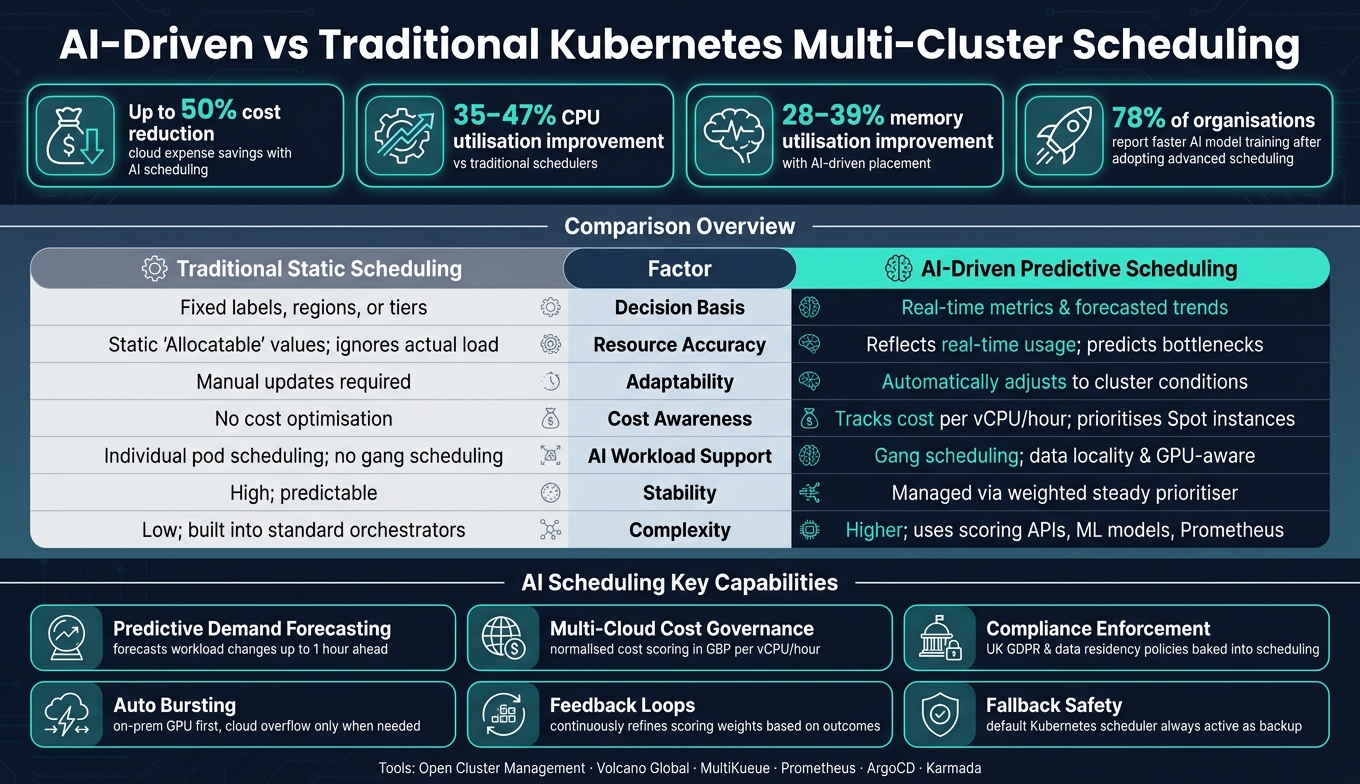 {AI vs Traditional Kubernetes Scheduling: Key Differences & Benefits}
:::
{AI vs Traditional Kubernetes Scheduling: Key Differences & Benefits}
:::
Foundations of Multi-Cluster Scheduling
Multi-Cluster Architectures and Components
Most multi-cluster setups operate on a hub-and-spoke model. Here, a central hub
cluster takes on the role of the control plane. This hub is responsible for scheduling logic, maintaining a global inventory of all connected clusters, and making placement decisions. The managed
or worker
clusters, on the other hand, focus solely on executing the workloads assigned to them [1].
Multi-cluster federation allows you to manage these clusters as a single logical entity while maintaining the isolation benefits of separate clusters.- Kubernetes Visual Handbook [7]
Modern multi-cluster designs separate the scheduling policy (defined through the Placement API) from the actual decision-making (handled by PlacementDecision). This separation allows orchestration tools to implement decisions without being tied to the scheduling logic [8][9].
Networking across clusters is handled by tools like Cilium ClusterMesh and Submariner. These solutions enable flat, encrypted pod-to-pod communication across cluster boundaries. Additionally, the Multi-Cluster Services (MCS) API standardises service discovery, streamlining global traffic routing without requiring custom configurations [7].
It’s worth noting that Kubernetes clusters using etcd face performance degradation when scaling beyond 10,000 nodes [7].
How Conventional Scheduling Works
While multi-cluster architectures enable unified management, conventional scheduling remains the foundation for pod placement. Kubernetes’ standard scheduling process uses constructs like labels, node affinity, taints, and tolerations to align workloads with suitable nodes or clusters. At the multi-cluster level, frameworks such as Open Cluster Management (OCM) extend this approach with a three-step process: filtering clusters based on specific criteria, scoring them using prioritisers like Balance or Steady, and finally selecting the best candidates [8].
The core logic behind this scheduling is bin-packing, which aims to fit requested CPU and memory resources into available capacity as efficiently as possible. While effective for simpler workloads, this method has its limitations.
The default Kubernetes scheduler focuses on packing resources efficiently. It does not optimise for cost.- Naeem ul Haq [4]
Metrics like AllocatableCPU
and AllocatableMemory
reflect configured capacity but don’t account for actual resource usage. This can create a false sense of stability, as a cluster might appear healthy to the scheduler while its real capacity diminishes. Scaling this system across hundreds of clusters makes manual adjustments to labels and placement scores unmanageable [1].
These shortcomings become even more apparent when dealing with AI workloads, which demand a more tailored approach to scheduling.
Scheduling Demands of AI Workloads
AI workloads push the boundaries of conventional scheduling, challenging nearly every assumption it relies on. These workloads differ structurally and require a fundamentally different approach.
| Scheduling Factor | Traditional Workloads | AI Workloads |
|---|---|---|
| Primary resource | General-purpose CPU/RAM | GPUs, TPUs, FPGAs |
| Placement logic | Resource bin-packing | Data locality and cost-awareness |
| Scheduling unit | Individual pods | Gangs of distributed nodes |
| Network sensitivity | Low to moderate | High-bandwidth, topology-sensitive |
| Cost risk | Minimal egress exposure | Spot interruption and cross-zone egress fees |
One of the biggest challenges is gang scheduling. Distributed AI training jobs require all compute nodes to start simultaneously. If even one node is unavailable, the entire job stalls. Conventional Kubernetes schedulers, which handle pods individually, lack the coordination required for this simultaneous allocation [11].
Another major hurdle is data gravity. AI models rely on enormous datasets for training, and placing a job in a different availability zone from its data store can lead to substantial cross-zone egress fees. These costs can quickly spiral out of control, catching organisations off guard [4]. Unfortunately, conventional schedulers lack mechanisms to address such complexities, leaving a gap that demands more sophisticated solutions.
Using AI to Improve Multi-Cluster Scheduling
AI Methods for Scheduling Decisions
AI takes scheduling to the next level by focusing on predicting future resource needs instead of simply analysing the current state. Instead of working with static data like available CPU or memory, AI models forecast demand trends over specific timeframes. For example, they might predict workload changes over the next hour (or 3,600 seconds) to proactively address potential bottlenecks [1].
Deciding where to deploy workloads is just as important as deciding what to deploy.- Jian Qiu, Red Hat [1]
One practical approach to this is dynamic scoring. Tools like Open Cluster Management (OCM) use a Dynamic Scoring Framework (DSF), which connects monitoring data (often from Prometheus) to the Placement API. By employing custom scoring APIs, machine learning models - like linear regression - can rank clusters based on expected cost or performance rather than relying on static labels [1]. These scores are normalised within a range of −100 to 100, ensuring compatibility with placement engines, and include a ValidUntil timestamp to discard outdated data if updates fail [15][16].
AI-powered schedulers also integrate with cloud provider APIs, enabling real-time inventory monitoring. This allows for automatic bursting: using on-premises GPU resources first and only turning to cloud resources when absolutely necessary [14]. Additionally, feedback loops help refine decisions over time by monitoring outcomes and adjusting scoring weights accordingly.
AI Scheduling in Practice
Two tools demonstrate how these concepts work in real-world environments:
MultiKueue: Part of Google Kueue, this feature manages job dispatching across a manager cluster and multiple worker clusters, even when Kubernetes versions differ [13]. MultiKueue has been optimised for high-scale environments, handling up to 10,000 jobs per minute. Its controller manager settings support a client connection QPS of 1,500 and burst limits of 3,000, ensuring stability during heavy AI/ML workloads [13].
Volcano Global: An extension of the open-source Volcano scheduler, this tool adapts to multi-cluster scenarios. It introduces cross-cluster queue priority and multi-tenant fair scheduling tailored for AI tasks [12]. It also supports gang scheduling, ensuring that distributed training jobs only begin when all required nodes are available, addressing the
all-or-nothing
constraint.
In the large model era, the winning strategy isn't just about how much compute you have - it's about how intelligently you use it.- Alibaba Cloud [14]
Benefits and Trade-Offs of AI Scheduling
AI scheduling offers a number of advantages but also brings added complexity. Here's a comparison of traditional static scheduling and AI-driven predictive scheduling:
| Feature | Static Policy Scheduling | AI-Driven Predictive Scheduling |
|---|---|---|
| Decision basis | Fixed labels, regions, or tiers [1] | Real-time metrics and forecasted trends [1] |
| Resource accuracy | Uses static Allocatablevalues; ignores actual load [15] |
Reflects real-time usage and predicts bottlenecks [1] |
| Adaptability | Manual updates required for changes [1] | Automatically adjusts to cluster conditions [14] |
| Stability | High; decisions are predictable | Variable; requires weighting to avoid flapping[8] |
| Complexity | Low; built into standard orchestrators | Higher; involves scoring APIs, monitoring stacks, and ML models [1] |
One challenge with dynamic scoring is its sensitivity, which can lead to frequent workload migrations due to small resource fluctuations. A practical solution is to blend dynamic metric prioritisation with a steady component. For instance, assigning a weight of 3 to the steady prioritiser alongside the resource-aware scorer can ensure that migrations only occur when resource changes are significant [8].
The payoff is clear: 78% of organisations have reported faster AI model training times after adopting advanced scheduling strategies [6]. This highlights the potential of AI to transform multi-cluster scheduling into a more efficient and responsive process.
Open Cluster Management: Scheduling AI Workload Among Multiple Clusters | Project Lightning Talk
Building an AI-Powered Multi-Cluster Scheduling Architecture
This section dives into the layered architecture that powers AI-driven scheduling, breaking down the components that make these advancements possible.
Core Components of the Architecture
An AI-powered scheduling system isn’t just a single tool - it’s a stack of interconnected components, each with a specific role. At the top is the hub cluster, which acts as the central management layer. Tools like Azure Kubernetes Fleet Manager or Open Cluster Management often serve this purpose, hosting global scheduling logic and enforcing policies across all connected clusters [1][5]. Below this, managed cluster agents - such as the DynamicScoringAgent - operate within individual clusters. These agents gather metrics and send normalised scores back to the hub [1].
These agents tie into the telemetry pipeline, where Prometheus collects real-time data from each cluster. AI models then process this data to rank placement options. The placement engine takes these rankings and works with a workload orchestrator - tools like ArgoCD or Karmada - to deploy the job [12][1]. To avoid delays or rate limits when accessing cloud APIs, it’s better to use an intermediate exporter to feed pricing data into Prometheus [4].
You cannot scale efficiently when placement decisions lack awareness of pricing and volatility. This requires a cost-informed scheduling architecture.- Naeem ul Haq, EdTech Platform Lead [4]
For organisations in the UK managing clusters across multiple regions, it’s critical to configure the hub cluster with data residency in mind. This ensures that sensitive workloads aren’t unintentionally routed outside approved boundaries.
Data Inputs for AI Schedulers
The effectiveness of AI-driven scheduling hinges entirely on the quality of data provided to the AI models. These inputs generally fall into three categories:
- Resource metrics: Real-time information on CPU, memory, and GPU availability.
- Performance metrics: Indicators such as network latency between clusters or model loading times.
- Governance metadata: Labels for clusters, compliance boundaries, and resource quotas [5][2][1].
Cost data plays a particularly important role. By tracking normalised costs per vCPU/hour in GBP - instead of assuming all nodes are equal - the scheduler can prioritise Spot instances or select cheaper regions when appropriate [4]. To ensure fair comparisons across diverse cluster profiles, raw metrics should be mapped to a standardised scoring range (−100 to 100) [10]. Additionally, including a validUntil field on every score ensures the scheduler avoids acting on outdated data if an agent fails to update [10].
Translating Business Goals into Scheduling Policies
Once the data pipeline is established, the next step is to align scheduling policies with business goals. These goals - whether they focus on cost-efficiency, low latency, or high availability - need to be translated into measurable scoring weights.
For example, a cost-focused policy treats cost-per-vCPU/hour as a strict engineering constraint, similar to CPU or memory limits [4]. A latency-focused policy uses Data Gravity scores to prioritise workloads in clusters closest to their data sources, reducing cross-zone egress fees - a key consideration given the pricing structure of UK cloud providers [4]. For reliability, burst scheduling can be configured to ensure local clusters handle the baseline load, with overflow directed to remote clusters only when absolutely necessary [3].
When rolling out new AI-driven policies, it’s wise to start by applying them to non-critical workloads. This approach allows organisations to validate model decisions while minimising risk [4].
Governance, Risk, and Operational Readiness
Reliability and Failure Handling
When it comes to operational continuity, managing scheduling risks is just as important as building a reliable architecture. A scheduler that fails quietly can be far more damaging than one that fails loudly. To mitigate this, it's crucial to always keep the default Kubernetes scheduler active as a fallback. If the AI-driven scheduler experiences delays or outages, the default scheduler ensures that critical pods are still placed without disruption [4].
Always keep the default scheduler active as a fallback mechanism for critical system pods.- Naeem ul Haq, EdTech Platform Lead [4]
Two particular scheduling behaviours need careful management. The first is thrashing, where workloads are moved between clusters too frequently, wasting resources and causing instability. Setting a minimum runtime for transient workloads can address this issue by temporarily treating these workloads as non-preemptible [17]. The second is the need for gang scheduling, which ensures that distributed training jobs are completed as a whole, rather than being left partially executed [17][11].
For teams managing large-scale clusters, advanced schedulers can simulate potential consolidation scenarios in memory before any changes are applied. Preemption is only executed if the simulation confirms that all workloads can be rescheduled successfully, which helps to avoid cascading failures [17].
Cost Governance and Compliance
AI-driven scheduling provides a chance to enforce financial discipline by treating cost constraints as non-negotiable engineering limits. For organisations in the UK, data residency requirements are a legal necessity. Workloads governed by UK GDPR or specific industry regulations must remain within approved cluster boundaries. These boundaries should be encoded directly into scheduling policies. To minimise risk, start by testing non-critical workloads using the schedulerName field to validate compliance [4].
However, technical measures alone are not enough. Teams must also develop the right skills to make the most of AI-driven scheduling.
Preparing Your Organisation for AI-Driven Scheduling
Transitioning to AI-driven scheduling requires more than just technical upgrades - organisational readiness is key. Teams accustomed to traditional, hand-coded heuristics (often referred to as Software 1.0) need to adapt to working with learned models and neural networks [19]. This shift demands deliberate investments in new skills and workflows.
The gap between cluster complexity and scheduler intelligence is widening. Every month, we add more services, more teams, more constraints. The heuristics don't scale.- Pradeep Singh, Software Engineer [19]
Hardware expertise is also becoming increasingly important. Managing AI workloads across clusters involves more than just standard CPU and memory tuning - it requires a deep understanding of GPUs, TPUs, and dynamic resource allocation [18][11]. Organisations that view this as purely an infrastructure challenge, without addressing the skills and cultural changes needed, are likely to face difficulties in adoption.
For teams seeking structured guidance during this transition, Hokstad Consulting offers support in AI strategy and DevOps transformation. Their focus on cloud cost engineering aligns closely with the need to integrate cost governance into scheduling policies for production environments.
Conclusion: Putting AI to Work in Multi-Cluster Scheduling
AI-powered multi-cluster scheduling is no longer just a concept - it’s a practical tool that UK engineering teams can use right now to cut cloud costs, boost reliability, and adapt quickly to shifting demands. Many organisations report up to a 30% drop in infrastructure expenses, with even greater savings when AI scheduling is paired with strategies like architectural optimisation and smart use of spot instances.
For UK businesses, staying compliant with regulations is critical. AI schedulers can predict demand surges and scale capacity in advance, helping to minimise latency and errors. For organisations governed by frameworks like FCA regulations, UK GDPR, or NHS data standards, AI scheduling can automatically enforce compliance policies. This trifecta of cost efficiency, performance improvement, and regulatory assurance makes AI scheduling a powerful asset in today’s dynamic, multi-cluster setups.
To make the most of these advantages, adopting AI scheduling requires a measured, step-by-step approach. Start by assessing your current costs and performance. Identify workloads suitable for an AI-assisted pilot and initially run the scheduler in a recommendation mode before enabling full automation. Introduce safeguards to maintain control. Each phase of this process is low-risk, reversible, and provides clear metrics to track progress. This gradual method ensures both compliance and performance gains.
Hokstad Consulting supports UK organisations by evaluating Kubernetes environments, designing architectures ready for AI integration, and aligning scheduling policies with business objectives and data residency needs. For teams without extensive machine learning expertise, they offer services to develop and implement AI-driven schedulers, while also equipping internal teams with the skills to manage these solutions long-term.
The divide between the capabilities of traditional schedulers and the demands of modern multi-cluster environments continues to grow. AI scheduling bridges this gap. Organisations that adopt it thoughtfully, with well-defined policies and measurable targets, will be in a stronger position to control costs, meet service-level objectives, and adapt to future regulatory or market shifts with confidence.
FAQs
When is AI scheduling worth it in multi-cluster Kubernetes?
AI scheduling shines in multi-cluster Kubernetes environments, where the challenges of handling complex workloads, managing costs, and optimising resources surpass the capabilities of traditional approaches. Its strength lies in accurately predicting resource requirements, keeping costs under control, and adapting to fluctuating demands.
This approach proves particularly useful for dynamic workloads. By minimising the need for manual adjustments, it helps avoid both over-provisioning and under-provisioning. The result? Greater efficiency and noticeable cost savings, especially in intricate multi-cluster or multi-cloud configurations.
How do AI schedulers stop workload thrashing between clusters?
AI schedulers help avoid workload thrashing by employing dynamic placement strategies that adapt to real-time cluster conditions, resource availability, and workload priorities. By leveraging predictive analytics and real-time metrics, they ensure resources are distributed efficiently. Workloads are assigned to clusters that have the capacity and appropriate hardware, minimising unnecessary reassignments, contention, or job restarts. This approach keeps multi-cluster environments stable and efficient through smarter, data-driven decisions.
What data do I need for cost- and compliance-aware scheduling in the UK?
For businesses in the UK focused on cost-efficient and compliant scheduling, it's crucial to gather data on real-time and historical resource usage, cloud pricing across providers, and regulatory requirements such as GDPR and data residency rules. Adhering to strict security protocols is essential - not just to maintain compliance, but also to optimise costs effectively.