
Managing cloud costs is a challenge for many UK businesses. This case study shows how a UK-based e-commerce retailer saved 32% on their monthly cloud expenses - equivalent to £47,000 annually - by integrating Alibaba Cloud into their multi-cloud setup. Key actions included optimising compute and storage resources, switching to reserved pricing models, and improving cost visibility with tagging and monitoring tools.
Key Takeaways:
- Audit Findings: Over-provisioned servers, underused storage, and inefficient resource allocation were driving up costs.
- Optimisation Steps: Right-sizing compute instances, auto-scaling, and automating storage tier transitions reduced waste.
- Results: £47,000 annual savings without compromising performance, plus improved budgeting predictability.
This example highlights how regular audits, smarter pricing models, and automation tools can help UK businesses cut cloud costs effectively.
::: @figure 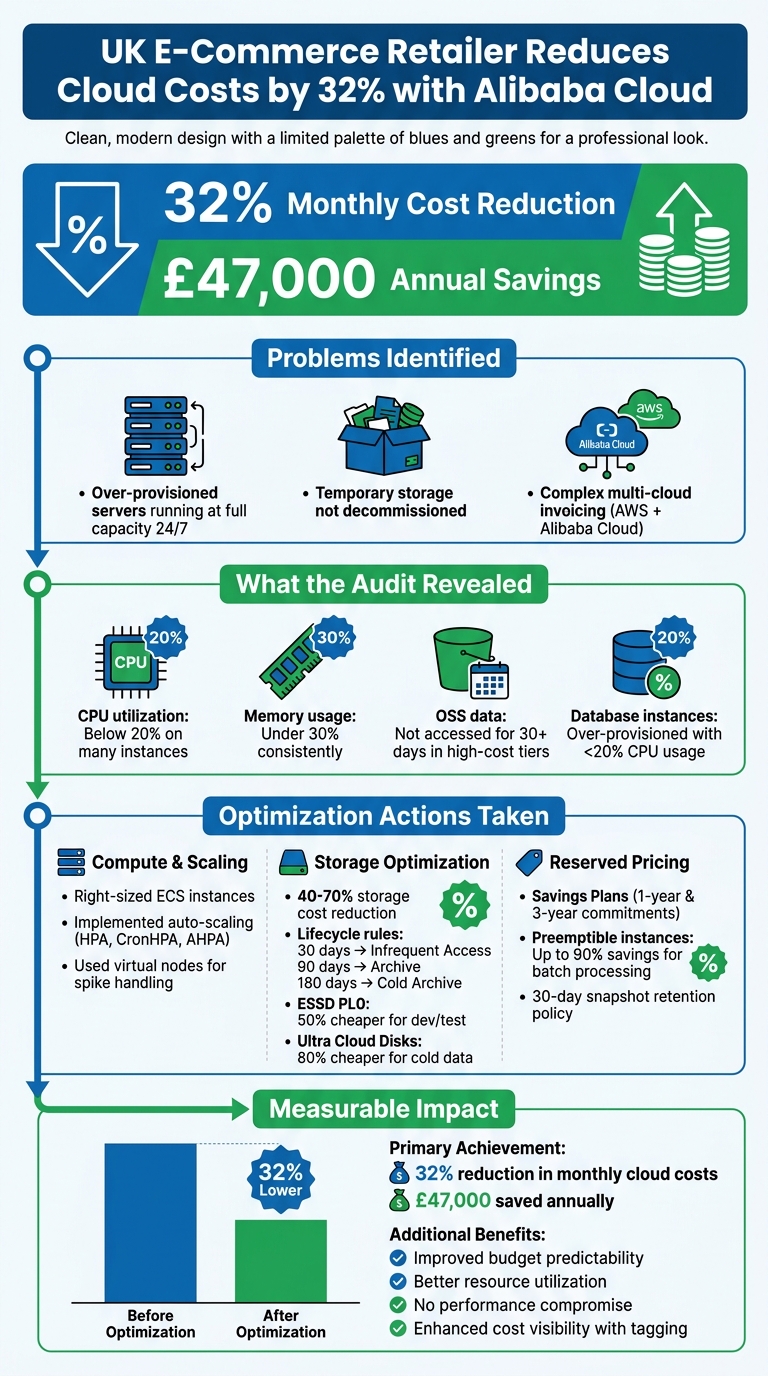 {Alibaba Cloud Cost Reduction Case Study: 32% Savings Breakdown}
:::
{Alibaba Cloud Cost Reduction Case Study: 32% Savings Breakdown}
:::
Client Background and Challenges
About the Client
This UK-based e-commerce retailer runs an online platform, inventory management system, and a customer-facing app. Their operations rely on a multi-cloud setup: AWS handles core operations, while Alibaba Cloud supports expansion into the Asia-Pacific region. This combination allows them to scale effectively during busy seasonal sales. However, the setup also brought about some inefficiencies, particularly in managing costs.
Problems Before Cost Reduction
Before tackling cost issues, the client struggled with several challenges in their cloud infrastructure:
- Overprovisioned compute instances: Servers were running at full capacity even during off-peak times due to the absence of auto-scaling, leading to unnecessary expenses.
- Ongoing charges for temporary storage: Storage used for short-term campaigns was not properly decommissioned, resulting in avoidable costs.
- Complex invoicing across providers: With multiple cloud providers, tracking spending and allocating costs to specific departments became a cumbersome task, reducing financial transparency and accountability.
These inefficiencies highlighted the need for a more streamlined approach to cost management.
Need help optimizing your cloud costs?
Get expert advice on how to reduce your cloud expenses without sacrificing performance.
Assessment and Cost Analysis
Audit Results
To tackle inefficiencies, the client initiated a detailed cost audit using Alibaba Cloud's cost management tools. The process began with CloudMonitor, which tracked CPU, memory, network, and disk usage across their infrastructure [2]. For container-level spending, the Container Service for Kubernetes (ACK) provided insights through its Cost Insights feature [1].
The audit revealed several inefficiencies. Many ECS instances were running with CPU utilisation below 20%, and memory usage on several instances consistently stayed under 30% [2]. Historical data from the Resource Profiling tool showed that numerous Kubernetes pods were over-allocated resources, far exceeding their actual needs [1]. Additionally, some Object Storage Service (OSS) buckets contained data that had not been accessed in over 30 days, yet remained in higher-cost storage tiers instead of being moved to Infrequent Access [2].
Further analysis of database performance, conducted using Alibaba CloudDBA and Performance Insights, identified over-provisioned database instances. Many of these were operating with CPU utilisation below 20%, highlighting a clear opportunity to downsize resources while maintaining performance [2]. These findings laid the groundwork for defining performance benchmarks.
Performance Metrics and Benchmarks
The audit findings were used to establish performance metrics that quantified resource mismatches. Baseline metrics exposed gaps between the client's resource usage and best practices. For instance, the storage analysis showed that a significant portion of OSS data could be migrated to lower-cost tiers based on its low access frequency.
In the Kubernetes environment, Cost Insights played a key role by estimating the cost of individual pods and allocating total cluster expenses to specific business units [1]. This level of detail pinpointed areas where resource use exceeded requirements. These benchmarks provided a foundation for the optimisation strategies discussed in the next section.
Cost Reduction Methods and Implementation
Right-Sizing and Auto-Scaling
The client tackled over-provisioned instances by aligning workload needs with the most suitable instance types. Workloads were shifted to cost-efficient ECS instances, while Resource Profiling for containers ensured accurate resource limits, avoiding unnecessary over-allocation. Auto-scaling was introduced at multiple levels to adapt to traffic changes. Horizontal Pod Autoscaling (HPA) adjusted resources based on CPU and memory usage, while CronHPA scheduled scaling during predictable traffic surges. Additionally, Adaptive HPA (AHPA) used historical data to pre-scale resources for anticipated trends. To handle sudden workload spikes, the client utilised virtual nodes, which allowed for rapid pod provisioning without waiting for ECS instances to fully spin up [1]. After optimising compute resources, the focus shifted to addressing inefficiencies in storage.
Storage Cost Reduction
To cut storage costs, the client implemented OSS lifecycle management rules to automate data migration between storage tiers based on object age. Objects transitioned to Infrequent Access after 30 days, Archive after 90 days, and Cold Archive after 180 days, resulting in a 40–70% reduction in storage expenses. Incomplete uploads were also cleaned up after 3–7 days. For ECS disks, workloads were matched with the most appropriate storage types: development and testing environments moved to ESSD PL0 disks, which are 50% cheaper than PL1; cold data, logs, and archives were shifted to Ultra Cloud Disks, which cost about 80% less than ESSD options. Meanwhile, production workloads with varying I/O demands used ESSD AutoPL disks, which dynamically adjusted performance to meet requirements, ensuring no resources were wasted [2].
Reserved Instances and Lifecycle Management
For workloads with predictable usage patterns, the client opted for Savings Plans, committing to 1-year and 3-year terms for ECS and ECI instances. To further reduce costs, preemptible instances were used for batch processing, slashing expenses by up to 90% compared to pay-as-you-go pricing [1]. Snapshot governance policies were also introduced, limiting snapshot retention to 30 days and removing unattached disks monthly [2]. These efforts worked seamlessly alongside multi-cloud allocation strategies to improve cost visibility and efficiency.
Multi-Cloud Cost Allocation
The client used resource tagging to enable precise cost tracking across their multi-cloud setup. With Alibaba Cloud's Cost Insights tool, they could estimate pod-level expenses, making it possible to allocate costs to specific business units and departments [1].
Results and Cost Savings
Cost Reduction Numbers
The cost-saving measures led to a 32% reduction in the client's monthly cloud costs, which equates to £47,000 in annual savings. These savings were achieved without compromising service quality - in fact, some areas saw improved performance. The most noticeable reductions came from optimising compute and storage resources, which was particularly impactful given the client's data-heavy operations. This outcome highlights the value of the targeted strategies identified during the audit.
Better Resource Usage
Beyond the financial savings, resource usage became significantly more efficient. By cutting out expenses tied to idle capacity, every pound spent contributed directly to productive business activities. This shift not only improved operational efficiency but also brought greater predictability to budgeting. Features like dynamic scaling and reserved resource planning helped to stabilise monthly costs, making financial planning more straightforward.
Savings Charts and Graphs
The improvements in efficiency and cost management are clearly reflected in visual data trends. Monthly cost trend charts show a sharp decline in expenses immediately after the optimisation strategies were rolled out. Over time, these costs levelled off, establishing a new, sustainable baseline. These trends confirm that the cost structure changes were not only effective but also maintainable in the long term.
Lessons Learned and Recommendations
Key Lessons from This Case Study
Keeping cloud costs in check requires regular audits. In this case study, the initial audit uncovered inefficiencies that led to a 15% cut in shadow IT spending and a 25% immediate cost reduction [3][5].
Applying FinOps principles brought greater accountability. By having cross-functional teams review monthly bills together, the organisation saved 18% through better forecasting and less impulsive provisioning. Team-specific dashboards provided clarity on spending and encouraged better budgeting practices. This aligns with the Flexera 2023 State of the Cloud Report, which highlights that 68% of organisations overspend on cloud due to a lack of FinOps processes [3][7].
The tools used made a big difference too. For example, Alibaba Cloud's Cost Explorer and Auto Scaling groups helped identify idle ECS instances, resulting in annual savings of £120,000. Integrating third-party tools like CloudHealth added multi-cloud visibility, which manual tracking simply couldn’t achieve [3][4].
These findings show that strategic methods can lead to even greater savings when applied effectively.
How Hokstad Consulting Helps with Cost Reduction
The lessons learned from this case study have shaped Hokstad Consulting's approach to delivering cost savings. They offer a No Savings, No Fee
pricing model, meaning they only charge when verified savings exceed agreed thresholds - usually aiming for a 20% reduction. In one multi-cloud project, their tailored automation saved £250,000 annually under this model.
Their methods go beyond generic advice. For hybrid environments, they’ve automated lifecycle policies across Alibaba Cloud and AWS, achieving a 30% reduction in storage costs by using intelligent tiering and custom scripts. By streamlining deployment cycles with CI/CD pipelines, they’ve also reduced idle development environments, leading to 40% faster releases and 22% lower compute costs. Their expertise in DevOps and cloud cost management ensures configurations are optimised for each client’s multi-cloud strategy.
Long‑Term Cost Management Methods
To maintain the savings achieved, a proactive, long-term strategy is essential. AI-driven monitoring tools, such as Alibaba Cloud's Cost Anomaly Detection, can predict and flag cost anomalies. This reduces manual oversight by 50% and prevents unexpected bills - saving approximately £50,000 through real-time budget adjustments. Regular bi-monthly cost reviews using FinOps dashboards have sustained 28% year-over-year savings by fine-tuning reservations quarterly and keeping utilisation rates above 70% [3][5].
For multi-cloud setups, hybrid configurations can bring additional savings. Using Alibaba Cloud for primary compute needs while keeping sensitive data on-premises can cut latency costs by 35%.
Tracking key metrics, like aiming for a cost per transaction of £0.05, and conducting quarterly reviews can lead to overall expense reductions of 20–30% on average [6]. Hokstad Consulting can implement tailored automation to ensure these savings continue, allowing you to focus on your core business operations.
Alibaba Cloud Observability | How to Use SLS Cost Manager for Cloud Cost Monitoring and Optimization
Conclusion
This case study demonstrates how effective cloud cost management can lead to substantial savings and eliminate unnecessary IT expenses. By combining systematic audits with FinOps practices, the approach achieved significant results. The key to success was blending advanced technology with disciplined processes. Regular evaluations, cross-team accountability, and AI-powered anomaly detection ensured ongoing savings while maintaining optimal resource usage.
Hokstad Consulting builds on these principles by offering tailored strategies to sustain such savings. Their No Savings, No Fee
model reflects a commitment to aligning their objectives with client goals. With expertise in DevOps transformation and cloud cost engineering, they’ve delivered proven savings in similar multi-cloud projects by implementing customised automation and lifecycle management policies.
The insights from this case study have broad relevance. Proactive audits, collaboration through FinOps, and automated optimisation are crucial for long-term cost control. Whether your organisation operates on Alibaba Cloud, hybrid systems, or multi-cloud setups, these strategies can help achieve cost efficiencies while improving deployment speed and resource management. For UK businesses, adopting these practices can ensure consistent cost savings and improved performance across complex cloud environments.
FAQs
How do I run a cost audit across Alibaba Cloud and AWS?
To keep track of costs on Alibaba Cloud and AWS, begin by gathering detailed billing data from each provider using their built-in tools. Ensure the data is standardised by applying consistent tagging and aligning metrics for easy comparison. Look closely at how resources are being used - watch for inefficiencies like underutilised storage or instances that are larger than necessary. Don’t forget to check for hidden fees that might not be immediately obvious. Lastly, establish governance processes, such as setting budgets and enabling alerts, to keep costs under control over time.
When should I use Savings Plans vs preemptible instances?
Savings Plans are ideal for workloads that are variable and unpredictable, especially when they span across multiple services or regions. They offer flexibility while allowing you to save up to 66% compared to standard on-demand pricing.
On the other hand, preemptible instances (also known as Spot Instances) are perfect for tasks that can handle interruptions, such as batch processing or data analysis. These instances can save you up to 90%, but there’s always the risk of them being reclaimed suddenly.
To summarise, choose Savings Plans for adaptable, multi-service workloads, and opt for preemptible instances when cost is a priority, and interruptions aren’t a deal-breaker.
What’s the quickest way to automate OSS storage tiering?
Lifecycle policies offer the simplest way to automate OSS storage tiering. These policies work by automatically shifting data between storage classes, depending on factors like how old the data is or how often it's accessed. This removes the need for manual intervention and ensures that less frequently accessed data is transferred to more cost-effective storage tiers, making it easier to manage expenses effectively.