
Cloud spending is rising, and UK organisations need ways to allocate these costs fairly across teams. Chargeback models solve this by assigning cloud expenses directly to the teams consuming resources, promoting accountability and cost management. This article covers:
- What is chargeback? It moves cloud costs from a central IT budget to individual teams' budgets.
- Why it matters: Teams become accountable for their spending, leading to smarter resource use.
- Challenges: Issues like inaccurate tagging and distributing shared costs fairly (e.g., Kubernetes clusters, Reserved Instances).
- Solutions: Start with showback (informational reporting) before implementing chargeback for financial accountability.
Key Takeaways:
- Define cost objects and pools: Identify who pays (teams, products) and group shared expenses (e.g., networking, security tools).
- Choose allocation drivers: Use metrics like GB transferred or query counts to split costs.
- Select a model: Options include usage-based, fixed allocation, or hybrid models.
- Implementation steps: Build a service catalogue, integrate with finance systems, and ensure strong governance.
Start with showback if tagging accuracy is below 90% and gradually progress to chargeback. This approach reduces cloud waste (up to 20%) and ensures fair cost distribution for shared services.
Strategies for Cloud Cost Allocation and Chargeback
Core Components of a Chargeback Framework
A solid chargeback model starts with establishing a strong foundation. Before diving into cloud spend allocation, you need to define two key elements: cost objects and cost pools.
Defining Cost Objects and Cost Pools
A cost object refers to the entity receiving the bill. This could be a business unit, a team, a product, or even an environment like production or staging [3][5]. On the other hand, a cost pool is a collection of shared expenses that can’t easily be assigned to a single owner. Examples include centralised networking, shared Kubernetes clusters, or security tools. These shared costs are grouped together and then distributed to the relevant cost objects [5][6].
Together, cost objects and cost pools create an allocation taxonomy, which ensures every pound of cloud spending is categorised in a way that aligns with business priorities. A helpful rule of thumb is to limit the organisational hierarchy to no more than three levels (e.g. Business Unit → Team → Project) to avoid compliance issues with tagging [5]. This structure is particularly important since shared services often make up 15–25% of an enterprise’s cloud budget [4].
Once these elements are in place, the next step is to determine the right metrics to fairly allocate shared costs.
Choosing the Right Allocation Drivers
After defining cost pools, the focus shifts to allocating them fairly. Allocation drivers are metrics used to calculate each team's share of shared costs. Depending on the service type, appropriate drivers might include:
| Shared Cost Category | Allocation Metric |
|---|---|
| Shared databases | Query count or storage volume [6] |
| Networking / data transfer | GB transferred or data egress [7] |
| Kubernetes control plane | Proportional split based on namespace usage [7] |
| Enterprise support contracts | Percentage of total direct spend [7] |
| Security / monitoring tools | Even split or headcount-based [6] |
Simple models that teams trust are often more effective than overly detailed ones. As Finout explains [7]:
Overly precise allocation models that nobody trusts are worse than simple ones that everyone accepts.
For resources that can’t be tagged directly - like Kubernetes namespaces or shared managed service fees - virtual tags can be used at the FinOps platform level. This approach avoids making changes to production infrastructure [5][7]. Additionally, using amortised costs instead of unblended costs ensures teams benefit proportionally from centrally purchased Reserved Instances or Savings Plans [2][3].
These allocation drivers form the basis for comparing detailed cost assignment with broader reporting methods.
Showback vs Chargeback: Which Approach Fits?
Clear cost allocation also requires understanding the difference between showback and chargeback, two methods of enforcing accountability.
- Showback: This method reports cloud usage back to teams without transferring any budget. It’s purely informational.
- Chargeback: Here, costs are assigned directly to each team’s budget, making them financially responsible [3].
| Dimension | Showback | Chargeback |
|---|---|---|
| Money movement | None; informational only [2] | Costs move to team budget or P&L [2] |
| Tagging requirement | 60–80% coverage is often sufficient [2] | Requires 90%+ accuracy [2] |
| ERP integration | Not required | Required for internal billing [3] |
| Behavioural impact | Encourages awareness | Drives active optimisation [2] |
For many UK organisations, showback is a better starting point. It’s particularly useful when tagging accuracy is still improving or when teams are new to cloud cost data. Running showback for at least one quarter can help identify gaps and build familiarity with cost allocation before transitioning to chargeback [2][7].
The FinOps Foundation captures this well:
Neither way \[showback or chargeback\] should be considered more mature than the other, as which method used is entirely dependent on organisational accounting policy and preference.[3]
Common Chargeback Models for Shared Cloud Services
::: @figure 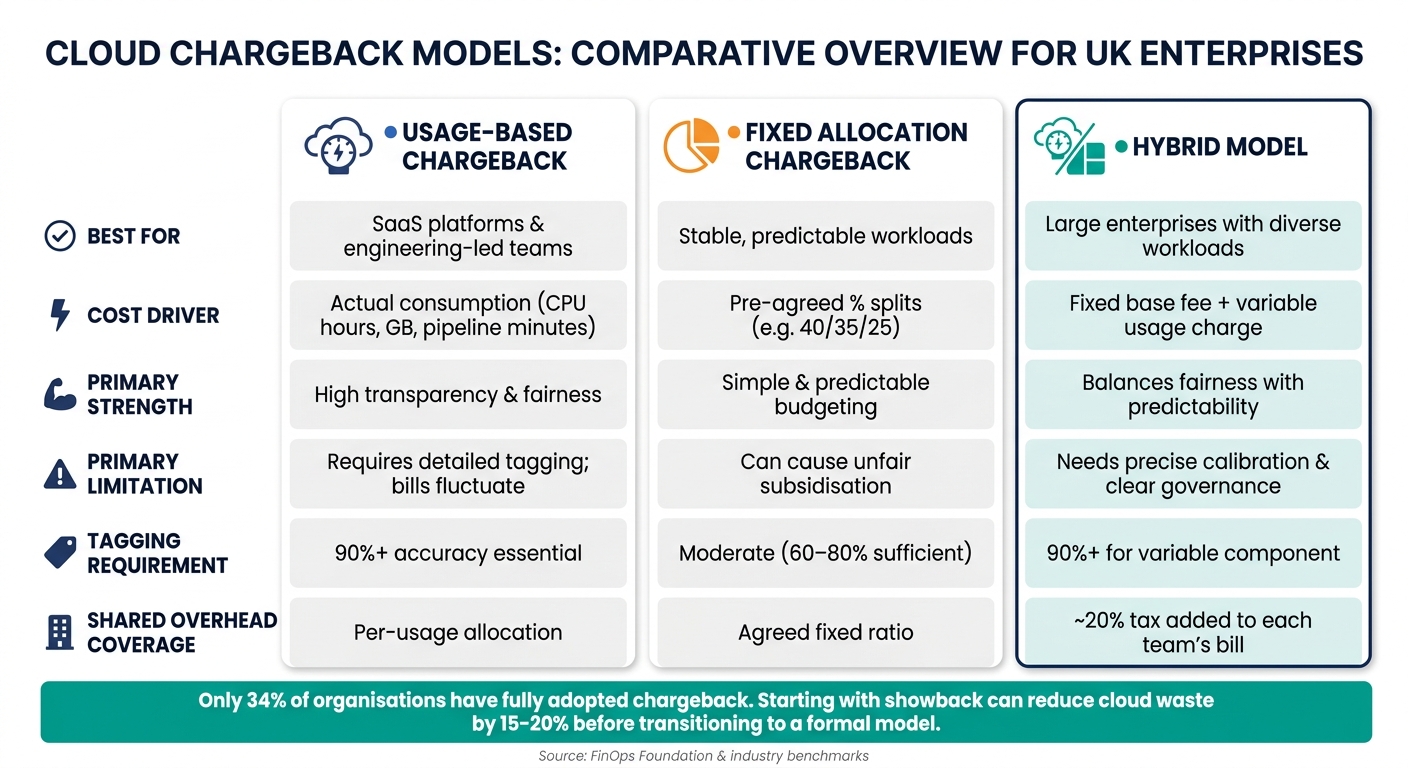 {Showback vs Chargeback vs Chargeback Models: Cloud Cost Allocation Compared}
:::
{Showback vs Chargeback vs Chargeback Models: Cloud Cost Allocation Compared}
:::
Once you've determined your cost pools, allocation drivers, and whether to use showback or chargeback, the next step is deciding how to distribute shared cloud costs. There are three commonly used models, each offering a different balance between simplicity and fairness. These models aim to tackle the challenges of fairly distributing shared cloud expenses.
Usage-Based Chargeback
This model assigns costs based on actual consumption - such as CPU hours, storage usage, data transfer, or pipeline minutes. It's highly transparent since teams can see a direct link between their technical choices and their expenses. For example, if a team over-provisions resources or runs oversized containers, the costs fall squarely on them.
However, this approach relies on accurate and detailed data. Metrics must be captured and tagged precisely for the allocation to be trusted [8]. Without reliable tagging and granular usage data, disputes can arise. This model works well for engineering-focused teams and SaaS platforms, especially where workloads vary significantly from month to month.
Fixed Allocation Chargeback
Fixed allocation divides shared costs using pre-determined percentages or ratios, regardless of actual usage. For instance, three business units might agree to split the cost of a monitoring platform at 40%, 35%, and 25%, based on factors like headcount or past usage patterns.
This method is easy to manage and makes budgeting straightforward since teams know their charges in advance. However, it has a downside: teams with heavier usage may end up subsidising lighter users if consumption changes. To maintain fairness, these splits should be reviewed quarterly, as usage patterns for shared services can evolve over time [5]. This model is best suited for workloads that are stable and predictable.
Hybrid Models: Fixed Plus Variable Charges
For organisations needing a mix of predictable budgeting and dynamic cost allocation, a hybrid model offers flexibility. It combines a fixed base fee with a variable component based on actual usage. For example, a team might pay a set amount each month for always-on infrastructure (like security tools or shared networking) and an additional charge for their compute or storage consumption.
If shared infrastructure is charged back poorly, product margins are distorted, internal pricing becomes unreliable, and engineering teams lose trust in financial reporting.- SysGenPro [9]
This approach is popular among large UK organisations because it balances fairness with predictability [8][9]. One variation is the tax
model, where a fixed percentage (often around 20%) is added to each team's cloud bill to cover shared overhead like governance and security [4]. The main challenge is ensuring the fixed and variable components are carefully calibrated, with clear documentation to prevent confusion as the organisation scales.
| Model | Best For | Primary Strength | Primary Limitation |
|---|---|---|---|
| Usage-Based | SaaS platforms, engineering-led teams | High transparency and fairness | Requires detailed data and fluctuating bills |
| Fixed Allocation | Stable, predictable workloads | Simple and predictable budgeting | Can lead to unfair subsidisation |
| Hybrid | Large enterprises with diverse workloads | Balances fairness with predictability | Needs precise calibration and clear governance |
Implementing Chargeback in Practice
With the chargeback framework established, the next step is to focus on practical implementation, which involves organising services, integrating financial systems, and setting up governance structures.
Building a Service Catalogue for Chargeback
Before charging teams for services, you need a clear overview of what you're offering. A service catalogue acts as a detailed inventory, mapping shared services – such as a Kubernetes cluster, centralised logging, or a shared CI/CD pipeline – to the cloud resources they rely on and the cost allocation method used.
Each entry in this catalogue should include key details like the service name, its associated cost pool, the unit of measurement (e.g., pod hours, storage gigabytes, or pipeline minutes), and the teams utilising the service. Without this clarity, your chargeback model risks generating invoices that teams might dispute due to unclear cost allocation.
Start by exporting cloud billing data, such as AWS Cost and Usage Reports or billing exports from Azure and GCP. Use this data to establish a clear allocation logic that reflects amortised costs for fairness [1][2]. This step ensures that your chargeback model has a solid foundation.
Once your services are catalogued, the next step is to integrate the data with internal financial systems.
Integrating Chargeback with Finance Systems
After setting up billing data, the focus shifts to connecting it with your organisation's financial systems. This involves normalising and enriching the data to make it compatible with ERP platforms like SAP, Oracle, or NetSuite. If your billing data is in USD, use the monthly average exchange rate to convert it to GBP for local reporting [4].
Before moving to actual chargeback billing, run a shadow billing cycle for one or two rounds. This trial phase helps identify tagging errors and refine allocations. Aim for at least 90% tagging accuracy before fully implementing the chargeback model [3].
Once the financial integration is reliable, the final step is to ensure robust governance for long-term success.
Governance and Stakeholder Communication
Even the most accurate chargeback model needs strong governance to gain trust and support. Teams must understand the rules, trust the data, and have a straightforward way to raise concerns. A formal dispute resolution process – for example, allowing teams a 10-business-day period to challenge an invoice with a designated resolver – can help address issues early and prevent escalation [6].
Effective communication with stakeholders is just as critical. Shifting the conversation from how much did we spend?
to was it worth it?
connects chargeback data to key business metrics like cost per customer or cost per transaction [3]. This reframing positions cloud costs as a strategic factor rather than just a financial obligation.
Ultimately, whether you implement a showback or chargeback model depends on your organisation's accounting policies. Establishing clear roles, ownership, and transparent communication from the start is essential for a chargeback model that stands the test of time.
Conclusion: Choosing the Right Chargeback Model
Key Takeaways
When it comes to chargeback models, there is no universal solution. The model you pick should align with your organisation's data maturity and tagging practices. The guiding principle? Start simple, build trust, and gradually introduce accountability.
Interestingly, only 34% of organisations have fully adopted chargeback, which underscores the need for a measured, data-driven rollout [4]. Starting with a showback model can reduce cloud waste by 15–20% [4], proving it’s more than just a temporary solution - it’s a smart first step.
Whether you opt for fixed, usage-based, or hybrid models, your choice should reflect your operational setup and maturity. Each approach has its strengths, so select the one that best suits your environment.
Next Steps for UK Organisations
For organisations in the UK, the focus now should be on actionable steps to improve cloud cost management. Start by auditing your tagging compliance - if it’s below 80%, prioritise showback and work on improving tagging accuracy before moving to financial chargeback. Once compliance hits 90%, consider piloting a chargeback model with a few teams [2].
Additionally, ensure your cost allocation logic includes shared infrastructure expenses. These often account for 15–25% of cloud budgets and cover areas like networking, security tools, and platform services [4][2]. Agreeing on allocation rules for these costs is essential before fully implementing chargeback.
Another important consideration for UK organisations is VAT. Separate VAT from your cloud KPIs to stay compliant with HMRC regulations [4]. If you’re looking for expert support in structuring your chargeback process, Hokstad Consulting can help design a framework tailored to your organisation’s unique needs and maturity level.
FAQs
How do we allocate shared Kubernetes costs fairly?
Fairly distributing shared Kubernetes costs means finding the sweet spot between technical accuracy and ease of implementation. To begin, split costs into two categories: directly attributable costs (like compute and storage) and shared overheads (such as the control plane and monitoring expenses). A practical approach is using a 70/30 split - allocate 70% of costs based on resource requests and the remaining 30% according to actual usage.
To track usage effectively, leverage namespaces, labels, and metrics tools. Introducing a showback phase - where costs are reported without enforcement - can help establish trust and transparency before moving to a formal chargeback model.
What should we do with cloud costs that can’t be tagged?
For cloud costs that can't be tagged, avoid quietly spreading them across departments. Instead, make them a clearly visible, unallocated line item to ensure transparency and accountability.
To tackle these costs, you can use virtual tags within a FinOps layer. This allows you to link account IDs or services to specific teams. Alternatively, allocate expenses proportionally using usage-based drivers like request counts, data egress, or CPU hours. This approach ensures fair distribution and helps teams understand their contributions to overall costs.
How can we stop teams gaming chargeback metrics?
To keep chargeback metrics fair and accurate, it's essential to set up solid governance with clear and transparent rules. Start by enforcing standardised tagging policies - this ensures resources are attributed correctly. Automated tools can help by flagging any untagged resources, saving time and reducing errors.
Accountability is another crucial piece of the puzzle. A RACI matrix (Responsible, Accountable, Consulted, Informed) can clarify roles and responsibilities, making it clear who owns what. Regular audits are also vital - they can help identify any anomalies or inconsistencies in the data.
Lastly, implement approval workflows. By involving department heads in the review of charges, you can maintain transparency and ensure everyone agrees on how costs are allocated. This not only builds trust but also keeps the process aligned with organisational goals.