
When managing cloud costs, showback and chargeback are two popular approaches. Here's the gist:
- Showback provides cost transparency by reporting cloud usage and expenses to teams without billing them directly. It’s best for organisations just starting their cloud cost management journey or those prioritising collaboration over strict accountability.
- Chargeback goes further by billing teams or departments for their cloud usage. It enforces financial accountability and is ideal for mature organisations with strong cost governance practices.
Both methods improve visibility and reduce waste, but they differ in complexity, financial impact, and organisational fit. Starting with showback and transitioning to chargeback is often the most effective strategy.
Quick Overview:
- Showback: Transparency without billing; promotes awareness.
- Chargeback: Direct billing; enforces cost control.
Key Considerations:
- Start with showback for early FinOps stages or less mature tagging systems.
- Transition to chargeback as tagging accuracy and cost allocation improve.
Choosing the right model depends on your organisation’s readiness, goals, and culture. Read on for a detailed breakdown of both approaches, their pros and cons, and how to implement them effectively.
::: @figure 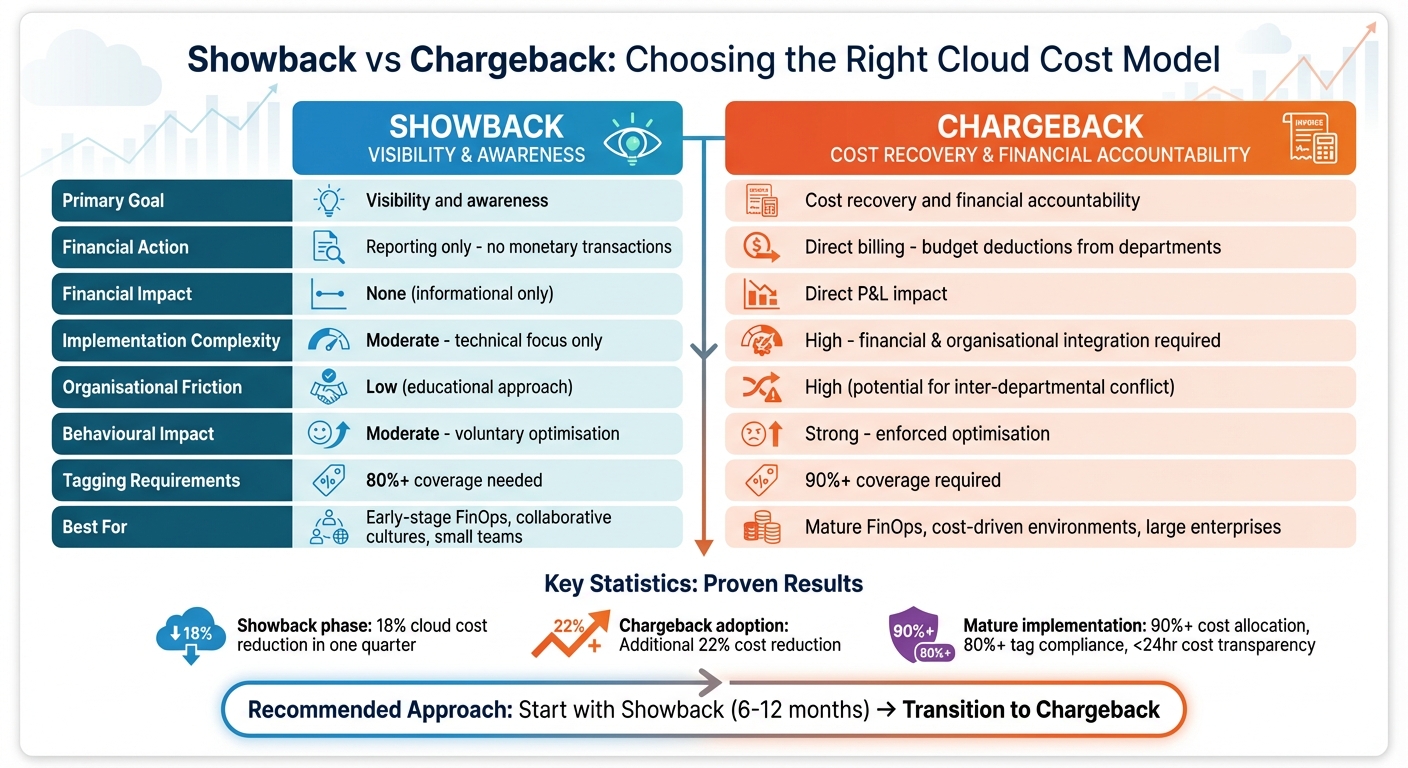 {Showback vs Chargeback Cloud Cost Management Models Comparison}
:::
{Showback vs Chargeback Cloud Cost Management Models Comparison}
:::
Fannie Mae's Journey from Showback to Chargeback
Need help optimizing your cloud costs?
Get expert advice on how to reduce your cloud expenses without sacrificing performance.
What is Showback?
Showback is a method used to report cloud resource usage and associated costs, offering full transparency without directly billing individual teams. Essentially, it reflects each team’s spending habits, but the actual expenses remain under a central IT or finance budget rather than being charged to specific departments [3].
As Rachel Whitener, SEO Content Editor at CloudZero, puts it:
Showback is a gentle way of teaching the responsible parties how they've contributed to total costs without taking the money out of a departmental budget[1].
This approach focuses on raising awareness and educating teams about their spending, rather than enforcing financial accountability. It’s particularly useful for organisations that value openness and shared responsibility [3].
How Showback Works
The showback process is straightforward and involves four main steps:
- Monitoring resources such as compute power, storage, and licences.
- Calculating costs using either market rates or internal pricing.
- Reporting spending by department or project.
- Sharing insights with relevant stakeholders.
Unlike more complex billing systems, showback relies on simple monitoring and reporting tools. This allows teams to see how costs are distributed across environments without directly impacting their budgets [3].
When to Use Showback
Showback is especially useful for organisations in the early stages of managing cloud costs. It’s a great starting point during the first one to three months of a FinOps journey, often referred to as the Crawl
phase. This period helps teams ensure data accuracy and improve resource tagging before introducing financial accountability [2].
It’s also a good fit for organisations that encourage collaboration and open communication rather than rigid budget enforcement. Teams generally welcome showback because it doesn’t come with immediate financial repercussions [1]. It’s particularly effective in shared infrastructure environments, where attributing costs to specific teams or projects can be tricky. Instead of rushing into financial decisions, showback allows teams to first understand their usage patterns, paving the way for more advanced cost management strategies later on.
With showback offering transparency without direct billing, the next section will explore how chargeback takes financial accountability to the next level.
What is Chargeback?
Chargeback takes cloud cost management a step further than showback by introducing direct billing, making teams financially accountable for their resource usage.
Unlike showback, which only reports on spending, chargeback deducts costs directly from a department's budget. This shift means teams aren't just informed about their expenses - they're responsible for paying them from their allocated funds. The result? A stronger focus on financial accountability and resource management. However, this model can cause tension if teams feel the cost allocation is unfair or unclear [1].
How Chargeback Works
Chargeback operates by tracking cloud resource usage, calculating costs based on predefined models, and deducting the corresponding amounts from departmental budgets. This creates a clear link between resource consumption and financial impact.
To maintain control, real-time budget limits are enforced, ensuring that teams stay within their allocated spending. Unlike showback, where costs are merely displayed in reports, chargeback involves actual financial transactions, moving money between budget lines and creating immediate consequences for overspending.
Implementing chargeback is more complex than showback. It requires advanced technical systems and financial processes. Mature implementations can achieve impressive results, such as allocating over 90% of costs, maintaining over 80% compliance with tagging policies, and delivering cost transparency in under 24 hours [1].
When to Use Chargeback
Chargeback works best in organisations with well-defined budgets and strong financial governance. It is particularly effective when teams have autonomy over cloud spending, as it reinforces accountability through financial consequences [2].
If cloud costs are spiralling and immediate behavioural changes are needed, chargeback can be a powerful tool. However, it's not something to rush into. A recommended strategy is to start with a showback phase lasting 6–12 months. This allows teams to trust the accuracy of the data before actual budget deductions are enforced [1][2].
Advantages and Disadvantages of Each Model
Building on the earlier operational breakdowns, let’s delve into the benefits and drawbacks of each model. Showback and chargeback each come with their own set of strengths and challenges. Grasping these nuances is crucial for determining the best fit for your organisation’s cloud cost management approach.
Showback: Advantages and Disadvantages
Showback is often praised for its simplicity and ability to reduce organisational friction. Since it doesn’t impose financial penalties or affect budgets directly, teams can focus on understanding their cloud usage without the pressure of immediate monetary consequences. For example, showback dashboards have been shown to cut cloud spending by 18% in just one quarter by raising awareness [2].
Showback focuses on education and transparency with low organisational friction, making it ideal for entry-level FinOps.- Hykell [2]
That said, showback has its limits. Because it relies on voluntary action, teams may prioritise speed or other goals over cost-saving measures. Without financial repercussions, the incentive to optimise is weaker [1]. Additionally, if tagging and cost allocation aren’t accurate, teams might question the reports, which can erode trust in the system [1]. As CloudZero suggests, sticking with showback until cost breakdowns are fully accurate is a wise strategy [1].
While showback aims for transparency and education, chargeback takes a more direct approach by linking cloud usage to financial outcomes.
Chargeback: Advantages and Disadvantages
Chargeback is all about accountability. By tying cloud spending directly to departmental budgets, it makes teams more conscious of their resource use. This approach can lead to swift behavioural changes. For instance, a financial services firm saw an additional 22% reduction in cloud costs after switching from showback to chargeback in 2024–2025 [2]. When teams know their budgets are on the line, they’re far more likely to eliminate waste.
However, chargeback isn’t without challenges. It requires more complex systems, both technically and financially, and demands advanced FinOps practices along with precise internal accounting [2]. The model can also create friction within organisations, as disputes over data accuracy or budget allocations might arise between departments [1] [3].
Here’s a quick comparison to highlight the differences:
| Factor | Showback | Chargeback |
|---|---|---|
| Primary Goal | Visibility and awareness | Cost recovery and financial accountability |
| Financial Impact | None (informational only) | Direct P&L impact (budget deductions) |
| Complexity | Moderate (technical focus) | High (financial & organisational integration) |
| Friction | Low (educational approach) | High (potential for inter-departmental conflict) |
| Incentive | Voluntary optimisation | Enforces optimisation to control spending |
| Best For | Small teams or FinOps beginners | Large enterprises with mature FinOps |
This comparison provides a clear framework to help you decide which model aligns best with your organisation’s needs and goals.
Showback vs Chargeback: Side-by-Side Comparison
Here's a breakdown of how showback and chargeback models differ across several key aspects. This comparison can help you decide which approach aligns better with your organisation's FinOps maturity and overall work environment.
| Factor | Showback Model | Chargeback Model |
|---|---|---|
| Primary Goal | Focuses on raising awareness and educating teams | Ensures financial accountability and recovers costs |
| Financial Action | Involves reporting only; no actual monetary transactions | Includes billing and transferring budgets |
| Implementation Complexity | Easier to implement; requires tracking and reporting [3] | More complex; needs integration with billing or ERP systems [1] |
| Behavioural Impact | Moderate impact, relying on voluntary actions [1] | Strong impact, driven by budgetary pressures [2] |
| Financial Impact | None, as central IT or Finance handles the expenses [2] | Direct impact; costs are charged to departmental budgets [2] |
| Organisational Friction | Minimal, as it’s seen as a transparency tool [2] | Higher, as disputes may arise over billing details [1] |
| Organisational Fit | Works well in collaborative, trust-driven environments | Suited for cost-focused, mature FinOps organisations |
| Behavioural Driver | Encourages voluntary improvements using data [1] | Mandates optimisation to adhere to budget limits [2] |
| Best For | Early-stage FinOps and team-oriented cultures [3] | Advanced FinOps and cost-driven settings [2] |
This table clearly shows how each model serves distinct purposes. Showback is an ideal starting point for organisations aiming to build awareness without causing friction, while chargeback is better suited for those ready to enforce financial accountability through direct cost allocation.
Interestingly, many organisations find value in combining both approaches. For example, using chargeback for essential services while keeping showback for experimental or less-defined resources allows for a smoother transition. This also helps refine tagging practices over time [3].
If your organisation currently allocates only 31–85% of costs with a tagging compliance rate of 10–50%, starting with showback is likely the better choice [1]. However, once you achieve over 90% cost allocation and more than 80% tag compliance, you’ll be better equipped to handle the stricter demands of a chargeback system [1].
How to Choose the Right Model
Choosing between showback and chargeback isn’t about finding the better
model - it’s about aligning the approach with your organisation’s current needs and goals. This decision plays a crucial role in cloud governance and cost management. Picking the wrong model could either fail to drive accountability (using showback when chargeback is needed) or create unnecessary friction (implementing chargeback before your organisation is ready).
Factors That Affect Your Choice
One of the most critical factors is tagging coverage. Without proper tagging, accurate cost allocation becomes impossible. For showback, tagging should cover at least 80% of resources, while chargeback requires over 90% coverage [5]. Mohit Sharma, Principal Consultant at Optivulnix, explains the risks:
Nothing destroys a chargeback program faster than inaccurate cost allocation. If Team A is charged for Team B's resources, trust collapses and leadership will roll back the program.[5]
Beyond technical readiness, organisational culture is equally important. Chargeback introduces an internal market dynamic, where IT functions as a service provider [3].
A hybrid approach can offer flexibility. For instance, apply chargeback to core services while using showback for experimental or new projects. This balances accountability with the freedom to innovate [4].
By considering these factors, organisations can plan a smooth transition from showback to chargeback.
Moving from Showback to Chargeback
Transitioning to chargeback requires both technical preparation and cultural alignment. Start small and build up gradually. Using a Crawl, Walk, Run
strategy, organisations can begin with a 3–6 month showback phase to familiarise teams with cost visibility before introducing financial accountability [1] [4].
For example, a global financial services firm reduced its AWS spend by 18% during the first quarter of their showback phase in 2025. A year later, after fully adopting chargeback, they achieved an additional 22% cost reduction [2].
Before fully implementing chargeback, run a shadow
chargeback phase for 2–3 months. This allows you to validate cost calculations and establish clear processes for handling disputes. Involve your FinOps team for data accuracy and set up a cross-functional steering committee to guide policy decisions [5]. One SaaS company, for example, used CloudZero to monitor Kubernetes costs by feature over six months of showback. After switching to chargeback in 2025, they reduced waste by 18% within one quarter and significantly improved forecasting accuracy [1].
Another key step is to create a transparent formula for allocating shared costs, such as networking and security. Teams must fully understand their spending habits, and cost forecasts should be reliable before making the shift to chargeback [1]. By taking a measured approach, organisations can improve financial accountability and reduce unnecessary expenses effectively.
Implementing Cost Allocation with Hokstad Consulting
Hokstad Consulting specialises in creating cost allocation systems that align with an organisation's unique structure and goals. Their approach combines a detailed analysis of cloud usage with tailored solutions to ensure effective implementation.
Customised Cost Allocation Systems
Hokstad Consulting begins with a comprehensive cloud cost audit to evaluate current resource usage, identify gaps in tagging, and analyse spending trends. This groundwork ensures that the chosen cost allocation model - whether showback or chargeback - fits seamlessly with the organisation's setup.
One key element of their strategy is developing tagging plans that reflect the organisational hierarchy. These plans can be structured around departments, projects, Kubernetes namespaces, or product lines. For example, in 2023, a UK-based SaaS company collaborated with Hokstad Consulting to automate tagging across its cloud environment. The results? Annual savings of £120,000 and a 95% reduction in downtime. By automating tagging enforcement, they eliminated the risk of untagged resources, ensuring accurate cost tracking from the start.
Hokstad Consulting also integrates cost controls into CI/CD pipelines and Infrastructure as Code (IaC) templates. This automation ensures financial governance by halting deployments that exceed budget limits and shutting down non-production environments during off-hours. A tech startup, for instance, saw deployment times drop from 6 hours to just 20 minutes - a 10-fold improvement - thanks to these DevOps-driven changes.
Continuous Optimisation and Support
Effective cost allocation doesn’t stop at implementation. Hokstad Consulting offers ongoing optimisation through real-time dashboards displaying costs in pounds sterling (£), coupled with regular audits to pinpoint idle or misconfigured resources. Their retainer model includes quarterly rightsizing reviews, ensuring the allocation model adapts to the organisation’s growth and changing needs.
To reinforce the benefits of cost accountability and transparency, Hokstad Consulting operates on a No Savings, No Fee
basis. This performance-based model means fees are only charged if savings are achieved. For example, an e-commerce platform working with Hokstad saw a 50% performance improvement while cutting costs by 30%, thanks to Hokstad’s targeted optimisation strategies. Leveraging AI, they predict workloads and automate cost-saving decisions, such as switching between Spot and On-Demand instances, ensuring efficient resource allocation as cloud requirements evolve.
Conclusion
Deciding between showback and chargeback isn't about picking a better
model; it's about aligning with your organisation's current needs, goals, and readiness. Showback is a great starting point for teams new to cloud cost management, as it focuses on raising awareness and fostering trust in cost data without attaching financial consequences. On the other hand, chargeback directly ties resource usage to budget accountability, making it a better fit for organisations ready for stricter financial oversight.
A phased approach is often the most effective. Starting with showback allows you to validate your data and build trust within teams before transitioning to chargeback. This gradual shift ensures that tagging practices are well-established and that teams fully understand the cost data. For instance, LiveRamp’s 2020 initiative showed how refining tagging policies and enforcing strict namespacing can significantly improve cost allocation accuracy [1].
Hokstad Consulting helps UK organisations navigate this journey, whether you're setting up your first showback reports or advancing to a chargeback framework. Their services include automated tagging enforcement, real-time cost monitoring, and seamless integration with CI/CD pipelines, ensuring full cost visibility from the outset. Plus, their No Savings, No Fee
model minimises risk while delivering tangible cost reductions.
FAQs
How do we know we’re ready to move from showback to chargeback?
To evaluate your organisation's approach to cost management, begin by assessing its current maturity level and operational requirements. A good starting point is implementing showback. This method helps create awareness of costs and promotes accountability across teams without directly charging them.
Once your organisation has established accurate tagging systems, conducts regular audits, and fosters a culture that prioritises cost awareness, you can move towards chargeback. This step involves directly billing departments or teams for their resource usage. However, readiness for chargeback also depends on having reliable automation in place, well-defined policies, and a thorough understanding of how resources are used. These elements are essential for managing billing complexities and ensuring accountability is effectively enforced.
What tagging level do we need for accurate cost allocation?
To allocate costs accurately, having a detailed tagging system is crucial. This approach allows resources to be tracked and categorised with precision, ensuring clear visibility and accountability. By implementing proper tagging, expenses can be assigned to the correct teams or projects, supporting better cost management overall.
How do you split shared cloud costs fairly between teams?
Organisations rely on cost allocation methods to fairly distribute shared cloud expenses and boost accountability. Showback involves reporting costs to departments based on their usage without directly billing them. This approach enhances transparency and helps highlight areas of potential waste. On the other hand, Chargeback assigns actual costs to specific teams, encouraging financial responsibility.
To ensure accurate tracking of shared resources, clear tagging of cloud assets, leveraging cloud-native tools, implementing automation, and conducting regular audits are essential. These practices help align cost allocation with the organisation's broader objectives.