
If your cloud setup changes every week, a one-time review will not keep spend under control. I’d use a one-time assessment for a fast baseline and quick cuts. I’d use a recurring audit when I need repeat checks, owner accountability, and tighter cost control over time.
Here’s the short version:
- One-time assessment = a point-in-time review
- Recurring audit = repeated checks on a set cycle
- Assessment suits migration reviews, due diligence, or sudden cost pressure
- Audit suits fast-moving teams, larger estates, and firms that need a clear audit trail
- Main difference = diagnosis vs. control
The article makes one point clear: 72% of organisations go over cloud budgets. That usually happens because small cost decisions build up between reviews. A one-off report can show waste today. It does not help much with drift next month.
::: @figure 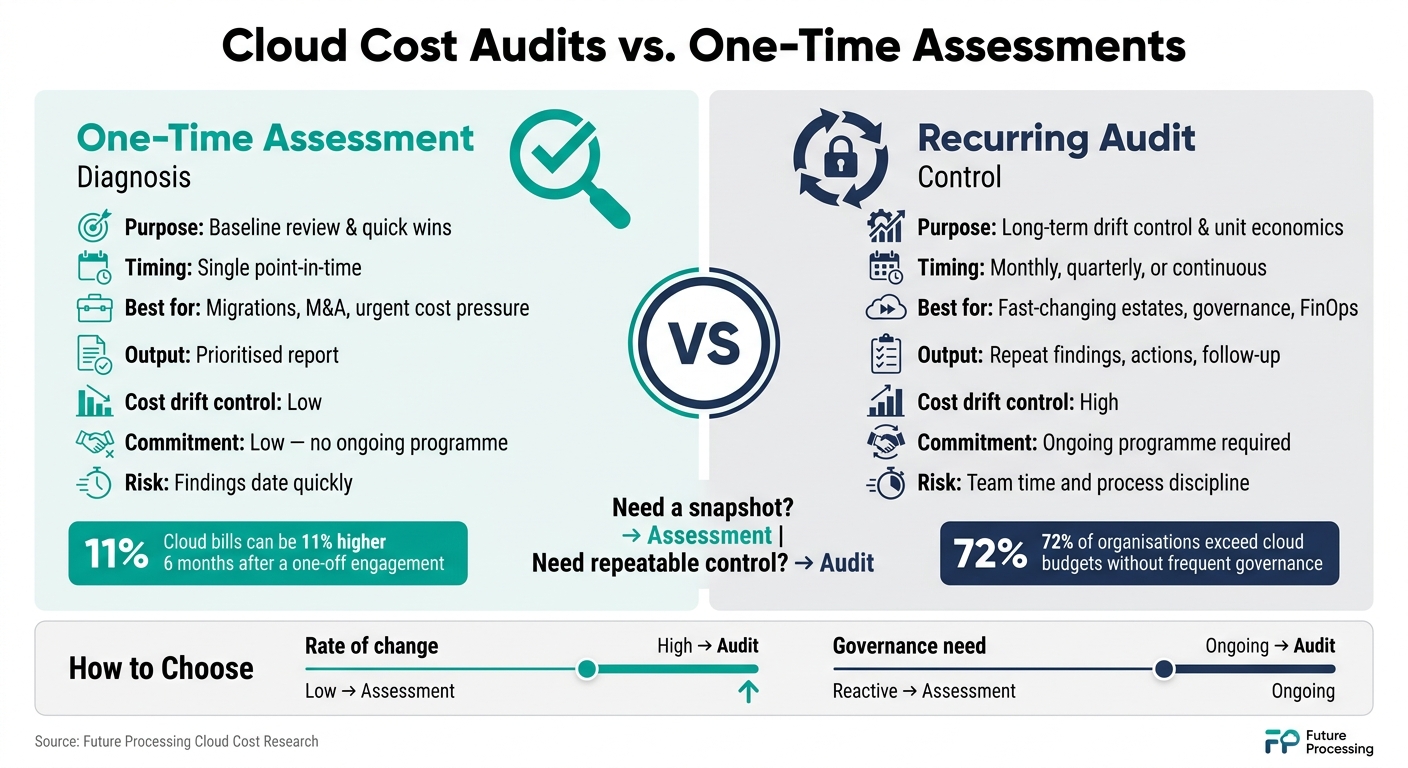 {Cloud Cost Audits vs. One-Time Assessments: Which Is Right for You?}
:::
{Cloud Cost Audits vs. One-Time Assessments: Which Is Right for You?}
:::
Building Cloud Cost Governance That Lasts | The Keys to AWS Optimization | S14 E10
Need help optimizing your cloud costs?
Get expert advice on how to reduce your cloud expenses without sacrificing performance.
Quick Comparison
| Criteria | One-Time Assessment | Recurring Audit |
|---|---|---|
| Purpose | Baseline and quick savings | Repeated cost control |
| Timing | Once | Monthly, quarterly, or continuous |
| Best for | Migrations, M&A, urgent cost checks | Fast-changing estates, governance, unit economics |
| Output | Prioritised report | Repeat findings, actions, follow-up |
| View of spend | What costs now | How spend changes over time |
| Control of drift | Low | Higher |
| Stakeholders | Finance, cloud leads | Engineering, FinOps, finance, leadership |
| Typical risk | Findings date fast | Team time and process load |
What I take from this is simple: if you only need a snapshot, an assessment is enough. If you need repeatable control, clearer ownership, and better tracking of costs against business value, the audit model is the better fit.
Cloud cost audits: recurring reviews for ongoing control
A one-off review gives you a snapshot. Recurring audits do more than that. They create a control loop that keeps cloud spend in check over time.
These audits run on a set schedule, usually monthly checks and quarterly deep dives, so teams can spot cost decisions while they're still happening, not months later.
Scope, cadence and data needed
The main strength of recurring audits is simple: they surface action often. It's not just about what they show. It's about when they show it.
| Feature | Monthly Checks | Quarterly Formal Audits |
|---|---|---|
| Primary Focus | Anomalies, idle resources, budget alerts | Strategic alignment, RI/Savings Plan coverage, total cost of ownership |
| Data Depth | Recent 30-day billing and usage spikes | 90-day+ historical trends and baselines |
| Stakeholders | DevOps, engineers, FinOps leads | CFO, department heads, procurement |
| Outcome | Immediate quick-win deletions and stops | Contract renegotiation, architectural shifts |
For either review cycle to work, you need two things in place:
- Reliable billing data
- Named service owners
Without named owners, accountability falls apart. No one is clearly responsible for judging whether a workload is worth what it costs. That gap is still common. Only 43% of large enterprises can calculate cost per data product [1]. In plain terms, many organisations still can't see whether a given service is delivering enough return for the money going into it.
Benefits and drawbacks of regular audits
Regular audits help teams cut waste early and spot deeper issues before they snowball. They can improve forecasting, give engineering a tighter feedback loop, and bring problems to light, such as retention failures or inefficient processing [1].
| Pros of Regular Audits | Cons of Regular Audits |
|---|---|
| Sustained savings and reduced cost drift | Requires significant internal staff time |
| Improved forecast accuracy for finance teams | Demands strict process discipline |
| Stronger governance and compliance | Requires constant follow-through between cycles |
| Identifies inefficiencies before they compound | Can lead to alert fatigue if not tuned properly |
The downsides are real. Running recurring audits takes time from internal teams. It also needs discipline and steady follow-through between review cycles. If alerts aren't tuned well, people start ignoring them, and that's when the whole thing loses steam.
How recurring audits fit DevOps and FinOps
Audit findings shouldn't sit in a slide deck. They need to move straight into delivery workflows.
Recurring audits fit the Inform and Optimise phases of FinOps [2]. Findings can flow into sprint planning, where remediation work becomes engineering tickets instead of vague recommendations. Cost checks can also be built into CI/CD pipelines, so teams catch issues during delivery rather than after the bill lands.
That matters because it turns cloud cost control into part of normal engineering work, not a side task someone remembers at month-end. CI/CD pipelines can also apply cost guardrails automatically as part of day-to-day practice.
Hokstad Consulting supports recurring audit cycles with dashboards and automation that cut monthly manual review.
One-time assessments: fast insight with limited continuity
Where audits give you ongoing control, one-time assessments offer a quick snapshot. They look at a single moment in time and answer an urgent question fast: where is cloud spend going, and what can we cut right now?
Teams often use them after a cloud migration, during M&A or investor due diligence, when spend is climbing fast, or when there’s sudden pressure to bring monthly cloud costs down.
Typical process and outputs
Most one-time assessments follow a similar path. It usually starts with a short discovery phase, where the team gets access to billing data, account structures, and the billing periods that matter. From there, they review recent billing and usage data to spot the main cost drivers and the easiest savings to go after first.
The main output is a prioritised report. It highlights the biggest sources of cost and sets out recommended actions. That kind of plain direction matters, because vague findings don’t tend to move finance teams.
Benefits and drawbacks of a snapshot review
The appeal is pretty obvious: low commitment, fast turnaround, and clear next steps. But speed has a trade-off. In cloud, things shift all the time, so findings can go out of date almost as soon as they’re delivered. As one industry expert put it:
Cloud cost governance applied four times a year to an environment changing daily is retrospective accounting, not governance.- Błażej Ksycki, Data Solutions Consultant, Future Processing [1]
There’s another issue too. If there’s no system for acting on the findings and checking progress, the work can stall after the report lands. Research suggests cloud bills can end up 11% higher six months after a one-off engagement concludes [1].
| Factor | One-Time Assessment |
|---|---|
| Speed | Fast turnaround |
| Commitment | Low - no ongoing programme required |
| Recommendations | Clear, prioritised actions |
| Continuity | None - findings date quickly in dynamic environments |
| Waste prevention | Reactive only - it cannot prevent repeat overspend |
| Best fit | Cloud migration reviews, M&A due diligence, rapid spend growth, urgent cost pressure |
Its main limit is simple: it only shows one point in time. Błażej Ksycki made that point clearly here:
A cloud audit confirms that spend exists and where it lands. It cannot confirm whether that spend is generating a return - because cost allocation stops at the infrastructure boundary.- Błażej Ksycki, Data Solutions Consultant, Future Processing [1]
So yes, the assessment shows current spend. What it doesn’t do is keep future spend under control.
Cloud cost audits vs. one-time assessments: direct comparison
The clearest differences come down to governance, engineering impact, and whether the savings stick. That’s the part that matters most. The gap isn’t only about what each review spots at the time. It’s about how long those results stay useful.
Comparison table: cadence, scope, cost impact and governance
The table below shows where the difference sits.
| Factor | One-Time Assessment | Recurring Audit |
|---|---|---|
| Objective | Baseline review and quick wins | Long-term drift control and unit economics [1] |
| Timing | Single point-in-time review | Ongoing - monthly, quarterly, or continuous |
| Scope | Infrastructure layer: compute, storage and network [1] | Workload or product level, checking cost against value delivered [1] |
| Governance value | Reactive oversight [1] | Ongoing control [1] |
| Cost drift control | Limited; costs can creep back after the review [1] | High; helps prevent recurring overspend [1] |
Scope is where the split becomes most obvious. One-time assessments usually stop at compute, storage and network. They show what things cost, but not whether that spend is pulling its weight.
Recurring audits go further. They track unit economics, such as cost per pipeline run or cost per GB stored, which helps teams spot issues that a basic infrastructure review can miss. A good example comes from Future Processing: one client found a £36,000 annual overspend in a data lakehouse that a standard infrastructure audit had missed. The cause was a failed VACUUM process for historical data versions [1].
When each approach makes the most business sense
The right fit depends on how fast your environment changes. If you need a quick baseline and a shortlist of immediate wins, a one-time assessment often does the job.
If your setup changes often, a recurring audit makes more sense. It gives you governance that can keep pace with day-to-day engineering decisions. That matters, because 72% of organisations go over cloud budgets when governance is too infrequent to intercept those decisions [1].
Choosing the right model and next steps
A practical decision framework
Use two signals to make the call: how much you spend and how fast that spend shifts.
In lower-spend setups that don't change much, a one-off assessment is often enough to set a baseline and spot quick savings. But in higher-spend estates, or in teams pushing changes every day, a recurring audit cycle makes more sense if you want steady control.
As Błażej Ksycki, Data Solutions Consultant at Future Processing, puts it:
Cloud cost governance applied four times a year to an environment changing daily is retrospective accounting, not governance.[1]
Start with rate of change and governance need. Then use spend as a second filter.
That matters even more when governance and auditability are built into the way the business runs. For FCA-regulated firms or UK GDPR-sensitive businesses, recurring audits create a stronger compliance trail than a point-in-time review.
Key takeaways for UK businesses
For UK businesses, the choice is fairly direct: one-off for diagnosis, recurring for control.
A one-time assessment gives you a baseline and helps you find quick savings. A recurring audit helps you hold onto those gains as the environment shifts. It's also the better setup for tracking unit economics over time, such as:
- cost per pipeline run
- cost per GB stored
- cost per transaction
Hokstad Consulting supports both approaches with cloud cost reviews and ongoing cost engineering.
FAQs
How often should we run a cloud cost audit?
Move past periodic reviews and aim for continuous monitoring where you can. Manual audits often happen monthly or quarterly. The problem is, they look backwards. By the time someone spots an anomaly, the damage may already be done and the financial loss can be far higher than it needed to be.
For most organisations, the best mix is:
- real-time automated monitoring
- monthly invoice reconciliations
- deeper quarterly reviews
When is a one-off assessment enough?
A one-off assessment is usually enough for smaller cloud setups with monthly spend of £1,000 to £10,000. At that level, round-the-clock automated monitoring can end up taking more time and effort than the savings it brings.
For larger or more complex environments, though, a one-off audit often falls short. It gives you a snapshot, not a live view. That means it can miss cost anomalies as they happen and leave organisations exposed to long-term waste that keeps ticking along in the background.
What do we need before starting a recurring audit?
Before you start a recurring audit, set a baseline first. In practice, that means using at least 90 days of spend history and documenting your current setup so unusual changes are easier to spot.
It also helps to have a few basics in place:
- standardised cost-allocation tags
- clear cloud budgets and spending alerts
- an inventory of cloud assets, plus a simple process for decommissioning idle or redundant resources