
Manual compliance in cloud operations is expensive and inefficient. It consumes up to 80% of a security analyst's time, leads to outdated findings, and increases risks of fines or misconfigurations. Automation solves these problems by enforcing policies, monitoring in real-time, and reducing repetitive tasks.
Key benefits of compliance automation:
- Cost Savings: Cuts compliance costs by 40–60% and reduces cloud waste (24% of budgets on average).
- Time Efficiency: Slashes audit preparation time from weeks to hours.
- Error Prevention: Stops non-compliant or high-cost resources before they inflate expenses.
- Scalability: Handles multi-cloud setups without additional labour.
- Labour Optimisation: Frees engineers to focus on innovation instead of manual checks.
Organisations using automation report savings of up to 35% in cloud costs and improved resource management by 45%. Tools like AWS Lambda, EventBridge, and Cloud Custodian enable continuous oversight and automated remediation, significantly cutting waste and operational costs.
::: @figure 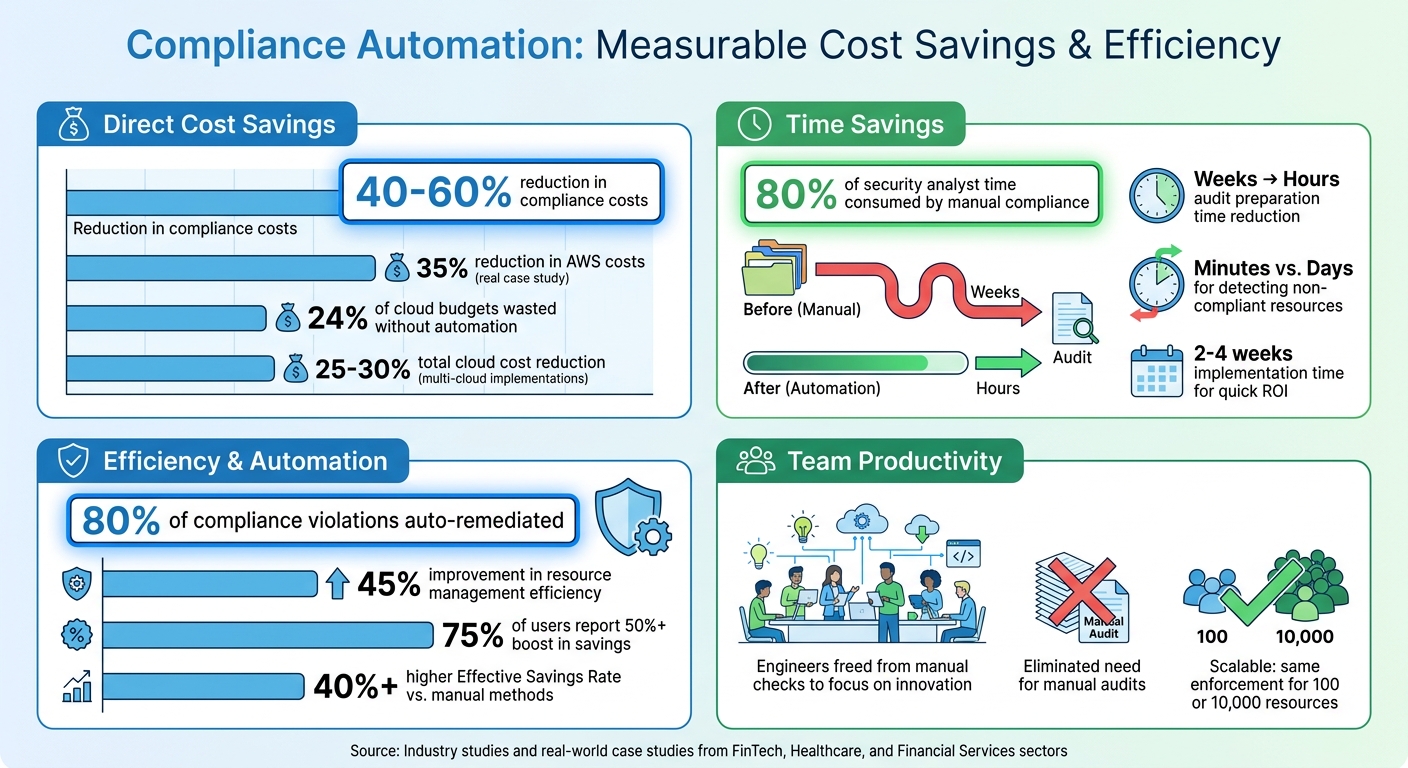 {Compliance Automation Cost Savings and Efficiency Gains}
:::
{Compliance Automation Cost Savings and Efficiency Gains}
:::
Research Findings on Cost Reduction Through Automation
Efficiency Gains from Automation
Studies show that automation delivers impressive time savings for organisations. For instance, automated systems can spot non-compliant or idle resources in minutes, whereas manual checks often result in outdated findings and prolonged inefficiencies [5][3]. With real-time compliance dashboards, audit preparation time is slashed from weeks to just hours, as opposed to manually gathering evidence [3]. Moreover, setting up compliance automation takes only 2–4 weeks and quickly yields a high return on investment by reducing manual efforts and preventing costly incidents [3].
Automation shifts organisations from reactive to proactive governance, completely changing how cloud costs are managed. Instead of reacting to overspending after reviewing monthly bills, automated systems identify waste at the moment resources are created [5]. This proactive approach catches expensive errors early, avoiding the accumulation of unnecessary costs over time.
Ultimately, these time efficiencies lead to measurable reductions in labour and operational expenses.
Labour and Operational Cost Reductions
Automated remediation resolves 80% of compliance violations, allowing engineers to focus on more strategic tasks [4]. A notable example comes from April 2026, when a leading FinTech company in India, part of a Japanese financial group, tackled high cloud expenses related to EKS, EC2, and unused EBS volumes. By utilising a policy engine (OPA Gatekeeper) alongside AWS Lambda and EventBridge for auto-remediation, the company achieved a 35% reduction in AWS costs, fully automated compliance, and 80% automated remediation. They also improved resource management efficiency by 45% and eliminated the need for manual audits [4].
Industry-wide data further highlights the potential for savings, with organisations wasting an average of 24% of their cloud budgets due to poor optimisation practices [6]. This underscores how automation can recover significant costs.
Beyond cost savings, automation strengthens risk management and supports scalability.
Better Risk Management and Scalability
Automated compliance tools provide consistent oversight across complex, multi-cloud setups. By adopting Governance-as-Code
, organisations can prevent the creation of non-compliant or high-cost resources using preventive controls, or detect them within minutes with detective controls [3]. For instance, preventive controls handle critical security needs like encryption, while detective controls manage softer requirements like tagging, ensuring thorough coverage without disrupting ongoing workloads [3].
Scalability becomes a critical factor as cloud environments expand. According to 451 Research, the increasing complexity of multi-cloud setups is overwhelming FinOps teams, making manual efforts insufficient for cost optimisation [6]. Automation, however, maintains the same level of policy enforcement whether monitoring 100 resources or 10,000, without requiring additional labour. This capability ensures long-term savings and operational consistency, further validating the financial advantages of compliance automation.
Need help optimizing your cloud costs?
Get expert advice on how to reduce your cloud expenses without sacrificing performance.
How Compliance Automation Reduces Cloud Costs
Cutting Down Manual Work with Automation
Automated guardrails are a game-changer when it comes to reducing human oversight and avoiding costly mistakes. Tools like AWS Service Control Policies (SCPs) or Azure Policy can block oversized instances from being deployed in development environments, ensuring non-compliant setups are avoided from the start. This proactive approach eliminates the need for engineers to conduct periodic audits to spot and fix issues. On top of that, routine tasks - like scheduling automatic shutdowns for non-production workloads during off-peak hours - further reduce the need for manual involvement [5].
Smarter Resource Allocation
When compliance tasks are automated, it frees up engineers to focus on more impactful work. Instead of constantly reacting to compliance issues or manually adjusting resource sizes, teams can shift their attention to designing cost-efficient architectures from the outset. This proactive mindset allows organisations to avoid unnecessary cloud spending while enabling engineers to work on optimising application performance or developing new features. In short, automation helps teams move from firefighting to innovation [5].
Ongoing Cloud Cost Management
Automation also brings major benefits to cost management by providing continuous oversight of cloud environments. Automated tools deliver real-time visibility across multi-cloud setups, replacing the need for fragmented monthly reviews. This means issues like untagged resources, idle instances, or oversized databases can be identified and resolved immediately - often without human input. By combining preventive controls that stop expensive resources from being created with detective controls that scan for waste, organisations can maintain effective cost management even as their cloud infrastructure expands [3].
These automation strategies are central to how we at Hokstad Consulting help clients refine their DevOps practices and build cost-effective, scalable cloud operations.
How to Implement Compliance Automation
Identifying High-Impact Areas for Automation
Start by mapping your organisation's regulatory requirements - whether it's GDPR, SOC 2, PCI-DSS, or FCA rules - to your cloud resources. This means identifying which regulations apply and linking them to specific services or workloads. For instance, you might flag resources costing over £1,000 per month that lack proper cost-centre tags or business justification.
To enforce these rules consistently, implement Governance-as-Code (GaC). This involves translating policies into code that operates across your entire multi-cloud setup. A well-structured tagging strategy can make a big difference. For example:
- Financial tags like
CostCentre: UK-FIN-001to track budgets by department. - Compliance tags such as
DataClassification: GDPR-Personalto ensure sensitive data is handled properly. - Technical tags like
Environment: Devto track resources by operational stage.
Once this mapping is in place, use AI and machine learning to monitor compliance continuously.
Using AI and Machine Learning
AI-driven monitoring can replace manual reviews, catching issues that traditional methods might miss - like sudden cost spikes or configuration changes. Machine learning models establish a baseline for normal usage, allowing them to detect anomalies such as unauthorised high-cost instances or unexpected data egress charges. These anomalies could signal security threats or unnecessary expenses, helping you stay compliant while keeping costs in check.
Start with detective controls that operate in audit mode, then move to preventive controls that actively manage risks. Tools like Cloud Custodian can automate simple fixes, such as adding missing tags or shutting down idle non-production resources. For higher-risk scenarios, like changes to production environments, manual approvals can be required. However, the effectiveness of these AI policies hinges on the quality of your metadata - accurate tags are essential.
Integrating these insights into a continuous optimisation process ensures compliance and cost management are sustained over time.
Continuous Optimisation and Monitoring
A layered control strategy works best. Use preventive controls, such as AWS Service Control Policies or Azure Deny policies, for critical security needs. For softer requirements, like tagging standards or cost management, detective controls are more appropriate. This balance helps maintain security without sacrificing operational flexibility.
Introduce a formal exemption management process to handle temporary deviations. This process should include expiration dates, detailed justifications, and approval from resource owners to prevent temporary fixes from turning into long-term vulnerabilities [3]. Regularly review and update your automated policies to keep pace with changing business needs and evolving regulations.
Conclusion
Measuring the Cost Savings
Automating compliance processes offers measurable savings that are hard to ignore. Studies reveal that organisations using automation can achieve an Effective Savings Rate over 40% higher than those sticking with manual methods [2]. On average, automation reduces compliance costs by 40–60% [7], and a staggering 75% of users of automated FinOps platforms report at least a 50% boost in savings [2].
The numbers don't lie, and real-world examples back this up. By February 2026, a healthcare provider cut cloud costs by 30% while maintaining HIPAA compliance, thanks to automated resource provisioning and encryption [1]. Similarly, a financial services company operating across multiple clouds reduced total cloud costs by 25% by implementing automated tagging and reserved instances [1]. Sportradar took it even further, slashing transaction costs by 90% with automated cost transparency and analytics. Meanwhile, Securian Financial saved around £160,000 annually by optimising VPC deployment through automation. These examples highlight how automation not only trims costs but also builds a foundation for a more agile and efficient cloud environment.
The benefits extend beyond just savings - they set the stage for scalable, cost-efficient operations.
Building Scalable and Cost-Effective Cloud Operations
Compliance automation isn't just about cutting costs upfront; it’s about creating a framework for long-term, scalable cloud management. Proactive controls catch non-compliant resources before they rack up unnecessary expenses, avoiding the pitfalls of post-billing detection [3]. As cloud infrastructures grow and evolve, embedding security and compliance into the workflow becomes essential.
Security and compliance shouldn't be afterthoughts, they should be automated, integrated, and continuous.– Steve Robinson, CEO, Hyperglance
The financial logic is clear, even when you look at the costs of automation tools. For instance, AWS Config charges just £0.002 per configuration item recorded and £0.001 per rule evaluation [3] - a negligible expense compared to the potential cost of a compliance breach or audit failure. As cloud environments become more complex, the advantages of automation over manual methods become increasingly evident. By automating compliance, organisations not only secure immediate cost reductions but also lay the groundwork for a resilient, scalable cloud strategy.
Reducing our cloud bill by seven digits with automated cost governance - Amanda Pearce (Verint)
FAQs
Which compliance checks cut cloud costs the fastest?
Automated compliance checks, particularly those using Policy as Code tools, are a highly effective way to manage cloud costs. By enforcing consistent policies across cloud platforms, these tools can slash errors and misconfigurations by up to 90%. On top of that, they can cut wasted spending by around 30%, making cloud operations far more streamlined and economical.
How do preventive and detective controls differ in practice?
Preventive controls are designed to proactively enforce policies, ensuring misconfigurations and security breaches are stopped before they can occur. In contrast, detective controls work by identifying and alerting you to issues - such as anomalies or instances of non-compliance - after they’ve happened. Together, these controls are essential for maintaining secure and efficient operations.
What’s the quickest way to start Governance-as-Code?
To get started with Governance-as-Code quickly, begin by translating your governance and compliance policies into machine-readable code. Focus on straightforward yet impactful policies, such as resource tagging or setting budget limits, to keep things manageable. Integrate these policies directly into your CI/CD workflows. By doing this, you’ll automate compliance checks from the outset, catching misconfigurations early and ensuring a smoother, more efficient process.