Governance-as-Code (GaC) is an approach to managing cloud compliance by automating policy enforcement and auditing through machine-readable code. It builds on the principles of Infrastructure-as-Code (IaC) but focuses on organisational policies like security, costs, and operations. Instead of relying on manual reviews, GaC integrates policies directly into deployment pipelines, ensuring compliance checks happen in real-time.
Key Takeaways:
- Why it matters: Manual compliance methods are too slow and inconsistent for modern cloud environments. GaC ensures policies are enforced before deployment, reducing risks and delays.
- How it works: Policies are written as code, stored in version control, and applied automatically during deployments. This includes real-time validation, continuous monitoring, and automated reporting.
- Who benefits: Organisations managing large-scale cloud resources (e.g., Netflix, NVIDIA) use tools like Open Policy Agent (OPA) and Kyverno to enforce security and compliance without slowing down operations.
- Core principles: Declarative policy definitions, version control for auditability, and continuous enforcement ensure transparency and consistency.
By automating compliance, GaC helps businesses prevent policy violations, cut cloud costs, and simplify audits. Tools like OPA, Cloud Custodian, and native cloud solutions (AWS Config Rules, Azure Policy) make implementation scalable across multi-cloud setups.
For businesses looking to modernise compliance, starting with reusable policy modules and integrating policy checks into CI/CD pipelines is a practical first step.
Governance as Code Explained: Automate Compliance & Scale Securely
Need help optimizing your cloud costs?
Get expert advice on how to reduce your cloud expenses without sacrificing performance.
Core Principles of Governance-as-Code
Effective Governance-as-Code relies on three main principles: declarative policy definitions, version control with immutability, and continuous automated enforcement. These principles work together to streamline governance, ensuring it keeps pace with the fast-moving world of cloud deployments.
Declarative Policy Definitions
Declarative policies focus on the desired end-state. For example, instead of detailing how to enable encryption on S3 buckets, a declarative policy simply states, All S3 buckets must have encryption enabled.
This clarity eliminates confusion and ensures uniform interpretation across teams and environments. Unlike procedural scripts that explain the steps to achieve a goal, declarative policies zero in on the outcome, making them more straightforward and consistent.
Version Control and Immutability
Policies stored in version control systems like Git serve as the single source of truth for governance. Every policy change is tracked, creating a clear and tamper-proof audit trail. To preserve this integrity, enforcement logs should be stored in tamper-proof WORM (Write Once, Read Many) storage, such as S3 with Object Lock. This ensures records remain unaltered, which is crucial for meeting regulatory standards like GDPR, ISO 27001, and PCI DSS, as well as UK-specific requirements such as HMRC reporting for R&D tax credits.
Semantic versioning ties specific policy versions to infrastructure states, enabling reliable rollbacks when needed. Together, these practices ensure compliance is maintained and verifiable, particularly in areas like cloud cost governance.
Automation and Continuous Enforcement
Automation transforms governance from a reactive process into a proactive system. Policies are checked in real-time during deployment pipelines, ensuring enforcement happens as deployments occur. This approach provides instant feedback, avoiding delays while maintaining robust security and cost controls. By using Policy as Code, organisations can achieve fully automated audit trails [1], offering complete transparency without the need for manual oversight. Git history replaces traditional, error-prone document-based systems, ensuring governance is applied consistently across all environments.
These principles establish a strong foundation for implementing Governance-as-Code, paving the way for a more efficient and transparent approach to compliance.
How to Implement Governance-as-Code
::: @figure 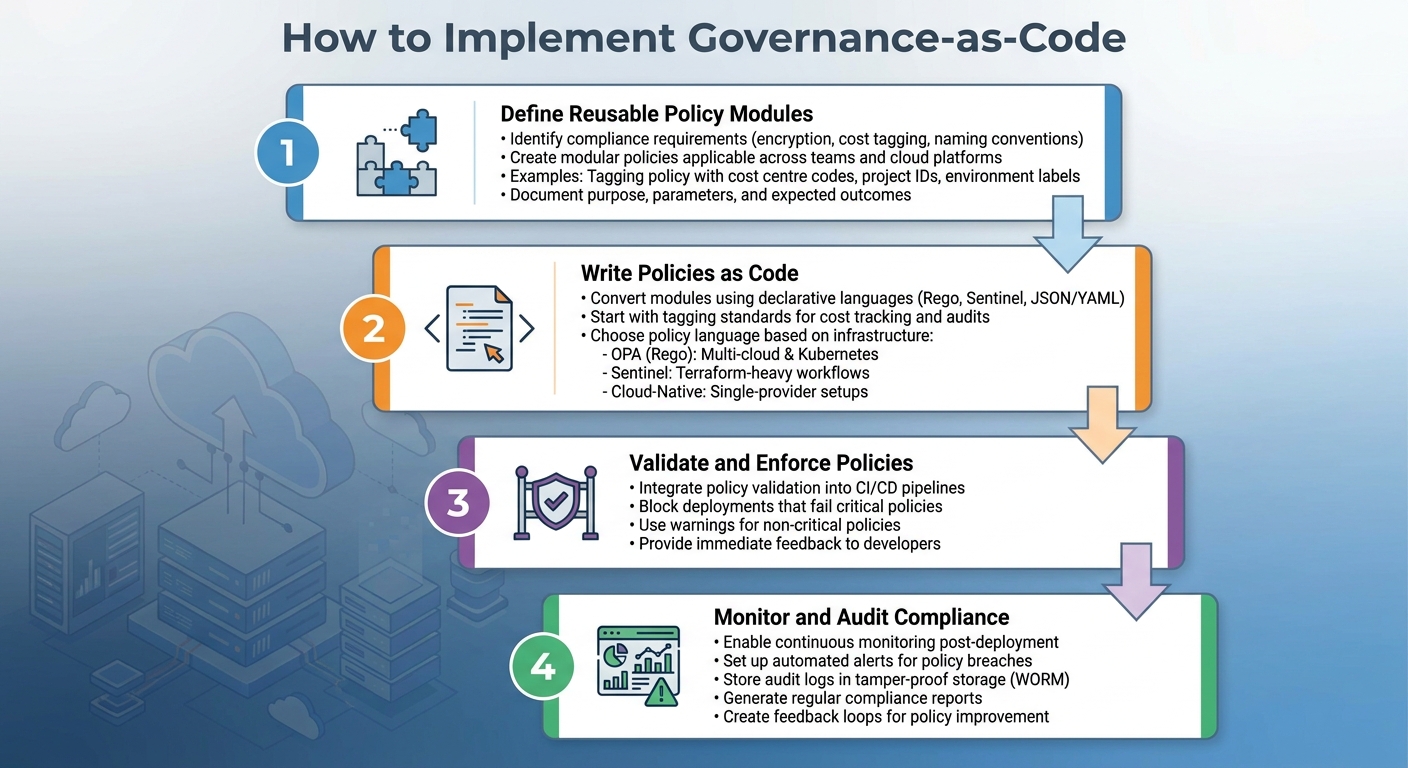 {4-Step Process for Implementing Governance-as-Code in Cloud Environments}
:::
{4-Step Process for Implementing Governance-as-Code in Cloud Environments}
:::
Implementing Governance-as-Code involves a structured, automated process that combines declarative definitions, version control, and automation. By following a series of steps - from creating reusable policy modules to continuous monitoring - you can shift compliance from a manual task to an automated safeguard. This approach builds on earlier principles to deliver scalable and consistent compliance.
Step 1: Define Reusable Policy Modules
Start by identifying the compliance requirements your organisation frequently encounters. These could include mandatory encryption, cost tagging standards, or resource naming conventions. Once identified, create policy modules that can be applied across teams and cloud platforms. For instance, a tagging policy module might enforce the use of cost centre codes, project identifiers, and environment labels on all resources. This modular approach ensures consistency across AWS, Azure, and Google Cloud deployments while saving teams from duplicating effort.
Each module should be tailored to the specific capabilities of the cloud provider. For example, a storage encryption policy might target S3 buckets in AWS, Blob Storage in Azure, or Cloud Storage in Google Cloud, but the core requirement - encryption at rest - remains the same. Document the purpose, parameters, and expected outcomes of each module to make them easy for teams to understand and implement.
Step 2: Write Policies as Code
Once policy modules are defined, convert them into code using declarative languages like Rego (for Open Policy Agent), Sentinel (for Terraform workflows), or JSON/YAML (for cloud-native tools). Start with tagging standards, as these are crucial for cost tracking, security audits, and resource management [2].
| Feature | Open Policy Agent (OPA) | HashiCorp Sentinel | Cloud-Native (AWS/Azure) |
|---|---|---|---|
| Primary Language | Rego (Declarative) | Sentinel DSL | JSON / YAML |
| Ideal Scenario | Multi-cloud & Kubernetes | Terraform-heavy | Single-provider depth |
| Integration | CI/CD, Kubernetes, APIs | Terraform Cloud | Native Cloud Tools |
| Context Access | Plan-based (JSON) | Plan, State, Config | Real-time Resource State |
Choose the policy language that aligns best with your infrastructure. For Terraform-heavy workflows, Sentinel offers deep integration. For Kubernetes or multi-cloud environments, OPA provides greater flexibility. Cloud-native tools are ideal for single-provider setups with tight integration needs.
Step 3: Validate and Enforce Policies
Incorporate policy validation into your CI/CD pipelines to catch violations before they make it to production. Configure pipelines to block deployments that fail critical policies, offering immediate feedback to developers. For less critical policies, consider a warning system that flags issues without halting deployments, allowing teams to address them over time without disrupting delivery.
Step 4: Monitor and Audit Compliance
Continuous monitoring is essential to ensure policies remain enforced after deployment. Major cloud providers offer tools for real-time compliance tracking:
| Feature | AWS | Azure | Google Cloud |
|---|---|---|---|
| Cost Visualisation | AWS Cost Explorer | Azure Cost Management | GCP Billing Reports |
| Budget Management | AWS Budgets | Azure Budgets | Budgets & Alerts |
| Compliance Tools | AWS Config Rules | Azure Policy | Cloud Asset Inventory |
| Policy Engine | CloudFormation Guard | Azure Policy | Organisation Policy |
| UK Regulatory Support | GDPR & Data Residency | GDPR & NHS Compliance | GDPR Compliance |
Set up automated alerts for policy breaches and ensure audit logs are stored securely in tamper-proof storage to meet GDPR requirements. Regular compliance reports should highlight trends, recurring violations, and areas where policies need adjustment. This creates a feedback loop that strengthens your governance approach over time.
Tools and Technologies for Governance-as-Code
Selecting tools that automate governance is key. The right approach combines preventive measures (to stop issues before deployment) with detective controls (to catch and address problems after deployment). Together, these strategies help organisations maintain compliance across their cloud environments.
Open Policy Agent (OPA)
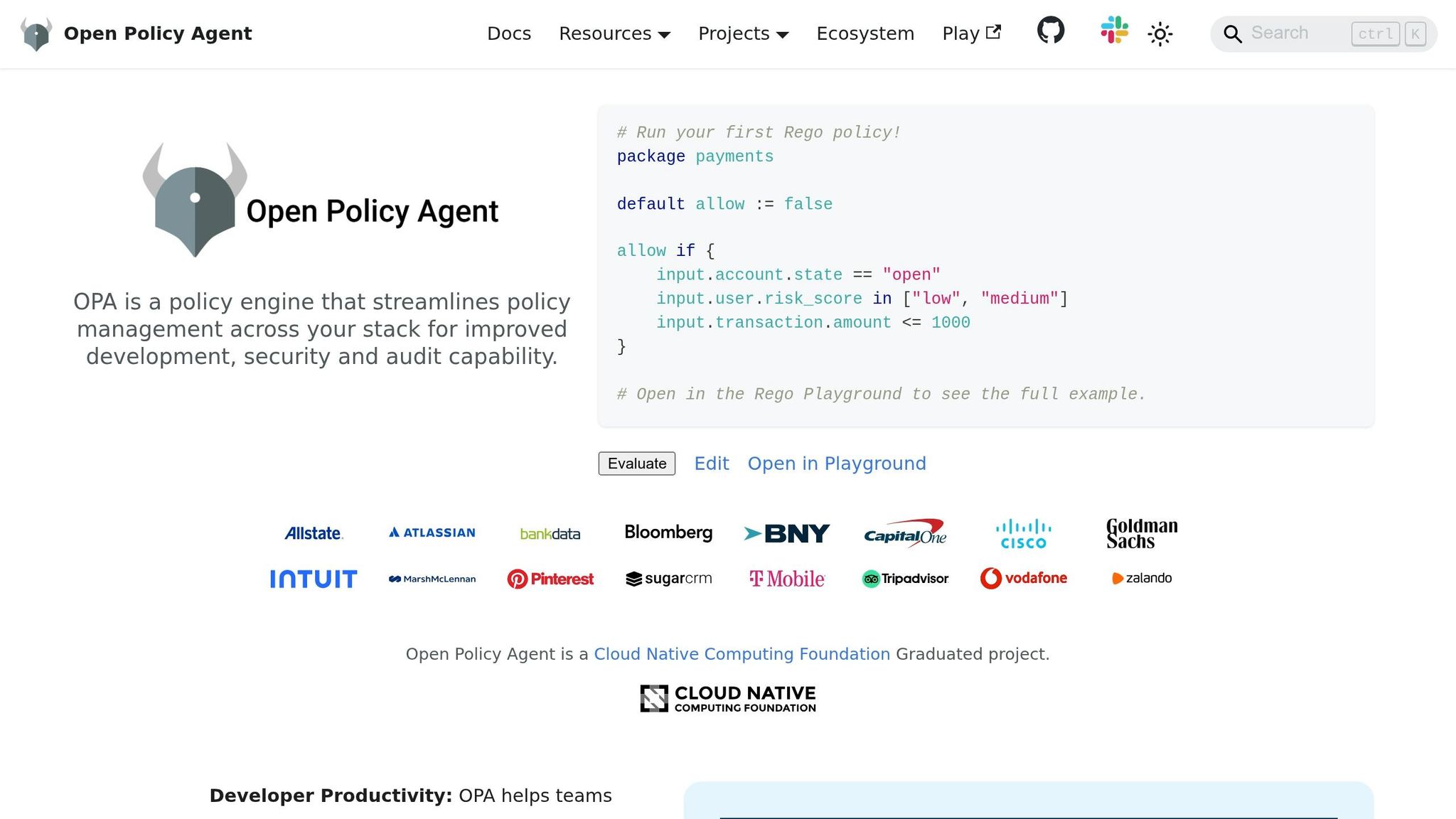
A popular starting point for Governance-as-Code is Open Policy Agent (OPA). As a CNCF Graduated project, OPA uses the declarative Rego language to evaluate JSON-based inputs and deliver policy decisions [4][8].
OPA separates policy decisions from enforcement. When your software needs to make policy decisions it queries OPA and supplies structured data (e.g., JSON) as input.- Open Policy Agent Documentation [8]
OPA shines when applied to preventive controls during CI/CD workflows. For example, you can use the terraform.parse_plan() function to validate Terraform plans directly in pull requests. Pair this with the --fail-defined flag to block non-compliant deployments by returning a non-zero exit code whenever violations are detected. This applies across major platforms like AWS, Azure, and Google Cloud [3].
Cloud-Native Compliance Tools
For platform-specific compliance, native tools like the following are highly effective:
- AWS Config Rules: Tracks configuration changes and evaluates resources against managed or custom rules.
- Azure Policy: Enforces real-time compliance with built-in definitions for standards like ISO 27001.
- GCP Policy Analyser: Part of the Security Command Centre, it offers continuous monitoring and alerting for Google Cloud environments.
These tools are ideal for single-provider setups, offering deep integration and immediate visibility into resource compliance. Some even provide automatic remediation for certain violations. However, managing policies across multiple providers can become challenging, as each platform uses its own native formats (like JSON or YAML). When combined with code-driven policies, these tools strengthen automated compliance frameworks aligned with Governance-as-Code principles.
Cloud Custodian for Multi-Cloud Governance
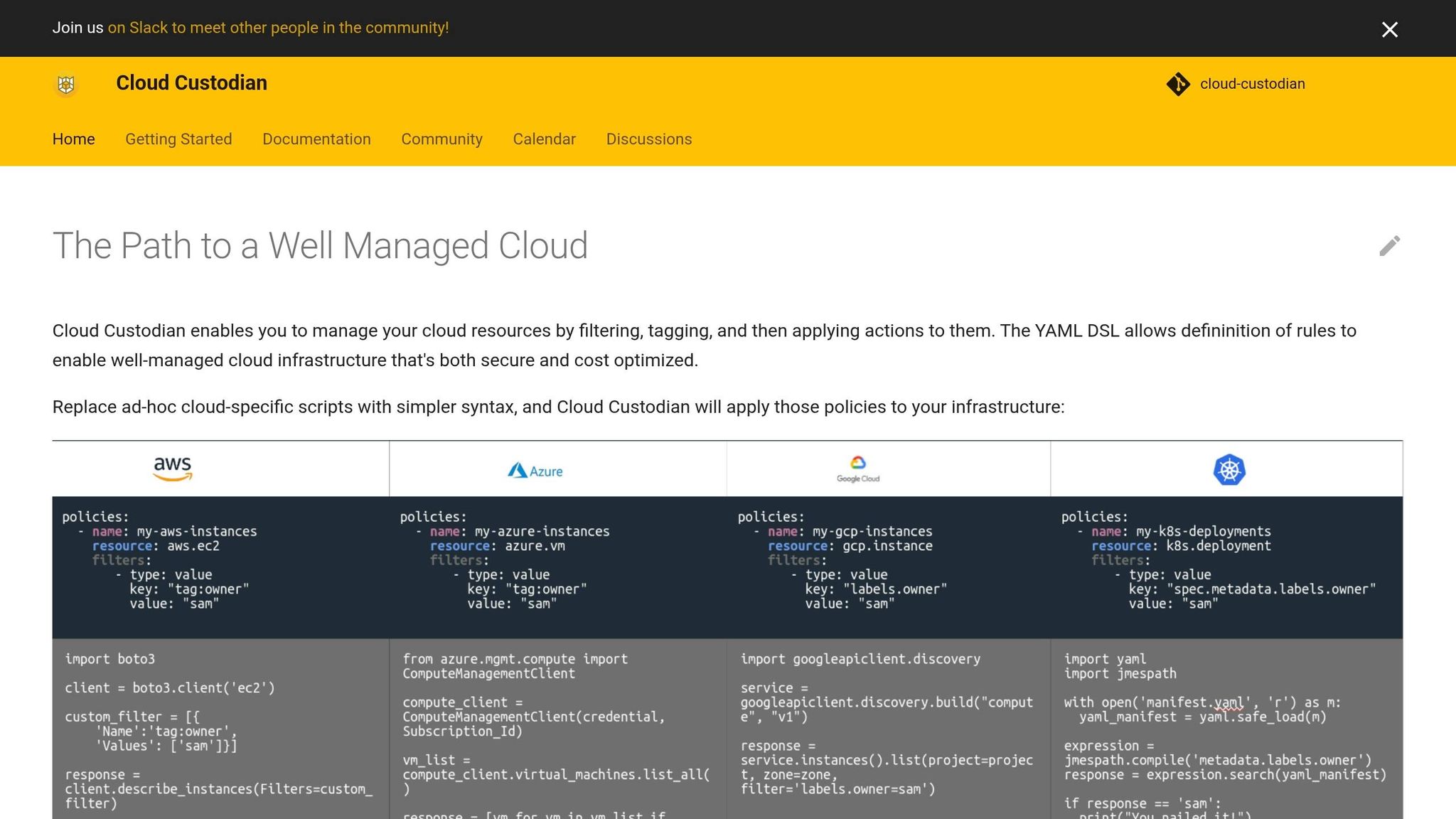
While preventive controls are essential, they aren't always enough. This is where Cloud Custodian comes in. As a CNCF Incubating project, it focuses on continuous detection and automated remediation across AWS, Azure, and Google Cloud [6]. Unlike OPA’s preventive approach, Cloud Custodian operates in real time, scanning active resources and addressing violations as they occur [7].
Cloud Custodian consolidates many of the adhoc scripts organisations have into a tool, with unified metrics and reporting.- Cloud Custodian Documentation [5]
Cloud Custodian uses a YAML-based DSL, which is simpler to adopt compared to Rego, making it easier for teams to get started. It enables actions like stopping non-compliant instances, revoking unauthorised security group rules, or ensuring cost-allocation tags are applied correctly [7]. By deploying it as serverless functions, you can automatically identify idle resources, enforce tagging standards, or optimise costs across your cloud estate.
This combination of preventive and detective tools ensures a robust, automated governance strategy that aligns with the principles of Governance-as-Code.
Benefits of Governance-as-Code
Governance-as-Code takes cloud compliance and cost management to the next level. By replacing manual reviews and reactive fixes with automated policies, it creates a proactive system that tackles issues before they grow into bigger problems. The result? A measurable impact on your business operations and outcomes.
Prevent Non-Compliant Deployments
One of the standout advantages is stopping compliance issues before they even reach production. When policy checks are built into CI/CD pipelines, developers receive immediate feedback - like identifying issues in a Terraform plan - so they can fix errors in minutes instead of days. For example, a financial services company streamlined its deployment approval process from five business days to just 15 minutes by automating governance checks[9]. This means faster delivery times without cutting corners on compliance.
Cost Optimisation and Transparency
Automated governance doesn’t just prevent compliance headaches - it also helps manage cloud costs. Policies can enforce budget limits, flag wasteful spending, and avoid expensive mistakes like provisioning oversized instances or running resources during off-hours. Real-time drift detection ensures console changes don’t bypass these cost-saving measures, keeping your cloud environment optimised over time[10]. On top of that, mandatory cost-centre tagging provides full visibility into spending, making it easier to allocate resources wisely and track every pound spent.
Better Auditability and Reporting
With immutable, version-controlled policies, Governance-as-Code makes audits far less painful. You’ll have a clear trail of enforcement history, so if an unauthorised S3 bucket comes up during an audit, you can easily reference the policy version, its enforcement, and any corrective actions taken. This level of transparency is a game-changer. In fact, 59% of organisations using compliance software report a major improvement in clarity around compliance efforts. Automated reporting also eliminates the need for weeks of manual evidence gathering - some organisations save up to five working weeks each year. As former U.S. Deputy Attorney General Paul McNulty wisely put it: If you find compliance costly, just try non-compliance!
Governance-as-Code makes staying compliant both manageable and effective.
Hokstad Consulting: Governance-as-Code Solutions
Governance-as-Code is all about aligning compliance, cost control, and DevOps workflows. Hokstad Consulting specialises in crafting automation solutions that enforce governance policies across multi-cloud setups, whether you're using AWS, Azure, GCP, or hybrid infrastructure. Their approach shifts compliance from a reactive process to a proactive, automated system. This not only safeguards your organisation but also helps cut down operational overheads. Hokstad achieves this through tailored modules focused on automation, cost auditing, and DevOps transformation.
Custom Automation for Policy Enforcement
Hokstad Consulting creates custom automation workflows that ensure governance policies are applied consistently across your cloud environment. By analysing your current deployment workflows, they identify key enforcement points and configure automated policy checks tailored to your organisation. For public cloud environments, this often involves tasks like resource tagging, instance sizing, and meeting regional compliance requirements. In private or hybrid clouds, the focus shifts to on-premises integration, data residency, and maintaining cross-platform consistency. They advocate for a monitor-first
approach, where new policies are initially deployed in audit mode. This allows teams to evaluate their impact before moving to strict enforcement, avoiding unnecessary bottlenecks and building confidence in the process.
Cloud Cost Audits and Optimisation
Hokstad Consulting complements automated compliance with detailed cost audits to uncover unnecessary spending and enhance efficiency. They establish a baseline for your cloud expenses, identify areas for improvement, and implement Governance-as-Code solutions to address these gaps. Their cloud cost engineering approach focuses on tracking resource usage, eliminating idle resources, rightsizing, and optimising reserved capacity. This typically results in 30–50% cost savings by enforcing policies that prevent over-provisioning and ensure proper cost allocation. Their audit reports break down spending by department, service, and resource type, while real-time dashboards keep you informed about spending patterns and potential policy breaches, ensuring every penny is accounted for.
DevOps Transformation and Continuous Compliance
Hokstad Consulting also integrates Governance-as-Code into your DevOps workflows, embedding automated policy checks at every stage of deployment. By tailoring policy validation to fit your specific processes, they ensure compliance is addressed before deployment, not after. Their services include setting up automated policy evaluations using tools like Open Policy Agent (OPA) and Cloud Custodian, establishing feedback loops for policy violations, and designing policies that fail safely with clear exceptions. They also introduce policy champions
- team members who bridge the gap between compliance and engineering. These champions translate compliance needs into actionable technical solutions, fostering collaboration between finance, compliance, and engineering teams. This ensures security and compliance are maintained without slowing down innovation or deployment speed.
Conclusion
Governance-as-Code brings a proactive approach to cloud compliance. By treating policies as executable code instead of static documents, organisations can enforce compliance in seconds while maintaining transparency through version control. This method offers clear advantages: stopping non-compliant deployments before they happen, cutting cloud costs by 30–50%, and providing audit trails that align with regulatory requirements.
Key Takeaways
The move to Governance-as-Code is built on three main ideas: using declarative policy definitions, implementing strict version control, and ensuring continuous enforcement. To adopt this approach, focus on:
- Defining reusable policy modules
- Writing policies as code
- Validating policies within your CI/CD pipeline
- Continuously monitoring compliance
Unlike Infrastructure-as-Code (IaC), Governance-as-Code focuses on controlling what can be built, setting clear boundaries for compliance.
Next Steps for Businesses
To streamline compliance and save costs, consider integrating Governance-as-Code into your operations. If your current system relies on manual reviews, spreadsheets, or post-deployment checks, you're likely facing delays, inconsistencies, and higher expenses. Start with a monitor-first strategy - use policies in audit mode initially to gauge their impact without disrupting workflows. This approach builds team confidence and ensures a smoother transition to automated controls.
Hokstad Consulting offers tailored solutions to help businesses implement Governance-as-Code seamlessly. Their services include custom automation for policy enforcement, detailed cloud cost audits to highlight savings, and DevOps transformation strategies that embed compliance checks at every stage of deployment. Whether you're working with AWS, Azure, GCP, or a hybrid setup, their expertise ensures compliance becomes a seamless part of your operations. Learn more at hokstadconsulting.com to see how automated governance can cut costs while maintaining continuous compliance.
FAQs
What’s the difference between Governance-as-Code and Infrastructure-as-Code?
Governance-as-Code (GaC) and Infrastructure-as-Code (IaC) are closely connected but serve different purposes. GaC involves automating governance policies - such as security protocols, compliance requirements, and cost management - through version-controlled code. This ensures these policies are consistently applied during deployments. In contrast, IaC is about automating the setup of infrastructure, like virtual machines or networks. Essentially, IaC handles the creation of infrastructure, while GaC ensures that this infrastructure aligns with organisational guidelines. Together, they work hand in hand to streamline and secure deployment processes.
Where should policy checks run in a CI/CD pipeline?
Policy checks should be built directly into the CI/CD pipeline. This ensures that misconfigurations are caught early, compliance is maintained continuously, and governance processes become automated. By doing so, organisations can uphold consistent cloud standards while minimising the chances of expensive mistakes.
How do you handle exceptions without breaking deployments?
When managing exceptions in Governance-as-Code, soft-fail policies are a handy approach. These policies highlight issues without halting deployments, giving teams the chance to address violations while keeping workflows running smoothly.
Tools such as Terraform, Open Policy Agent (OPA), and Cloud Custodian can be used to embed policies that either warn about or block non-compliance. A good strategy is to begin with more lenient rules and gradually tighten enforcement. This helps prevent unexpected interruptions while ensuring compliance evolves over time.