
Cloud waste is still huge: many firms lose 30–35% of spend on idle or oversized resources, even as global cloud spend passed $1 trillion in 2026. My view is simple: FinOps-as-Code helps by moving cost checks into the same Git, IaC and CI/CD flow that engineers already use, so bad spend is caught before deployment, not after the bill arrives.
If I had to sum up the article in a few lines, it would be this:
- FinOps joins finance, engineering and business around cloud spend.
- FinOps-as-Code turns budgets, tagging rules and usage limits into version-controlled policy.
- It shifts cost control from monthly review to pull request checks, pipeline gates and runtime rules.
- It works best with a Crawl-Walk-Run rollout: visibility first, then warnings, then hard blocks.
- It depends on clear ownership, clean tagging, low false positives, and a simple override path for valid cases.
- It is most useful where spend can jump fast, such as AI and GPU workloads.
What stood out to me is that this is not about adding more finance paperwork. It is about making cost policy part of delivery work. Tools like Infracost, OPA/Gatekeeper and Conftest can show a cost delta in a PR, block untagged resources, and stop banned instance types from being deployed. That gives teams feedback in minutes instead of weeks.
A few numbers make the point clear:
- One cited case saw a £4,000 overnight storage spike from one unreviewed release.
- After pipeline guardrails and tag checks, that team cut surprise spend by 75%.
- Scheduling shutdowns for non-production systems can cut compute costs by up to 65%.
Here’s the core idea in one quick view:
| Area | What changes with FinOps-as-Code |
|---|---|
| Cost checks | Move from after-the-fact reports to pre-merge review |
| Policy | Moves from documents and spreadsheets to code in Git |
| Enforcement | Moves from manual review to CI/CD and runtime controls |
| Team workflow | Engineers see spend impact during code review |
| Governance | Finance sets budgets, platform teams wire controls, app teams act on feedback |
In short: if cloud infrastructure is created in code, cloud cost control should sit in code too. That is the thread running through the whole article.
::: @figure 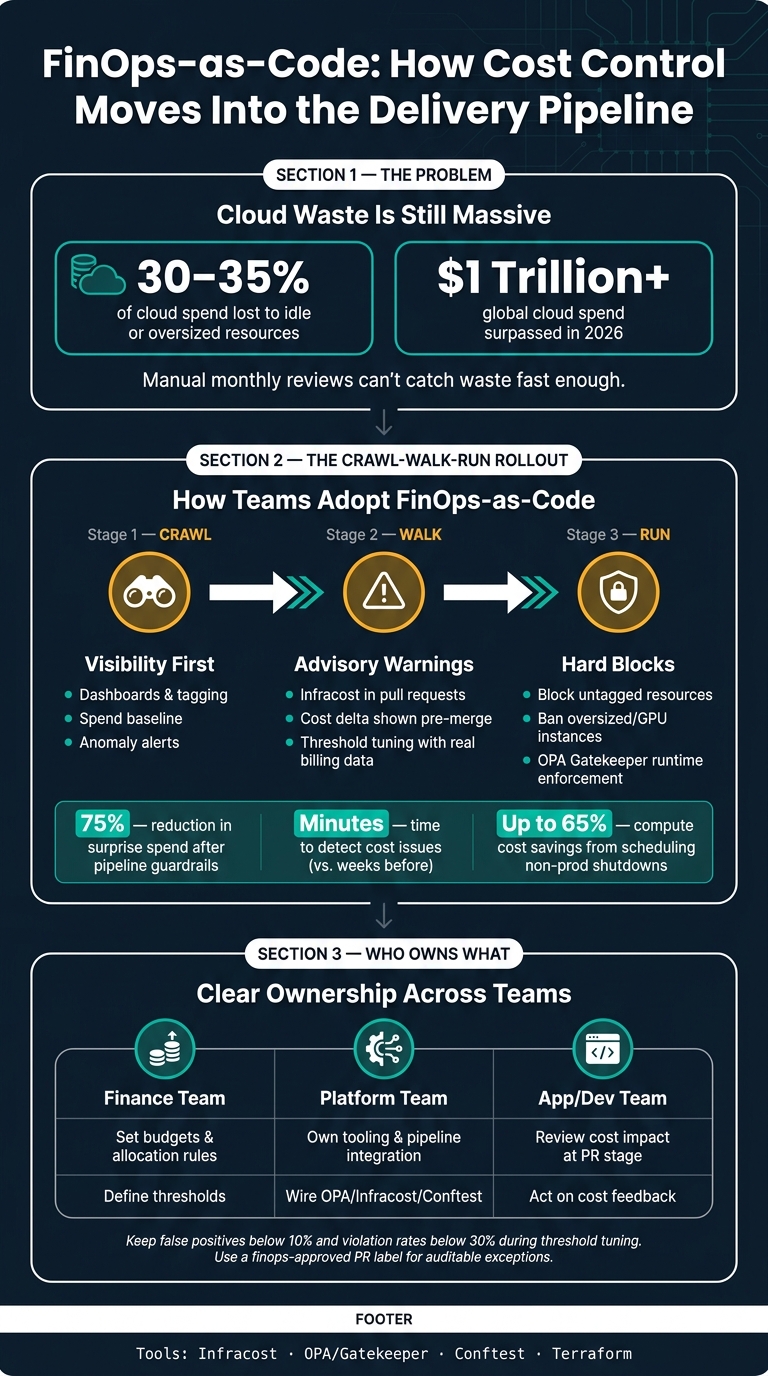 {FinOps-as-Code: From Pull Request to Cost Control}
:::
{FinOps-as-Code: From Pull Request to Cost Control}
:::
Preventing Waste by Design: Shift Left and Runtime FinOps Governance
Need help optimizing your cloud costs?
Get expert advice on how to reduce your cloud expenses without sacrificing performance.
What research shows about policy-driven cloud cost control
Manual checks just can’t keep up. That’s why research points to policy-driven controls that run before deployment. The shift matters: teams now treat cost policy as part of delivery, not something they look at later in a report. Research also shows FinOps now sits more often in CTO/CIO teams than in finance, which makes cost control an engineering job, not a finance-only process [1].
From after-the-fact cost reporting to pre-deployment checks
Pre-merge validation helps teams catch infrastructure changes before they hit production. Tools like Infracost add a monthly cost estimate straight into a pull request, so engineers can see the financial effect of a change right away.
Flexera reports that one unreviewed release caused a £4,000 overnight storage spike. After adding cost guardrails and tag validation to the pipeline, the team cut unexpected spend by 75% and reduced detection time from weeks to minutes [2].
A lot of teams begin with advisory warnings in pull requests. Later, they move to blocking gates that stop a merge when a budget threshold is crossed. That sounds simple, but the hard part is tuning the rules. If they’re too weak, people ignore them. If they’re too strict, delivery slows down and teams start looking for ways around them. From there, the next move is clear: turn those checks into rules that apply across budgets, pipelines and runtime controls.
Where FinOps-as-Code fits in cloud governance maturity models
In FinOps Foundation terms, FaC sits in Operate: policies are version-controlled, tested and enforced in pipelines [7].
| FinOps Phase | Focus | How governance works |
|---|---|---|
| Inform | Visibility and allocation | Dashboards, tagging, anomaly alerts |
| Optimise | Reducing waste | Right-sizing, rate optimisation, spot usage |
| Operate | Automated enforcement | Policy-as-code, CI/CD gates, continuous feedback |
Most teams follow a simple path. They start with visibility, move to advisory warnings, and then add hard blocks once thresholds have settled and teams know how the rules work. That maturity path leads straight into the way teams codify budgets, guardrails and allocation rules.
How FinOps-as-Code simplifies day-to-day governance
At this point, FinOps-as-Code turns policy into day-to-day delivery controls. Governance moves from simple visibility to repeatable checks built into delivery pipelines.
Codifying budgets, guardrails and allocation rules
A mandatory tagging schema sets out four required tags: team, environment, service, and cost-center [4]. Budget thresholds sit next to infrastructure code in Git, so every change goes through a pull request and leaves a clear record of what was approved and when [5].
Guardrails follow the same pattern. Rules that block GPU instances in developer sandboxes or stop oversized SKUs are written once and then applied everywhere. Engineers don't have to keep these rules in their heads because the pipeline checks them for them.
Using pipelines and runtime controls to enforce cost policies
Those written rules matter only if pipelines apply them on their own. Infracost parses a Terraform plan and posts a monthly cost delta straight into the pull request, which means the cost impact shows up during code review, not weeks later [1]. Pipelines can also block a merge if a proposed change would push monthly spend past a set threshold or if resources are missing required tags [1].
Runtime controls take this a step further. OPA Gatekeeper works as an admission controller in Kubernetes, rejecting pods that go beyond resource limits or do not include mandatory labels [8]. Manual audits tend to miss this sort of change.
Another simple control is scheduling shutdowns for non-production environments. Research suggests this can cut compute costs by up to 65% [4]. When that schedule is written into code, it runs on time and every time, without relying on someone to remember to switch things off on a Friday afternoon.
Building continuous feedback between finance, engineering and operations
Once controls are automated, the main task is keeping finance, engineering and operations lined up on thresholds and responses. Automated notifications can be sent into Slack or Jira when spend gets close to a monthly threshold or when an anomaly is detected [4][5][6]. Cost signals sit alongside deployment and operational alerts, so teams see them while they can still do something about them.
Developers get cost signals within minutes during code review instead of weeks later through a bill [1][6]. Finance teams get more confidence that spend is being checked all the time, not only reviewed at month-end.
Implementation patterns, operating model and policy maintenance
A reference architecture for a workable FinOps-as-Code setup
Once policy is set, the next job is to make it run inside day-to-day delivery work. That usually means keeping policy in Git, running checks in CI/CD, and feeding billing data back into threshold tuning.
A common setup uses Terraform or account-level policies to enforce mandatory tags at provisioning time, Infracost to show cost deltas in pull requests, and OPA/Rego or Conftest to test policy rules in the pipeline [1].
Research points to a Crawl-Walk-Run rollout instead of a big-bang launch [1][4][5]. At the start, teams focus on visibility and building a spend baseline. Then they add advisory warnings in pull requests. After thresholds have been tuned using actual billing and usage data, high-confidence violations can move to hard blocks for issues like untagged resources or banned instance types [1][5]. This is especially important for AI and GPU workloads, where one instance can push spend up fast.
Team ownership, change control and policy maintenance
Tooling helps, but ownership matters more. Platform teams usually own the tooling and pipeline integration. Finance sets budgets and allocation rules. Application teams check cost impact during code review [1][3]. A central Cloud Centre of Excellence can set the broader governance model and handle rate negotiations such as Reserved Instances or Savings Plans.
The main failure points are pretty simple:
- Too many overlapping policies
- Rules that are so strict they slow work down
- False positives that make people stop paying attention
If policies fire too often for the wrong reasons, developers stop trusting them. A sensible target is to keep false positives below 10% and violation rates below 30% while thresholds are being tuned [1]. For valid exceptions, such as reproducing a production bug, a finops-approved PR label gives teams an auditable override without turning into a permanent back door [1][3]. Keeping policy changes in pull requests also leaves a clear audit trail showing what changed and why.
Where Hokstad Consulting can help
Teams that do not yet have this operating model often need hands-on support. Hokstad Consulting can help design policies, wire them into CI/CD, and set up auditable exception workflows and baseline cost audits.
Benefits, limits and conclusion
Reported benefits and common trade-offs
Once policies sit in Git and run through pipelines, the main question is simple: what changes day to day? The pattern in the evidence is fairly clear. FinOps-as-Code helps cut surprise cloud spend when cost checks happen inside the delivery pipeline.
| Area | Benefit | Trade-off |
|---|---|---|
| Cost savings | Earlier cost feedback and fewer unexpected overruns | Savings still depend on reliable tagging and billing data |
| Operational overhead | Automation reduces manual review, but rules need periodic tuning | Policies need regular review to avoid alert fatigue |
| Engineering impact | Cost checks arrive at pull-request stage | Teams need IaC and OPA skills |
| Governance robustness | Version-controlled rules improve consistency | Weak enforcement can lead to inconsistent or stale tagging |
| Delivery velocity | Hard blocks slow releases unless exceptions are clear | Hard blocks can slow releases if exception workflows are unclear |
That said, this isn't magic. The gains only hold up when teams keep reviewing policies and make exception routes easy to follow. If that part is fuzzy, people start working around the process, and the whole thing gets messy fast.
There’s also the human side. Cultural resistance still gets in the way. Treating cost with the same seriousness as uptime and latency doesn’t happen overnight.
Conclusion: FinOps-as-Code makes cloud cost control more consistent
FinOps-as-Code works because it moves the money discussion to the moment decisions are made - the pull request - not weeks later, when the spend has already landed.
The best results come when policy, pipelines and budget owners line up. In practice, that means budgets stored in Git alongside infrastructure code [5], guardrails enforced in pipelines, and clear ownership shared between finance and engineering. For UK organisations dealing with growing cloud estates - especially AI and GPU-heavy estates - the argument for this approach is strong [4]. A sensible way in is to start with advisory warnings, tune thresholds using actual billing data, and move to hard blocks only when teams trust the rules.
FAQs
How is FinOps-as-Code different from regular FinOps?
FinOps-as-Code stands apart because it takes a proactive, automation-led approach to cloud cost control.
Traditional FinOps often depends on reviews, dashboards, and manual audits after resources have already been deployed. By that point, teams are often looking backwards.
FinOps-as-Code shifts that work earlier. It builds cost policies straight into development and deployment pipelines, so teams can spot waste sooner, apply rules automatically, and stop overspending before resources are provisioned.
When should teams use warnings instead of hard blocks?
Teams should use warnings instead of hard blocks when they need to fine-tune policy thresholds, collect data from day-to-day use, and avoid slowing down development work.
This works well during early policy calibration, when teams are still seeing how rules behave in practice. It also makes sense when policies are there to guide people, not strictly police every action.
What needs to be in place before adopting FinOps-as-Code?
Before adopting FinOps-as-Code, organisations need clear, measurable cloud cost governance policies and automation practices. That means setting machine-readable rules for tagging, spending thresholds, and approval workflows.
They also need a few practical pieces in place:
- automated tagging
- pre-deployment validation
- continuous monitoring
- collaboration between finance, DevOps, and compliance teams
Policy code should live in Git and plug into CI/CD pipelines, so teams can check cost rules as part of normal delivery work. Cost insights should also be available during planning, not just after resources have already been deployed.