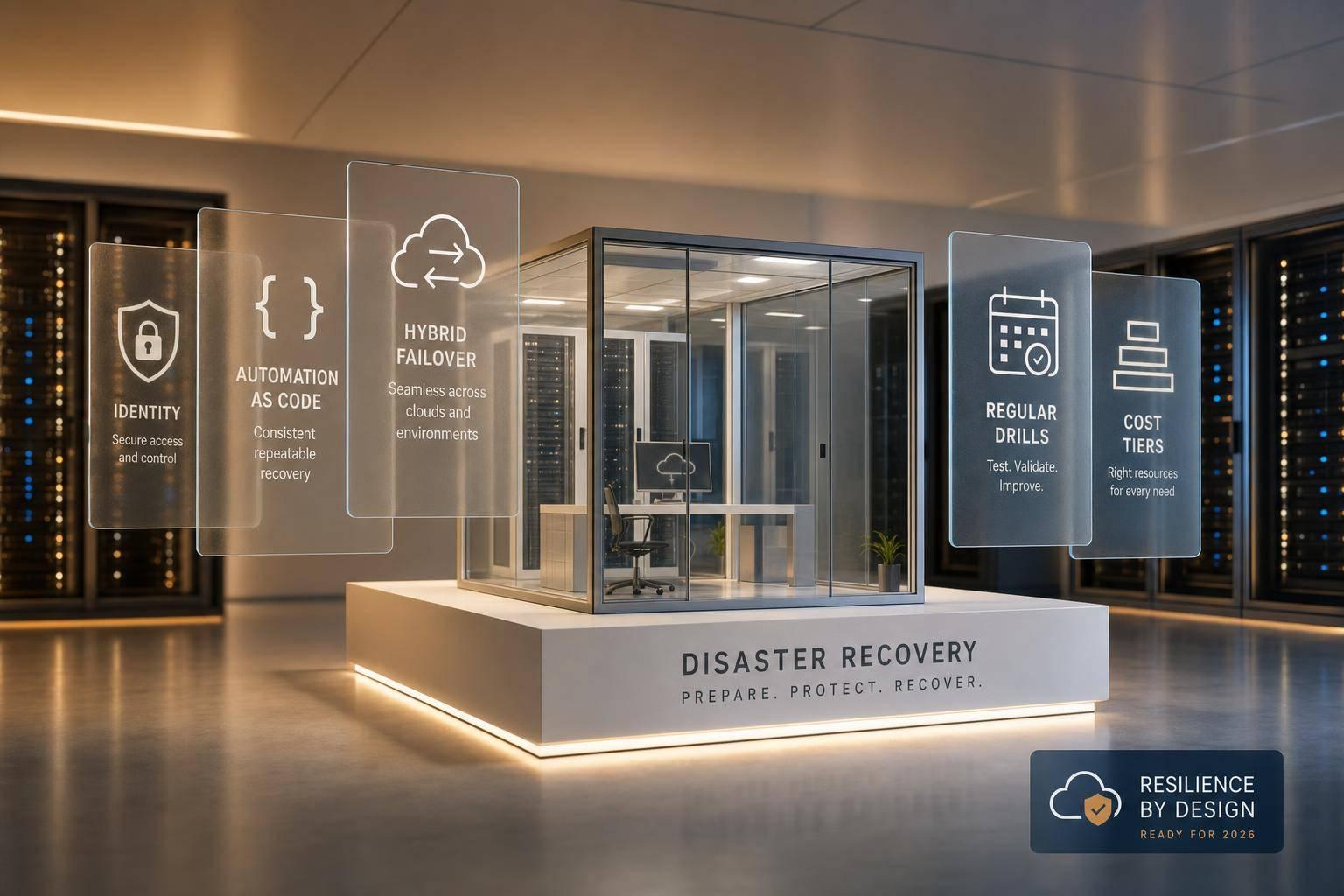
Hybrid cloud DR in 2026 is about restoring business service, not just servers. From what I can see, the pattern is clear: UK firms are using hybrid and multicloud DR more often, writing recovery steps into code, testing more often, designing for ransomware, and watching DR cost much more closely.
If you want the short version, here it is:
- Hybrid and multicloud DR is now common for many enterprise estates.
- Identity comes first. If users cannot sign in, restored apps still do not help.
- Automation is replacing PDF runbooks with Terraform, Ansible, and policy-led workflows.
- Ransomware has changed recovery design. Only 28% of ransomware-hit firms fully recovered data, and 41% of data is typically hit in a cyberattack.
- Testing is getting stricter: weekly micro-drills, quarterly tabletop exercises, six-monthly failover drills, and annual full restores.
- Cost is now tracked in £, not vague risk language. Unplanned cloud downtime costs UK firms about £4,700 per minute, and many lose more than £240,000 per hour.
- Tiering matters. The top recovery pattern should usually cover under 10% of workloads, with the rest matched to business need.
A few numbers tell the story fast: 77% of UK organisations reported at least one cyber incident or attack in the past 12 months, and Monzo said it shifted payment and transfer traffic to its backup platform in 15 seconds during an AWS outage.
| Area | What changed in 2026 |
|---|---|
| Architecture | More hybrid and provider-diverse DR setups |
| Recovery focus | From data-first to identity-and-service-first |
| Execution | From manual steps to DR-as-code |
| Cyber recovery | More immutable backups and isolated clean rooms |
| Testing | More frequent drills tied to engineering workflows |
| Cost model | Less idle kit, more usage-based spend |
My take: the biggest gap is not DR intent. It is whether firms can prove recovery targets under test, with clean data, working identity, and business services that staff and customers can use.
That is the lens I’d use for the rest of this article.
Cloud Repatriation Strategy, Economics, and the Future of Hybrid IT
Key hybrid cloud disaster recovery trends in 2026
::: @figure 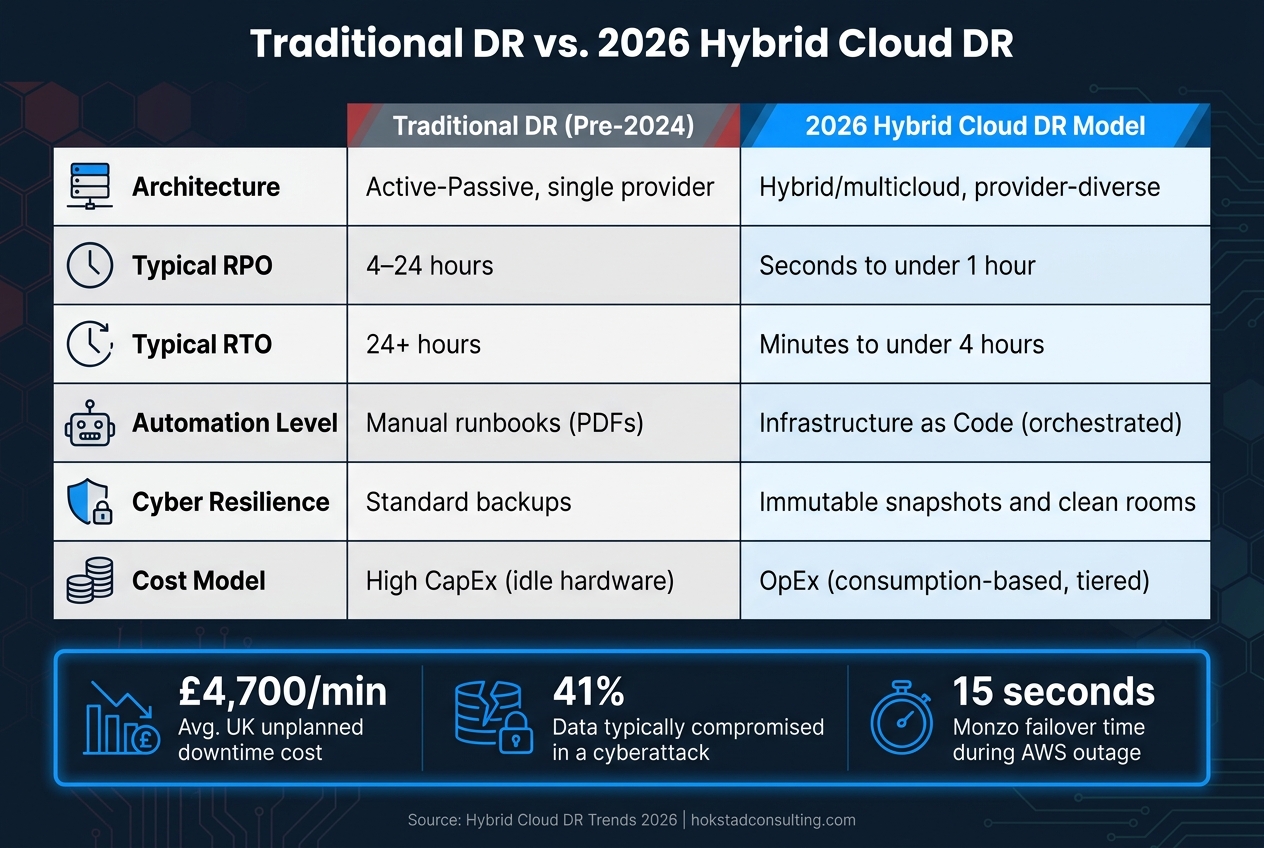 {Traditional DR vs. 2026 Hybrid Cloud DR: Key Differences}
:::
{Traditional DR vs. 2026 Hybrid Cloud DR: Key Differences}
:::
Hybrid and multicloud DR as the default enterprise pattern
Hybrid and multicloud DR is no longer a niche setup. For most enterprises, it's now the standard pattern.
Across financial services, SaaS and e-commerce, organisations are mixing private infrastructure with public cloud services to spread risk. The reason is simple: downtime is expensive. Unplanned cloud downtime costs UK enterprises an average of £4,700 per minute [5].
The main focus is now on the systems that hurt most when they go down: mission-critical applications, identity infrastructure, payment processing and customer-facing e-commerce platforms. These are usually protected with Active-Active or Warm Standby designs [2][5].
Identity systems have moved to the front of the queue. That’s a big shift. Recovery used to centre on data. Now it centres on how fast a service can be made usable again. If identity isn’t back, restored apps are still locked up and useless.
That dependency is pushing teams towards policy-based orchestration.
Automation, DR-as-code and policy-driven orchestration
Manual runbooks are being replaced by declarative orchestration built in Terraform and Ansible. What matters now is consistency and a clear audit trail, especially under DORA [7].
Policy as code pushes this a step further. Teams are writing RPO and RTO rules directly into testable modules. That means compliance can be checked automatically after recovery instead of being signed off by hand [3][6].
Testing has changed too. Rather than relying on occasional checks, teams are running weekly automated drills and quarterly full-path restores inside CI/CD pipelines [3][6].
That move towards automation also gives firms a stronger base for cyber-resilient recovery.
Cyber-resilient recovery, AI-assisted operations and cost-aware design
Three forces are shaping DR design in 2026.
First, ransomware has changed the meaning of “protected”. Research shows that 41% of data is typically compromised in a cyberattack, with 57% recoverable on average [2]. That’s why clean-room recovery is gaining ground. Data is restored into a fully isolated environment, where AI-powered tools scan for indicators of compromise before anything reconnects to production [7].
Second, AI is now being used to spot anomalies, review telemetry and trigger self-healing before failover is needed [7][3]. In plain terms, teams are trying to fix problems before they turn into an outage.
Third, cost control is shaping architecture decisions. Organisations are moving away from idle secondary data centres and towards tiered, usage-based models that keep recovery capacity in place without heavy upfront capital spend [2]. The result is lower idle capacity cost without weakening recovery targets.
The table below shows how the 2026 model differs from pre-2024 practice [3][6][7].
| Feature | Traditional DR (Pre-2024) | 2026 Hybrid DR Model |
|---|---|---|
| Architecture | Active-Passive, single provider | Hybrid/multicloud, provider-diverse |
| Typical RPO | 4–24 hours | Seconds to under 1 hour |
| Typical RTO | 24+ hours | Minutes to under 4 hours |
| Automation level | Manual runbooks (PDFs) | Infrastructure as Code (orchestrated) |
| Cyber resilience | Standard backups | Immutable snapshots and clean rooms |
| Cost model | High CapEx (idle hardware) | OpEx (consumption-based, tiered) |
These choices are changing how private and public clouds split recovery duties.
Design choices for private cloud, high availability and testing
Recovery patterns across private cloud and public cloud
The main decision is simple: which workloads need the strongest recovery setup, and which can live with a simpler fallback path?
A practical rule is to keep Tier 0 active-active to under 10% of workloads so engineering capacity is not overstretched [4]. That matters because active-active sounds great on paper, but it takes serious effort to build, run and test. For everything else, the recovery pattern should match business criticality. Start with identity, access and payment services. Bring back the rest of the estate after that.
Monzo Bank gives a useful example. In March 2025, it published details of its Stand-in
platform - an independent system built on Google Cloud that mirrors 18 core services from its primary AWS environment. During an AWS outage in August 2024, Monzo shifted card payment and transfer traffic to Stand-in in 15 seconds, with no customer disruption [4]. That is isolated failover in action: the recovery target stays separate from faults in the main platform. Put plainly, Tier 0 services can justify the most expensive pattern. Lower tiers usually cannot.
| Recovery Pattern | RPO | RTO | Cost | Best suited for |
|---|---|---|---|---|
| Active-Active | Near-zero | Seconds | Highest | Tier 0: mission-critical services such as payment authentication |
| Warm Standby | Seconds to minutes | Minutes | High | Tier 1: business-critical services such as e-commerce |
| Pilot Light | Tens of minutes | Tens of minutes | Medium | Tier 2: operational systems such as ERP and CRM |
| Backup & Restore | Hours to days | Hours to days | Lowest | Tier 3: admin, archive and dev/test workloads |
These tiered patterns only work if recovery times are tested in practice, not guessed at from a design document.
RPO, RTO and continuous DR testing
Once the pattern is chosen, the next step is obvious: do the drills hit the target or not?
In 2026, RPO and RTO are engineering targets, not policy statements. Recovery Time Achieved (RTA) - what happens during a drill - often differs from the Recovery Time Objective written on paper. The pattern sets the target. Testing shows whether the target holds up under pressure.
RS2 Smart Processing completed a full cross-region failover and failback drill, proving seconds-class RPO and audit-ready recovery [4].
Testing is also getting more disciplined. It now sits inside the same orchestration model that handles deployment and change. Six-monthly technical failover drills and annual full restoration tests sit alongside the automated weekly micro-drills and quarterly tabletop exercises already embedded in CI/CD pipelines [3][6].
| Testing Type | Frequency (2026 trend) | Primary objective |
|---|---|---|
| Automated micro-drills | Weekly | Validate specific service failover within CI/CD |
| Tabletop exercise | Quarterly | Clarify stakeholder roles and expose documentation gaps |
| Technical failover drill | Six-monthly | Measure RTA against RTO for critical tiers |
| Full restoration test | Annually | Validate end-to-end business processes and collect audit evidence |
Teams are also using synthetic workloads and event replay to prove data integrity and business impact, not just server availability [3][6]. That point matters. A green dashboard can look reassuring, but it does not prove that recovery worked in any business sense. Auditors and business stakeholders need to see that gap clearly.
Cost and operating model impact for UK organisations
With recovery patterns and testing in place, the next issue is simple: who funds DR, and who runs it?
Cost control and DR tiering by workload
DR spend should match workload criticality. It shouldn't be forced into one company-wide standard.
Research shows that 90% of mid-size and large UK enterprises lose more than £240,000 per hour during unplanned downtime, and 41% lose between £800,000 and £4 million per hour [4]. That kind of loss makes a strong case for serious DR investment at the top end. But it only makes sense for the workloads that need that level of cover. Keeping Tier A to no more than 10% of production workloads helps teams focus engineering time and budget where the risk is highest [4].
There's another issue here: cost drift. Overprovisioned resources or orphaned assets left behind after tests or failover can quietly push DR spend up between drills [1]. That's one reason more teams are moving to consumption-based (OpEx) DR models, where capacity scales up during a recovery event instead of sitting idle all year [2].
The table below links workload tiers to realistic cost expectations for UK organisations in 2026 [4]:
| Tier | Typical Use Case | Approx. Monthly Cost (per server) |
|---|---|---|
| Tier A | Mission-critical (e.g., payments, safety) | £500+ |
| Tier B | Business-critical (e.g., CRM, ERP) | £40–£100 |
| Tier C | Administrative (e.g., archives, dev/test) | £5–£20 |
Once those tiers are in place, ownership usually moves away from a vague shared model and into platform engineering.
DevOps, platform engineering and internal ownership of DR
In 2026, DR is more often owned by platform engineering and tested like a product, with recovery rehearsals built directly into release pipelines [3][6].
That changes the day-to-day model. Release pipelines, observability, and policy-as-code now check whether systems are recoverable, not just whether they deploy cleanly [3][6]. Put plainly, DR works better when someone clearly owns it. If it sits awkwardly between infrastructure, security, and application teams, things tend to get missed.
Where specialist consulting adds value
External specialists tend to help most when internal teams need a baseline cost review, recovery automation, or migration planning.
Hokstad Consulting fits where teams need cloud cost audits, DR automation, or migration support to define a realistic recovery baseline.
Conclusion and future research directions
The 2026 evidence points in one clear direction: hybrid DR is now an operating model, not a fallback plan. Set against the patterns, testing methods and cost models above, three points stand out. Architectures now span more than one environment as a matter of course, and recovery plans are more often codified, which cuts drift and makes execution more repeatable [3][7][6]. Cyber-resilient recovery now sits at the centre of DR strategy: recovery starts with identity, then critical services, and only then data [2]. AI now helps with detection and root-cause analysis, but it still plays a support role rather than acting on its own [3][7]. At the same time, cost governance is shaping architecture choices in a direct way, with consumption-based models and workload tiering keeping DR spend in line with risk [2][4].
What’s left is less about whether DR is changing and more about where the evidence is still thin. That shifts the next set of questions from theory to day-to-day practice.
Three gaps still stand out: limited long-term evidence on AI-led recovery, uneven cost data, and weak UK data on measured Recovery Time Achieved versus stated RTO. Current models also understate recurring costs, including cross-region data egress, capacity reservations in recovery regions, and the 0.25–0.5 FTE often needed per workload to keep runbooks aligned with production [4].
Future research should measure actual failover performance, hidden recovery costs, and the dependability of AI-assisted recovery under live incident conditions.
FAQs
How do I choose which workloads need active-active DR?
Choose active-active disaster recovery only for mission-critical workloads where you need near-zero downtime, zero RPO, and no manual intervention.
Match the setup to the business impact of each workload. Keep active-active for globally distributed transactional systems, where even a brief outage can hit users and revenue straight away. For most other Tier-1 customer-facing services, warm standby gives you a better balance between recovery speed and cost.
What should we test first to prove recovery works?
Start by listing your applications, databases, and infrastructure across both on-premises and cloud setups. Then map how users move through those systems and note the dependencies between them. After that, sort each item by business impact and set RTO and RPO for every tier.
For the first test, run a hybrid rehearsal with one service that customers don’t see. Check that you can complete an end-to-end restore within your stated SLA, from failover through to a confirmed green state.
How can we control hybrid cloud DR costs without weakening resilience?
Align your architecture with the business impact of each workload. One recovery target for every system sounds neat on paper, but it usually wastes money and effort. A customer payment platform and an internal archive don’t carry the same operational risk or financial exposure, so they shouldn’t be treated the same way.
Tier services based on what happens if they go down. For lower-tier workloads, use lower-cost setups like Pilot Light or Warm Standby. Keep Active-Active for mission-critical systems where downtime can hit revenue, service, or trust hard.
There’s also a cost control angle that’s easy to miss. Use tiered storage, automate data lifecycle rules, and tidy up properly after recovery drills. If you don’t, orphaned resources and overprovisioned capacity can quietly pile up and push costs higher than expected.