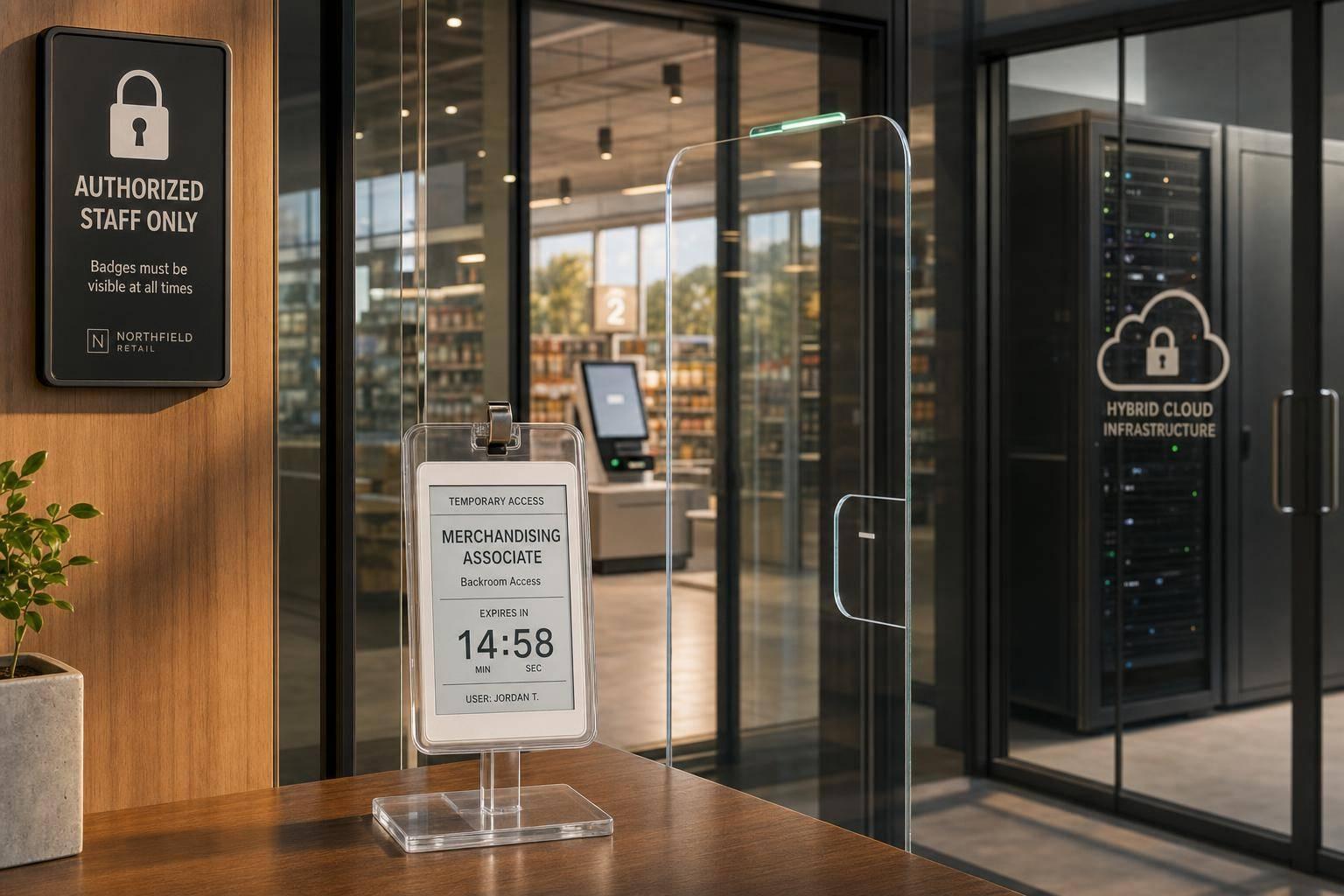
Most identity incidents start with weak access control. In hybrid retail, where on-premises systems and public cloud services work side by side, IAM policy needs to cover staff, contractors, suppliers, service accounts and AI agents in one clear model.
If I had to sum up the article in a few lines, it would be this:
- Use role-based access as the default for retail jobs such as cashiers, store managers and warehouse staff.
- Add context-based rules for things like device state, location, working hours and contract end dates.
- Use policy rules across cloud platforms for cases such as blocking production access without an approved change.
- Treat machine identities like user accounts, with owners, expiry dates, short-lived credentials and logging.
- Automate joiner, mover and leaver changes from HR data so access does not stay live after someone leaves.
- Require MFA, short admin sessions and just-in-time privilege for payment, production and admin access.
- Centralise logs and alerts across AD, cloud platforms and SaaS so you can spot policy drift, failed offboarding and risky sign-ins.
- Map controls to PCI DSS, UK GDPR and NIST so one set of IAM rules supports security and audit work at the same time.
A few figures stand out: 89% of security investigations involve identity weaknesses, and non-human identities now outnumber people by 17:1. That is why IAM policy in retail is no longer just about staff logins. It also covers bots, pipelines and apps that keep sales, fulfilment and stock movement running.
Here’s the core point: keep access tight, short-lived and linked to a job, device, system and time window. That gives you a policy model you can apply across stores, warehouses, head office and cloud services without turning access into a patchwork of one-off permissions.
Beyond the Perimeter: Implementing Zero Trust IAM in Hybrid & Multi-Cloud Realities | SHIFT 2025
Need help optimizing your cloud costs?
Get expert advice on how to reduce your cloud expenses without sacrificing performance.
Compliance requirements that shape IAM policy
Compliance sets the rules for who can access data, where they can access it from, and how long that access should last. In hybrid cloud retail, PCI DSS, UK GDPR and NIST all influence how access is granted, monitored and revoked across identity-controlled systems. So the main policy job is choosing the right controls.
PCI DSS, GDPR and NIST controls that matter most
PCI DSS calls for strong authentication, least privilege and regular access reviews for payment systems. UK GDPR focuses on data minimisation and data residency controls. NIST CSF 2.0 treats identity as a risk control. Put those together and you get a practical IAM baseline: RBAC, MFA, just-in-time privileged access and tamper-evident logging.
Retailers also need to treat non-human identities as governed identities. Service accounts, API keys and AI agents often outnumber human users, and they need the same least-privilege checks [4]. Use separate workflows, owners and expiry rules for staff, contractors and machines [5].
These requirements set the control needs. The next step is lining up identity sources, federation and roles around them.
Compliance mapping table for IAM controls
Map the main frameworks to a small set of reusable IAM controls. That way, one control can help cover more than one obligation.
| Compliance Framework | Key IAM Requirement | IAM Control Mapping |
|---|---|---|
| UK GDPR | Data minimisation and residency | RBAC, just-in-time access, region restrictions |
| PCI DSS | Least privilege and MFA | MFA, automated reviews, just-in-time access |
| NIST CSF 2.0 | Identity as risk management | Identity inventory, context-based authentication |
Prioritise controls that meet several requirements and can be enforced in the same way across identity sources.
Hybrid IAM architecture and access model for retail
The controls above need an operating model. This section shows how to apply them across identities, federation and workloads.
Hybrid retail stretches across stores, warehouses, HQ systems and cloud e-commerce. That means IAM policy needs to enforce the same access rules in each place, not one set for head office and another for the cloud.
Identity sources, federation and unified control
Identity is the control plane for hybrid retail access.
A layered identity model works best here. Each identity type should map to the systems it can access. On-premises Active Directory can stay as the main source for workforce identities, then federate to a cloud identity provider for SSO. Cloud-native IAM can then manage infrastructure and workload access.
The table below shows how that maps to retail systems in practice:
| Identity Layer | Protocol/Mechanism | Retail Systems Protected |
|---|---|---|
| Workforce Identity | On-premises AD / SSO Federation | HQ productivity (M365), HR systems, legacy ERP |
| Store/Warehouse Identity | Federated IdP (Entra ID/Okta) | Point-of-sale, inventory management, handheld scanners |
| Infrastructure Identity | Cloud-native IAM (AWS/Azure/GCP) | E-commerce hosting, data lakes, fulfilment APIs |
| Machine/NHI Identity | Workload Identity Federation | CI/CD pipelines, automated supply chain bots, AI agents |
Service accounts, API keys, bots and AI agents need their own identity class. They shouldn't sit in the shadows as background
access. Give each one clear boundaries, a named owner and an audit trail. They should also follow the same lifecycle controls as staff accounts.
Role design for retail personas and lifecycle events
Once identity sources are unified, the next move is to map each retail persona to a fixed access bundle and a lifecycle rule.
Build roles around HR personas such as cashiers, store managers, warehouse operatives and engineers. This keeps access tied to the job itself, not to one-off requests or old permissions that never got cleaned up.
Automate joiner-mover-leaver changes through HR-driven SCIM sync. Manual offboarding is too slow for PCI DSS access-removal requirements [1]. For contractors and vendors, use time-bound roles and just-in-time access so permissions don't linger after the work is done.
For store and warehouse roles, use context-based authorisation to check device health and user activity before granting sensitive access [2].
Where Hokstad Consulting fits
Hokstad Consulting can help automate the infrastructure and deployment workflows that carry IAM controls across hybrid retail environments.
With the identity model in place, the next step is to turn it into reusable policy patterns.
Policy design patterns for secure and scalable access
::: @figure 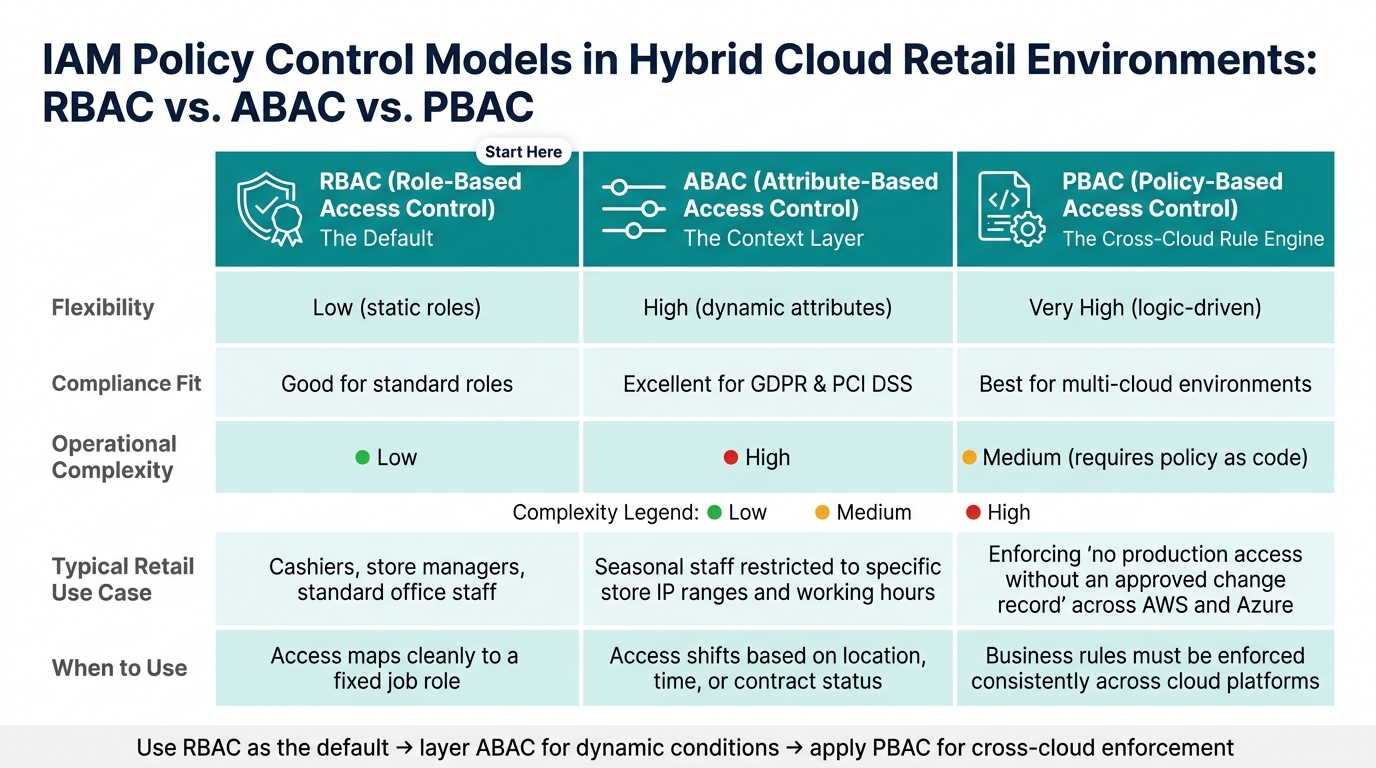 {RBAC vs ABAC vs PBAC: IAM Policy Models for Hybrid Cloud Retail}
:::
{RBAC vs ABAC vs PBAC: IAM Policy Models for Hybrid Cloud Retail}
:::
Good identity design only matters if you can turn it into policy that people can apply day after day. The aim is simple: keep access tight by default, but not painful to run at scale. The same policy also needs to work across on-premises systems, cloud workloads and machine identities. These patterns turn compliance needs into day-to-day access rules.
RBAC, ABAC and policy-based access in retail
Use RBAC for standard retail personas, ABAC for context-based restrictions and PBAC for rules that must hold across AWS and Azure.
RBAC works well when access maps cleanly to a job. Think cashiers, store managers and office staff. It’s the plain starting point because roles stay fairly fixed.
ABAC is useful when access needs to shift based on context. Seasonal staff are a good example. They may need access that changes with a contract end date, an assigned store’s IP range or working hours. ABAC lets you add location, time and contract-based restrictions without rebuilding roles from scratch.
PBAC takes that a step further by putting business rules straight into policy logic. So a rule such as no production access without an approved change record can be enforced in the same way across AWS and Azure.
Tie each model to a clear trigger: role, location, device state or ticket status.
| Control Model | Flexibility | Compliance Fit | Operational Complexity | Typical Retail Use Case |
|---|---|---|---|---|
| RBAC | Low (static) | Good for standard roles | Low | Cashiers, store managers, standard office staff |
| ABAC | High (dynamic) | Excellent for GDPR/PCI | High | Seasonal staff restricted to specific store IP ranges and working hours |
| PBAC | Very high | Best for multi-cloud | Medium (requires policy as code) | Enforcing no production access without an approved change record across AWS and Azure |
Use RBAC as the default, ABAC when access depends on changing conditions and PBAC for cross-cloud rules. That mix helps keep access aligned across stores, cloud services and machine identities.
Least privilege, separation of duties and just-in-time access
Apply least privilege by scoping each role to one task set, one system and one time window.
Policy as code, version control and continuous review
Policy falls apart fast if changes are made ad hoc. The fix is boring in the best way: version changes, review them and deploy them the same way every time. Manage IAM policies as code in version control, with peer review before deployment. That keeps policy changes aligned across environments.
Quarterly access reviews should be scheduled outside peak trading periods, such as Black Friday or the Christmas run-up, to avoid operational disruption [3]. Use the RACI below so each control has one clear owner:
| Activity | Security | DevOps/Platform | App/Data Owner | HR |
|---|---|---|---|---|
| Create production role | Accountable | Responsible | Responsible | Informed |
| JML offboarding | Accountable | Informed | Consulted | Responsible |
| Policy-as-code review | Consulted | Responsible | Accountable | N/A |
| Quarterly access review | Accountable | Informed | Responsible | Consulted |
One accountable owner per activity helps stop review drift. These rules then feed the authentication and logging controls in the next section.
Authentication, monitoring and operational governance
MFA, session controls and zero trust enforcement
Require MFA for all privileged accounts and any access to cardholder data. In live retail systems, that’s what makes RBAC, ABAC and just-in-time access stick in practice, not just on paper. Federated SSO with MFA at the identity provider also keeps sign-ins simpler across the business.
Conditional access should bring together device compliance, location, risk score and session context. Then add step-up authentication for higher-risk actions, such as privilege changes, payment system access, or logins from an unrecognised device or location. For platform support teams, use privileged access workstations, short session lengths and JIT elevation instead of standing admin rights.
The same model needs to apply to machine identities too. If people face strict access checks but services and automation do not, you’ve left the back door open. Segment access paths so payment systems can only be reached through controlled, logged entry points. For APIs, pipelines and AI agents, use workload identity federation, managed identities or short-lived tokens. Avoid static API keys. In retail, day-to-day resilience now leans as much on identity controls as it does on infrastructure.
| Identity type | Authentication control | Operational note |
|---|---|---|
| Staff | Federated SSO + MFA + conditional access | Minimises login friction across store, warehouse and e-commerce apps |
| Contractors | Time-bound federated access + MFA + device/risk checks | Auto-expire access; review frequently |
| Platform support teams | JIT elevation + step-up auth + short session duration | Privileged access workstations for production support |
| Machine identities | Workload identity federation / managed identities / short-lived tokens | Avoid static keys; rotate secrets if unavoidable |
IAM logging, alerts and incident response
Authentication controls need central logs. Without them, you can’t show that rules were enforced, and you’ll struggle to spot drift before it turns into a problem.
Centralise directory, cloud and SaaS identity logs in one SIEM. That includes Active Directory, AWS CloudTrail/IAM Identity Center, Azure sign-in and activity logs, GCP audit logs and the main SaaS admin logs. Normalise records to a shared schema with user, device, application, resource, action, timestamp, outcome, privilege level and session ID. That makes cross-environment correlation possible and keeps audit evidence in one place instead of spread across silos.
Alerting also needs clear tiers so the team knows what needs instant action. Critical events such as new admin grants, MFA bypass, impossible travel and policy tampering should trigger automatic steps: disable the account, revoke tokens, open an incident ticket and preserve evidence. It also helps to link alerts with change management data, so approved admin work doesn’t flood the queue with noise.
| Event type | Log destination | Alert threshold | Response action |
|---|---|---|---|
| Login / sign-in | SIEM / central log platform | Repeated failures, impossible travel, unrecognised device | Step-up auth, suspend session, investigate |
| Privilege change | SIEM / central log platform | New admin grant, escalation outside approved window | Disable account, revoke tokens, open incident |
| Policy drift | AWS Config / Azure Policy | Wildcard permissions, deviation from IaC baseline | Block change, remediate, review owner |
| Anomalous behaviour | Behaviour analytics engine | Deviation from 90-day baseline | Revoke tokens, terminate session, investigate |
| Deprovisioning failure | HR system / IdP logs | Access still active more than 24 hours after offboarding | Force revoke, verify removal from downstream systems |
Keep logs in immutable, access-controlled archives for long enough to meet both PCI DSS audit needs and GDPR retention limits. Where possible, store them in UK or EU regions to support data residency expectations. Test the monitoring setup on a regular basis with synthetic events, including privileged role assignment, out-of-hours admin access, impossible travel, policy drift and deprovisioning failures. That way, you know the alerts fire before a live incident puts the system under pressure.
Put simply, these controls turn policy into audit evidence.
Conclusion: a practical IAM blueprint for UK retail
Hybrid retail IAM works when policy, MFA, logging and review are applied in the same way across every identity type.
FAQs
How do we start IAM design in a hybrid retail estate?
Start with a central Identity Provider (IdP) as the single source of truth across on-premises and cloud setups, using federation such as SAML or OIDC.
Then define access by persona and HR role. Apply Policy-as-Code so least-privilege rules stay consistent, and keep human and machine identities separate, with Just-In-Time access for privileged roles.
When should we use RBAC, ABAC or PBAC?
Use RBAC to set baseline permissions by job role. It keeps day-to-day access simpler to manage and makes standard permissions easier to roll out across a team.
Use ABAC when you need tighter control based on context. That might include department, resource tags, time, or location.
PBAC sits above both as the policy framework for governing access at scale. In most setups, RBAC does the heavy lifting, with ABAC added on top for cases that need more precise rules.
How do we control service accounts and AI agents safely?
Treat service accounts and AI agents as non-human identities. Give them least-privilege access, and make sure every action can be tied back to an owner and checked later through audit logs.
Avoid long-lived credentials. Instead, use federated workload identity so these accounts get temporary, short-lived credentials rather than static secrets that hang around for months.
You also need full visibility. Find every service account and agent in use, keep an inventory, and assign clear ownership so each one has someone responsible for it.
For AI agents, set clear access conditions and group them by risk tier. Low-risk tasks can run automatically. High-risk actions should trigger step-up authentication or require human approval.