
Cloud costs can spiral out of control without proper management. FinOps automation solves this by aligning financial oversight with operational processes. Here's how it works:
What is FinOps Automation?
It uses telemetry data and automated processes to manage cloud costs effectively. Tasks like identifying idle resources, resizing instances, and enforcing budgets are handled automatically, saving time and reducing errors.Why Cost Compliance Matters:
Rising cloud and AI expenses (e.g., some companies spend £8M+ annually) make cost compliance essential to avoid unexpected bills and maintain financial stability.Key Phases of FinOps Automation:
1.  **Inform:** Automates cost data collection and reporting for clarity.
2.  **Optimise:** Reduces waste via automated rightsizing, scheduling, and policy enforcement.
3.  **Operate:** Monitors costs in real-time to ensure compliance and prevent surprises.
Prerequisites for Automation:
Reliable tagging (e.g.,owner,project) and strong governance frameworks are critical to ensure accurate cost tracking and control.Tools and Techniques:
Cloud-native tools (e.g., AWS Cost Anomaly Detection) and Infrastructure as Code (IaC) frameworks embed cost controls directly into workflows, preventing costly errors before they occur.
::: @figure 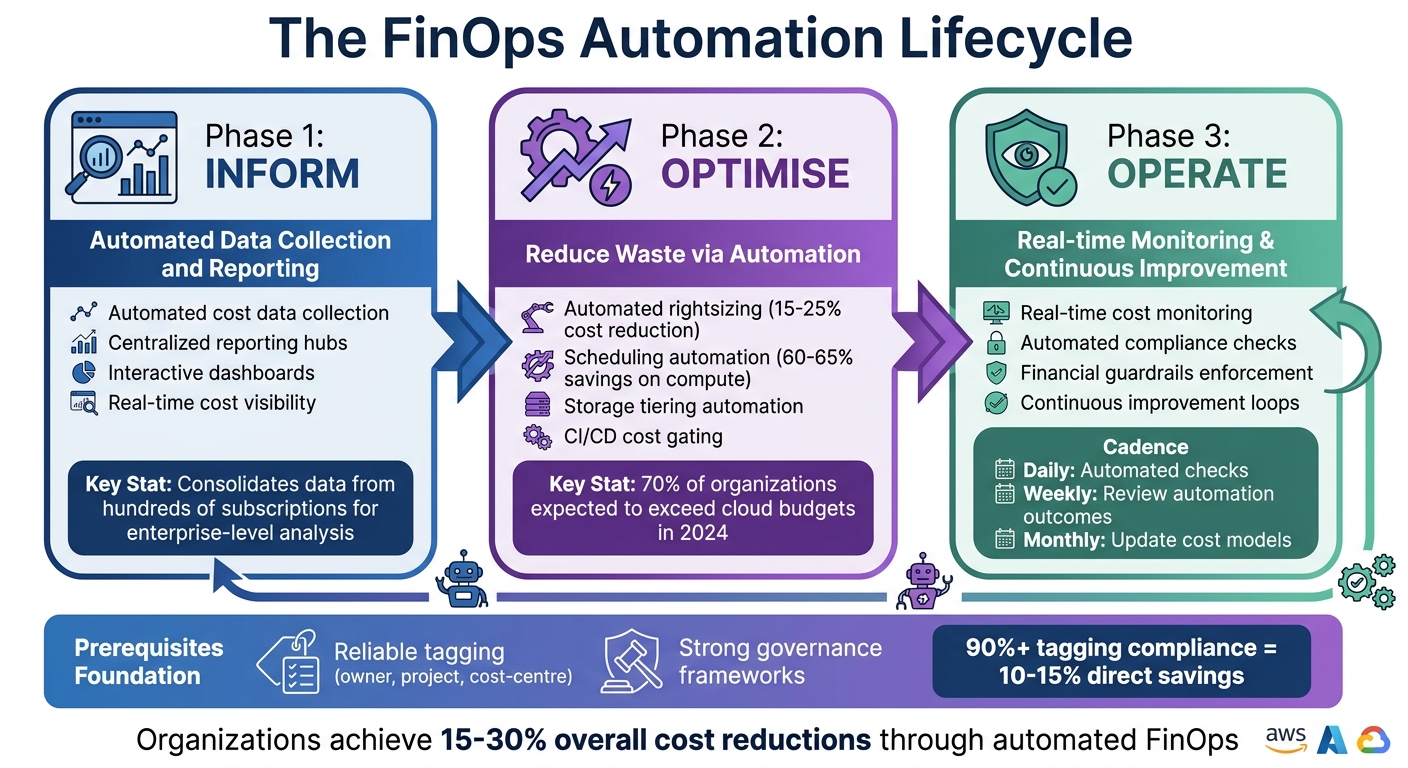 {FinOps Automation Lifecycle: Three Phases for Cost Compliance}
:::
{FinOps Automation Lifecycle: Three Phases for Cost Compliance}
:::
Prevent, Don’t Chase: Shift-Left Best Practices for FinOps and Security - Melanie Jean-Louis
Need help optimizing your cloud costs?
Get expert advice on how to reduce your cloud expenses without sacrificing performance.
FinOps Lifecycle Phases: Where Automation Improves Cost Compliance
The FinOps lifecycle is built around three key phases - Inform, Optimise, and Operate - each designed to enable better financial control. Knowing how automation fits into these stages helps organisations shift from simply reacting to costs to actively managing them.
The Inform Phase: Automated Data Collection and Reporting
The Inform phase focuses on collecting accurate cost data and making it accessible to stakeholders. Automation plays a crucial role here by transforming tedious, error-prone manual tasks into streamlined processes capable of handling large-scale data.
Centralised reporting hubs simplify this by automating data pipelines that gather, standardise, and store cost information from hundreds of subscriptions for enterprise-level analysis. For example, tools like Azure FinOps Hubs consolidate data from multiple sources and convert it into standard formats for consistent reporting [5]. This ensures that even with complex, scattered datasets, decision-makers have a clear view of their costs.
Additionally, interactive dashboards embedded directly into cloud portals make cost data immediately actionable. Engineers can see the financial impact of their infrastructure choices in real time, integrating compliance into their workflows rather than treating it as an afterthought [5].
Once accurate data is in place, automation takes centre stage in the Optimise phase to drive efficiency.
The Optimise Phase: Rightsizing and Policy Enforcement
The Optimise phase is all about reducing waste and improving efficiency. With 70% of organisations expected to exceed their cloud budgets in 2024 [2], automating these processes has become a necessity rather than an option.
Automated rightsizing ensures resources are matched to actual demand, often cutting costs by 15–25%. Scheduling automation goes further by shutting down test environments outside of business hours, saving an additional 60–65% on compute costs [2][6]. Storage tiering automation uses lifecycle policies to move data to cheaper storage options based on usage patterns [1][7]. Meanwhile, CI/CD cost gating integrates financial checks into deployment pipelines, preventing costly infrastructure decisions from reaching production [1][6].
One critical step is to analyse actual CPU and memory usage before committing to Reserved Instances or Savings Plans. Without this analysis, organisations risk locking in unnecessary expenses for one to three years [6].
After optimisation, the Operate phase ensures these cost-saving measures are sustained over time.
The Operate Phase: Monitoring and Continuous Improvement
The Operate phase shifts the focus from periodic reviews to real-time monitoring, using telemetry to enforce financial guardrails [1]. This approach ensures compliance as a continuous process rather than a series of reactive interventions.
Achieving this requires establishing a rhythm: daily automated checks, weekly reviews of automation outcomes, and monthly updates to cost models [1][4]. This routine transforms cost management into an ongoing operational practice, reducing the need for manual oversight and preventing last-minute budget crises.
Together, these phases form a cohesive FinOps framework, where automation not only simplifies processes but also ensures consistent, long-term cost compliance.
Prerequisites for FinOps Automation
For FinOps automation to work effectively, it needs a solid foundation of clean tagging practices and strong governance rules. Without these, even the most sophisticated automation tools will struggle to maintain control over costs.
Establishing Reliable Tagging and Telemetry Practices
Tagging is the backbone of cost visibility. Organisations with poor tagging practices often face 40% higher waste rates compared to those with well-defined tagging systems [8]. In 2026, data showed that 38% of cloud spending in environments without proper enforcement was completely unallocated due to missing tags [8].
To get started, focus on 5–7 essential tags, such as environment, owner, cost-centre, project, and managed-by. This approach ensures high-quality data without overwhelming developers [8][9]. Overloading teams with too many tags early on can lead to resistance and lower data quality. For instance, Oracle OCI environments aiming for advanced FinOps practices target 95% tagging coverage [9]. Achieving ≥90% compliance can result in 10–15% direct savings by improving accountability [8].
Use tools like AWS Service Control Policies (SCPs) and Azure Policy to enforce tagging by blocking untagged resources [8][10]. In AWS, remember to activate tags in the Billing and Cost Management console for them to appear in Cost Explorer and billing reports [10]. Azure simplifies this by allowing tags from resource groups to cascade automatically to all contained resources [8].
Rather than counting the number of tagged resources, evaluate compliance based on the financial impact of those resources, prioritising high-cost assets [8]. For example, a FinOps team managing 47 AWS accounts and 12 Azure subscriptions found that 38% of their £2.1 million monthly spend was unallocated. By using Terraform and AWS SCPs to enforce multi-cloud tagging, they achieved over 90% compliance, recovering an estimated £100,000–£150,000 each month [8].
Once tagging is in place, governance frameworks can turn these insights into actionable controls.
Building a Policy and Governance Framework
Tagging provides visibility, but governance is what ensures control over resources. As Fredrik Filipsson, Co-Founder of Redress Compliance, explains:
Most OCI cost governance failures are not technology failures. They are policy failures - the rules exist but are not enforced, the tags exist but are not mandatory [9].
To address this, translate financial rules into machine-readable Policy as Code. This allows you to block non-compliant resources at the API or CI/CD pipeline level. For example, you can automate the deployment of resources below a certain cost threshold (e.g. £500) while requiring manual approval for higher-cost items.
Establish a governance committee with representatives from DevOps, Finance, and Compliance to review policies quarterly. Use Git workflows to manage policy code, ensuring an audit trail for regulatory compliance.
Set up budget alerts at 50%, 75%, and 90% of monthly limits [9]. Automate actions like applying missing tags or shutting down non-production resources outside of business hours. This approach minimises waste while maintaining operational flexibility.
With these practices in place, automated FinOps processes can seamlessly optimise and monitor costs, aligning with the broader FinOps lifecycle.
Automated Tools and Techniques for Cost Compliance
Once you've established tagging standards and governance policies, the next step is deploying automated tools to monitor and enforce cost compliance. These tools generally fall into two categories: cloud-native cost management platforms and infrastructure automation frameworks. They help extend the control gained in the Inform, Optimise, and Operate phases into continuous, automated enforcement.
Cloud Provider Tools for Cost Management
Major cloud providers offer tools that use machine learning to detect anomalies in spending patterns. For example, AWS Cost Anomaly Detection analyses 10–14 days of historical data to create a baseline and flags any deviations within 24–48 hours [11][13]. You can set up monitors by service (like EC2 or S3) or customise them based on your tagging structure. As Dev Patel, a Cloud Cost Optimisation Specialist, puts it:
A single caught anomaly pays for a lifetime of monitoring [11].
Azure Cost Management evaluates subscriptions daily, using 60 days of historical data, while GCP Cost Anomalies provides hourly detection. It even identifies specific SKUs or regions driving cost spikes [13]. This type of proactive monitoring is essential. For instance, a single unmonitored incident involving forgotten GPU instances once resulted in costs exceeding $14,000 (around £11,200) over a weekend [11].
AWS also offers Budgets Actions, which automatically enforces Service Control Policies or IAM restrictions when spending thresholds are breached [12][15]. Sarah Chen, a Senior Cybersecurity Engineer, highlights the value of these tools:
AWS Budgets and Cost Anomaly Detection turn reactive cost reviews into proactive guardrails [12].
The first two budgets are free, and additional budgets cost just $0.01 (around £0.008) per day.
To make these tools even more effective, route alerts directly to the relevant teams using tagging data and set response SLAs. For instance, you could require critical anomalies over £5,000 to be investigated within one hour. Suppress alerts during planned events, like migrations, to avoid overwhelming teams with unnecessary notifications [13].
While cloud-native tools are excellent for anomaly detection and enforcement, IaC and Kubernetes automation take cost compliance a step further by embedding these controls directly into deployment processes.
Infrastructure as Code (IaC) and Kubernetes Automation
Infrastructure as Code (IaC), sometimes called FinOps as Code
, integrates cost controls directly into deployment pipelines [14][16]. Tools like Terraform can incorporate budget thresholds, anomaly monitors, and tagging policies into infrastructure deployments. This ensures that every new account or project launches with pre-configured cost guardrails [14][18].
Another useful tool is Infracost, which works with CI/CD pipelines to show developers the cost impact of infrastructure changes during code reviews. This shifts cost awareness to earlier stages in the development process [12][18]. In Kubernetes environments, tools like Karpenter for EKS can cut compute costs by up to 60% by prioritising spot instances and using consolidation policies [18].
Policy as Code frameworks, such as Open Policy Agent, allow teams to write rules that automatically block the provisioning of costly or non-compliant resources - like GPU instances in development environments - before they're deployed [17][18]. This approach is far more effective than cleaning up after the fact. For example, McKinsey estimates that FinOps as Code could help reduce the 30–35% of cloud budgets typically wasted on overprovisioned or idle resources, unlocking approximately $120 billion (about £96 billion) in value [18].
Automated remediation tools, such as Lambda functions or Azure Policy actions, can enforce IAM policies or shut down idle resources when thresholds are breached. These custom monitoring solutions often cost less than £8 per month [11][15]. By embedding cost compliance into every stage of resource deployment, these automation techniques strengthen the FinOps framework and help keep budgets in check.
Case Studies: FinOps Automation Outcomes
Cost Savings Through Automation
Real-world examples highlight how automated FinOps strategies can lead to substantial savings. Organisations that implement automated KPIs for cloud spending often achieve cost reductions of 15–30% overall [19]. Automating the shutdown of non-production environments can slash cloud costs by 40–65% [19]. For Amazon EC2 instances in development or testing environments, automated start/stop scheduling can result in savings of up to 70% [20].
Idle resources - like stopped virtual machines, unattached volumes, and unused IP addresses - can make up 27–35% of infrastructure waste [19]. Automated detection systems help by identifying and terminating these unused resources before costs escalate. Tools such as AWS Tag Editor with Lambda or Azure Policy enable standardised tagging enforcement, achieving 80–90% allocation coverage. This level of coverage is essential for accurate cost showback [19][20].
Leading companies are now achieving higher levels of cloud efficiency, though rising AI costs have become a notable factor driving cloud expenditure [3].
Hokstad Consulting's Cloud Cost Engineering Services
Hokstad Consulting showcases the benefits of applying these automation techniques through its cloud cost engineering services. Hokstad Consulting helps businesses cut cloud expenses by 30–50% by replacing traditional periodic audits with continuous, real-time monitoring. While manual audits can take hours or even days, Hokstad's automated systems deliver alerts in minutes and scale seamlessly across multi-cloud environments.
Their No Savings, No Fee
model ensures that fees are directly tied to the savings they achieve for clients, aligning their success with client outcomes. Services offered include automated tag enforcement, scheduled resource management, and customised cost compliance workflows. By embedding FinOps principles into CI/CD pipelines and infrastructure deployments, Hokstad helps clients maintain cost compliance while reducing waste. This automation-first approach extends beyond infrastructure management to include data platforms, addressing the often complex and opaque nature of cost management [21].
Conclusion
Key Takeaways
FinOps automation shifts cost management from a reactive process to a proactive system, addressing the challenges posed by fleeting cloud resources in today's environments [22]. By integrating automation into the Inform, Optimise, and Operate phases, organisations can curb waste before resources are even provisioned, rather than catching inefficiencies later [22].
Practical results back this up. For instance, companies have saved as much as £160,000 per year by automating VPC optimisation and achieved a 90% cut in transaction costs using automated visibility tools, as reported by Hokstad Consulting. These changes translate directly into measurable financial benefits.
Beyond the numbers, automation allows teams to focus on innovation and strategic priorities. By removing repetitive compliance tasks, it not only saves time but also safeguards budgets with automated guardrails that prevent costly misconfigurations [1]. Infrastructure Platform Engineering takes this further by embedding FinOps policies directly into deployment pipelines, ensuring compliance from the moment infrastructure is created [22].
That said, implementing these strategies hinges on effective tagging practices and strong governance frameworks. The technical demands often call for expert assistance, and services like Hokstad Consulting can help organisations achieve cost reductions of 30–50%. They enable continuous, real-time monitoring, ensuring compliance without the need for manual, periodic reviews.
Switching from manual to automated FinOps establishes a sustainable, scalable approach to financial governance, perfectly suited to the speed and complexity of modern cloud systems.
FAQs
What should we automate first in FinOps?
Start with automating cost visibility and governance to streamline your cloud operations. Conducting thorough cloud cost audits can help pinpoint unused or underused resources, which can lead to substantial savings. By using policy as code, you can ensure compliance with regulations like GDPR while also reducing the risk of manual mistakes.
To stay ahead, leverage real-time monitoring and AI-driven alerts. These tools not only help manage costs efficiently but also keep compliance on track. Together, these steps lay down a solid framework that supports continuous optimisation and ensures you meet required standards.
Which tags are essential for cost compliance?
When it comes to cost compliance in cloud environments, three key practices stand out: resource tagging, resource policies, and resource organisation.
These tagging strategies aren't just about keeping things tidy - they play a vital role in enforcing budgets, managing data efficiently, and adhering to regulatory requirements like GDPR. By implementing proper tagging, organisations can streamline their compliance efforts while also improving the accuracy and clarity of cost reporting processes.
How can we prevent overspending before deployment?
To keep costs in check before deployment, it's smart to adopt FinOps practices early on. Automation tools can play a big role here - helping enforce cost policies, apply resource tagging, and carry out regular audits. By using Policy as Code (PaC), you can automate compliance processes, making sure that unapproved resources don't get provisioned in the first place.
On top of that, continuous monitoring and open collaboration between teams are key. These steps make it easier to track budgets and avoid overspending, ensuring financial control is in place right from the start.