Managing compliance across multiple cloud platforms like AWS, Azure, and Google Cloud is complicated. Each provider has unique tools and controls, making it hard to maintain consistent governance. Policy versioning simplifies this by tracking governance rules, their changes, and approvals over time. This approach ensures compliance with regulations such as UK GDPR, the Data Protection Act 2018, and FCA requirements.
Key points:
- Policy-as-Code (PaC): Governance rules are written as code, stored in Git, and integrated into CI/CD pipelines for version control and testing.
- Versioning: Semantic versioning communicates changes clearly (e.g., major, minor, or patch updates).
- Enforcement Levels: Policies can be advisory, soft-mandatory, or hard-mandatory, depending on the risk.
- Cross-Cloud Consistency: A policy abstraction layer ensures uniform compliance across different cloud environments.
Policy versioning not only improves audit readiness but also reduces compliance risks and operational inefficiencies. By integrating these practices into workflows, organisations can confidently manage multi-cloud environments while meeting regulatory requirements.
Foundations of Policy Versioning in Multi-Cloud Environments
Core Concepts and Terminology
Defining key terms is crucial for consistent multi-cloud policy implementation. Without clear definitions, teams managing different cloud platforms might interpret policies differently, leading to inconsistent enforcement.
A policy baseline represents the minimum controls required across all environments. These typically include measures like encryption at rest, mandatory resource tagging, or data residency requirements. Guardrails set the operational boundaries that teams must adhere to without needing additional approvals. Beyond these, policy artefacts include:
- Exemption records: Documented and approved deviations from a policy, including reasons and expiry dates.
- Attestation records: Evidence that a policy control was implemented and functioning at a specific point in time.
Policies also use semantic versioning, a structured numbering system that communicates changes clearly. For example, a version 2.1.0 indicates:
- 2: A major structural change.
- 1: A new rule added without breaking existing ones.
- 0: A minor correction or update.
Another critical aspect is defining enforcement levels, as these determine how violations are handled. The table below outlines the enforcement levels and their impact:
| Enforcement Level | Action on Violation | Use Case |
|---|---|---|
| Advisory | Issues a warning; deployment continues | Testing new rules or low-risk scenarios like cost tagging. |
| Soft-Mandatory | Blocks deployment but allows overrides with authorisation | Critical compliance areas where exceptions are possible. |
| Hard-Mandatory | Blocks deployment with no overrides | High-risk situations, such as public S3 buckets or missing encryption. |
These definitions form the foundation for the GitOps-driven architectures discussed in the next section.
Reference Architectures for Policy Versioning
A GitOps-driven repository is a practical and effective approach to multi-cloud policy versioning. In this setup, all policy code is stored in version control, and changes are managed through pull requests, automated tests, and approval workflows before being applied in production.
A common practice is to use a monorepo organised by concern rather than by cloud provider. Instead of separate directories for AWS, Azure, and GCP, the repository might have folders like security, compliance, and cost. This structure simplifies ownership, as teams (e.g., the security team) can focus on reviewing changes within their domain, regardless of the cloud platform in question. Subdirectories often divide policies further into global, production, and team-specific scopes, each with its own configuration file.
The tools supporting this architecture typically fall into four categories, each playing a distinct role:
| Component | Tool/Framework | Purpose in Versioning |
|---|---|---|
| VCS | Git (GitHub/GitLab) | Stores and tracks policy code and its history. |
| Policy Engine | OPA / Sentinel | Evaluates policies against infrastructure plans. |
| CI/CD | GitHub Actions / GitLab CI | Automates testing and deployment of policy versions. |
| Audit Store | S3 (Object Lock) / Azure Blob | Maintains immutable attestation records for compliance. |
Every pull request for a policy change should trigger automated tests, such as opa test or sentinel test, to validate both successful and failing scenarios. Identifying issues during CI testing is far less disruptive than encountering them during a compliance audit.
Governance Models and Ownership
Even the best policy architecture can fail without clear governance and ownership. In multi-cloud environments, a Cloud Centre of Excellence (CCoE) is often responsible for defining, maintaining, and enforcing policy standards across all platforms. This model is especially effective for organisations requiring strict compliance, such as those regulated by the FCA or managing NHS data.
A practical tool for implementing governance is the CODEOWNERS file in the Git repository. This file maps specific policy folders to the responsible teams, automating the approval process. For example, security policies might require sign-off from the security team, while cost policies need approval from FinOps. This approach transforms governance from a static document (like a RACI matrix) into an actionable, enforced process at the point of change.
Need help optimizing your cloud costs?
Get expert advice on how to reduce your cloud expenses without sacrificing performance.
Policy as Code Automation for Multi-Cloud Security
Policy Versioning Lifecycle: Design, Change Management, and Deployment
::: @figure 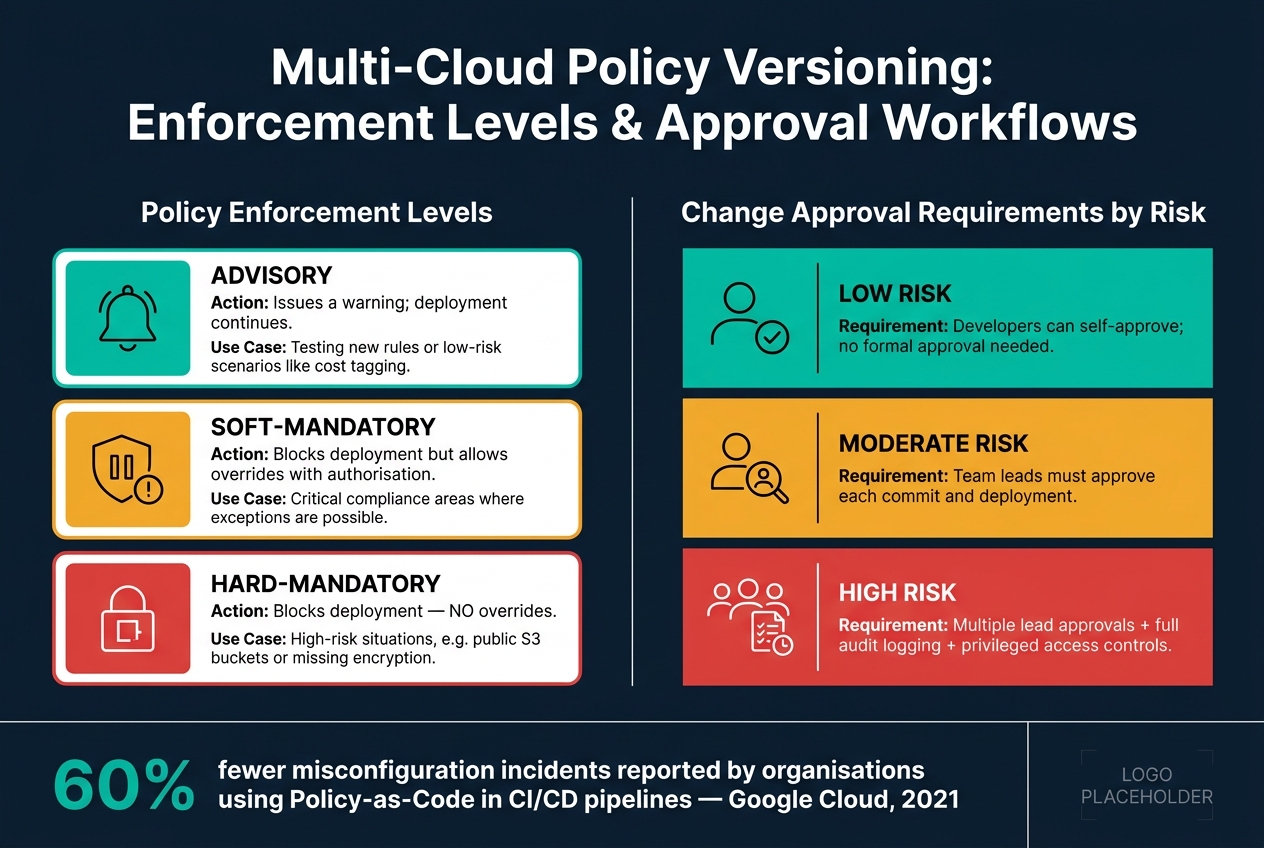 {Multi-Cloud Policy Versioning: Enforcement Levels & Approval Workflows}
:::
{Multi-Cloud Policy Versioning: Enforcement Levels & Approval Workflows}
:::
Designing and Structuring Policies
Creating effective policies starts with detailed metadata. Each policy file should include its version, relevant regulatory mappings (like ISO 27001, GDPR, or FCA guidelines), applicable jurisdictions, and enforcement levels. This metadata elevates a policy from a simple technical rule to a traceable compliance document.
It's essential to establish clear rules for what counts as a major, minor, or patch change. For instance, switching an enforcement level from Advisory to Hard-Mandatory should always trigger a major version update because it significantly impacts deployment behaviour across environments.
Policies should also be scoped with clear boundaries. A global encryption policy, for example, serves a vastly different purpose than a team-specific tagging rule. Mixing these within the same file can lead to confusion during audits. By keeping the scope explicit in both the file structure and metadata, organisations can demonstrate compliance more effectively to regulators.
Once policies are well-structured and versioned, the focus shifts to managing approvals and handling changes.
Version Control and Approval Workflows
With structured and versioned policies in place, the next step is to ensure a safe and efficient change management process. A Git-based branching model is a practical approach. Most teams rely on a main branch to represent the live, enforced policy baseline, while short-lived feature branches are used for proposed changes. Pull requests serve as the formal checkpoint for reviews. This process ensures changes are vetted before deployment.
Approval workflows should align with the risk level of the policy change. For example, a low-risk update, such as tweaking a cost-tagging rule, might only require approval from a single team lead. On the other hand, high-risk changes, like altering encryption requirements, demand stricter measures - multiple approvals, audit logging, and restricted access. The table below provides a practical breakdown:
| Resource Risk Category | Approval Requirements |
|---|---|
| Low Risk | Developers can self-approve deployments, no formal approval needed |
| Moderate Risk | Team leads must approve each commit and deployment |
| High Risk | Requires multiple lead approvals, full audit logging, and privileged access controls |
Automated testing plays a crucial role at the pull request stage. Tools like OPA (opa test) or Terraform Sentinel can validate both passing and failing scenarios before human reviewers step in. This combination of automation and rigorous review ensures reliable and controlled policy deployment.
Deployment, Rollout, and Rollback
Deploying a new policy version always carries risks, particularly when transitioning a policy from Advisory to Mandatory. Phased rollouts, such as canary deployments, help mitigate these risks by applying the updated policy to a limited subset of environments first. This approach allows teams to monitor for unexpected violations and proceed with a full rollout only when confidence is high.
Rollback processes, while challenging, are simplified with version control. Using git revert or resetting to a previous branch allows teams to restore a known-good policy version. The CI/CD pipeline can then automatically redeploy this version. Additionally, audit stores - like an S3 bucket with Object Lock or an Azure Blob with immutability policies - should retain records of both the failed deployment and the rollback. This ensures a complete timeline for regulatory review.
The hard part is not knowing the rule. The hard part is keeping the rule true as teams ship changes daily across multiple accounts, regions, and services[1].
Using Policy Versioning to Strengthen Multi-Cloud Compliance
Mapping Policies to Regulatory Requirements
Once you’ve established a versioning framework, the next step is to align these policies with specific regulatory requirements. This ensures compliance is not only achieved but also easily demonstrable. A traceability matrix - a structured document linking each versioned policy to the relevant regulatory clauses - can be a game-changer here.
Take an encryption policy as an example. It might map to GDPR Article 32 (technical security measures), PCI DSS Requirement 3.5 (protection of stored cardholder data), and ISO 27001 Annex A.10.1 (cryptographic controls). With this setup, auditors can quickly access evidence, including the policy version, its Git approval history, and the corresponding regulatory clauses.
The real advantage? Audit readiness. Every policy update comes with a timestamp, an approver’s details, and a clear regulatory justification. This transforms audits from a laborious, manual task into a simple exercise in retrieving pre-documented evidence.
Continuous Compliance and Monitoring
Creating versioned policies is just the beginning; ensuring they are consistently enforced across live cloud environments is equally important. One of the biggest challenges in multi-cloud setups is policy drift - when the actual state of a resource no longer matches the policy requirements.
To tackle this, integrate versioned policies into a continuous scanning process. This could involve scheduled checks or scans triggered by infrastructure events, where resources are evaluated against the current enforced policy version. If drift is detected, automated remediation workflows can either alert the relevant teams or directly fix low-risk issues. Importantly, any remediation should be logged against the specific policy version that flagged the issue, maintaining a clear audit trail.
This approach is particularly critical for organisations governed by FCA guidelines or GDPR, where demonstrating ongoing compliance - not just compliance at a single point in time - is a regulatory requirement. By establishing this continuous feedback loop, you can ensure policies remain aligned across all cloud platforms.
Cross-Cloud Policy Harmonisation and Translation
Maintaining consistent policy intent across multiple cloud platforms is essential for effective multi-cloud compliance. Each cloud provider has its unique mechanisms, terminology, and enforcement methods, making it impractical to write separate policies for each platform. This can lead to inconsistencies and increased complexity.
The solution? Use a policy abstraction layer. This involves creating a single, cloud-agnostic policy - written in a language like Rego - that is versioned centrally and maps to provider-specific controls. For example, a high-level policy like all storage must be encrypted
can translate into an AWS S3 bucket policy, an Azure Storage Account rule, and a GCP Cloud Storage constraint, all derived from the same versioned source.
One practical way to simplify this is by using helper functions in your policy code. For instance, while AWS and Azure use tags
for resource labelling, GCP uses labels.
A helper function can standardise these differences, ensuring your core policy logic remains consistent regardless of the cloud provider. This approach not only keeps your compliance posture uniform but also significantly reduces the effort required to adapt to regulatory changes - update one policy version, and it applies everywhere.
Operationalising Policy Versioning with Hokstad Consulting
Common Multi-Cloud Policy Management Challenges
Managing policy versioning in multi-cloud environments is a complex task, and Hokstad Consulting has identified recurring challenges faced by organisations in the UK. Even with reliable technical systems, ensuring consistent policy application across AWS, Azure, and GCP often proves difficult. Hokstad frequently encounters five key issues in this area.
The most common issue is policy inconsistency across clouds. For example, one provider might enforce stricter encryption standards or apply a different RBAC model than another. This not only creates compliance risks with frameworks like ISO 27001 and UK GDPR but can also lead to unnecessary costs - such as one cloud using premium storage tiers while another is under-regulated. Another significant problem is the reliance on manual, spreadsheet-based policy tracking. Many teams still use wikis or shared documents instead of version-controlled code, which makes it hard to maintain an audit trail or demonstrate change control to auditors.
Other challenges include limited central visibility, where teams struggle to answer basic questions like What policies are active across all production accounts?
There’s also siloed ownership, where different teams - security, platform, and application - manage conflicting policies in isolation. Finally, weak CI/CD integration means policies are often treated as static configurations, not dynamic artefacts that evolve through versioning. These issues are interconnected: siloed ownership leads to conflicting policies, which remain hidden from central oversight and untested before deployment, amplifying risks.
Hokstad Consulting's Approach to Policy-Driven Governance
Hokstad Consulting tackles these challenges by treating policy versioning as an engineering discipline. Their process begins with a policy discovery and baselining exercise, which involves cataloguing existing controls across all clouds. Each control is classified as mandatory (for compliance), best practice, or optional (for optimisation) and mapped to regulatory standards like UK GDPR, PCI DSS, or ISO 27001 Annex A.
Next, policies are converted into code using tools like OPA/Rego, integrated with native cloud constructs (e.g., Azure Policy, AWS Service Control Policies) through infrastructure-as-code platforms like Terraform or Pulumi. These policies are stored in Git repositories, using semantic versioning (e.g., v1.2.3) and metadata that includes ownership details and links to regulatory requirements. Clear branching strategies ensure separation between development, testing, and production environments.
Hokstad also integrates CI/CD pipelines to automate linting, unit and integration testing, and documentation updates before deploying any policy. New policies are initially rolled out in audit mode, where they report violations without enforcement. After a defined trial period, they can be enforced fully. This staged approach allows teams to reverse poorly scoped policies quickly, avoiding disruptions or compliance risks. Hokstad supports organisations with workshops and reusable templates, empowering teams to independently manage policy changes.
This engineering-led approach not only strengthens governance but also supports cost and performance optimisation.
Balancing Policy Versioning with Cost and Performance Goals
Policy versioning has a direct impact on cloud costs. Overly strict policies, such as enforcing premium storage tiers across all environments, can inflate budgets unnecessarily. On the other hand, lenient policies in certain clouds can create uneven risk exposure. Hokstad Consulting addresses this by designing cost-conscious policies from the start. These include mandatory tagging for chargeback, restrictions on instance types and storage tiers, and automated start/stop schedules for non-production environments outside UK business hours.
The iterative nature of policy versioning also supports controlled cost management. For instance, teams can A/B test stricter instance-type policies in non-production environments, monitoring their impact on both costs and performance before rolling them out to production. Hokstad integrates cost data directly into compliance dashboards, providing metrics in GBP (£) that show cost-per-application and cost-per-policy. This ensures that governance decisions are not only compliant but also financially informed. Their approach to cloud cost engineering aims to achieve savings of 30–50%, using policy versioning as a sustainable tool for balancing cost and compliance effectively.
Conclusion
Multi-cloud compliance is no small feat. Each cloud provider enforces its own controls, data residency rules vary widely, and the shared-responsibility model shifts depending on the services in use. Without a systematic approach, these differences can quietly snowball into compliance gaps that often only surface during audits.
Policy versioning offers a practical way to address these challenges. By treating policies like code and storing them in Git, organisations can maintain a detailed audit trail of every policy change - tracking who made changes, when, why, and how they align with regulatory requirements. Standards such as ISO 27001 and UK GDPR emphasise the importance of a continuous, verifiable audit trail, not just periodic snapshots. A 2021 Google Cloud security white paper even highlighted that organisations using infrastructure-as-code and policy-as-code within CI/CD pipelines saw up to a 60% drop in misconfiguration-related incidents compared to manual methods.
But compliance success isn't just about the tools; it’s about the process. A structured lifecycle - including thoughtful design, peer-reviewed changes, staged rollouts, and quick rollback capabilities - shifts compliance from being an annual headache to becoming part of regular engineering workflows. Balancing consistent, auditable controls across AWS, Azure, and GCP while allowing for cloud-specific security nuances ensures effective governance without forcing a rigid, one-size-fits-all approach.
For business leaders, the benefits are clear: policy versioning reduces compliance risks, speeds up audit preparation, and helps manage cloud costs. It turns governance into a measurable asset.
As discussed earlier, Hokstad Consulting offers the expertise to embed policy versioning into workflows, ensuring it becomes a sustainable, internally managed practice. For multi-cloud organisations, starting with an initial assessment of policy versioning is a smart and actionable step forward.
FAQs
How do we decide what’s a major vs minor policy change?
Determining if a policy change is major or minor in a multi-cloud setup comes down to its impact and scope. For example, major changes - like introducing new encryption standards or modifying core access controls - can have far-reaching effects on compliance and security. These typically demand a detailed review and formal approval process. On the other hand, minor changes, such as adjusting tagging conventions, are more limited in scope, less disruptive, and easier to roll out. It's crucial to always factor in compliance and governance requirements when categorising changes.
How can we enforce one policy consistently across AWS, Azure and GCP?
To maintain a uniform policy across AWS, Azure, and GCP, you can implement Policy as Code (PaC). This approach converts compliance rules into executable code, which can be centrally managed for consistency. Tools like Open Policy Agent (OPA) and Terraform allow you to create cloud-agnostic policies, ensuring a standardised approach across platforms.
By integrating these policies into your CI/CD pipelines, you can automate compliance checks, minimise errors, and streamline operations. This also supports a centralised governance model, helping you stay aligned with UK regulations, such as GDPR.
What’s the safest way to roll out (and roll back) a new policy version?
Automating processes with Policy-as-Code (PaC) within CI/CD pipelines is one of the most reliable ways to ensure safety and consistency. This method allows for early validation, ongoing monitoring, and controlled implementation of changes.
Some essential practices include:
- Storing policies in version control: This ensures transparency and makes it easier to track changes.
- Embedding automated checks in CI/CD pipelines: Automated checks catch potential issues before deployment.
- Gradual rollout of changes: Rolling out updates step by step reduces the risk of widespread disruptions.
- Maintaining rollback procedures: Having a clear rollback plan ensures you can quickly revert changes if needed.
These steps help reduce risks and maintain compliance, even in complex multi-cloud setups.