
Managing shared cloud costs can be tricky, especially when development and testing environments use the same resources. Without clear allocation, it's easy to lose track of which team or project is driving costs. Here's what you need to know:
- Unclear Costs: Shared resources like Kubernetes clusters or load balancers make it hard to assign expenses. Around 30–50% of cloud spending often goes untagged.
- Development Costs: Dev environments are idle 70% of the time, yet many pay for 24/7 usage. Automated shutdowns can cut costs by up to 58%.
- Testing Costs: Testing setups often run 24/7 but are only used during peak times. Scheduling shutdowns can reduce costs by nearly 70%.
- Challenges: Tagging limitations,
zombie
resources, and shared bottlenecks complicate cost allocation. - Solutions: Automating shutdowns, using ephemeral environments, and tools like Kubernetes autoscaling can help reduce waste.
Allocating costs fairly requires smart strategies and tools to track usage accurately. This not only saves money but also improves resource management.
::: @figure 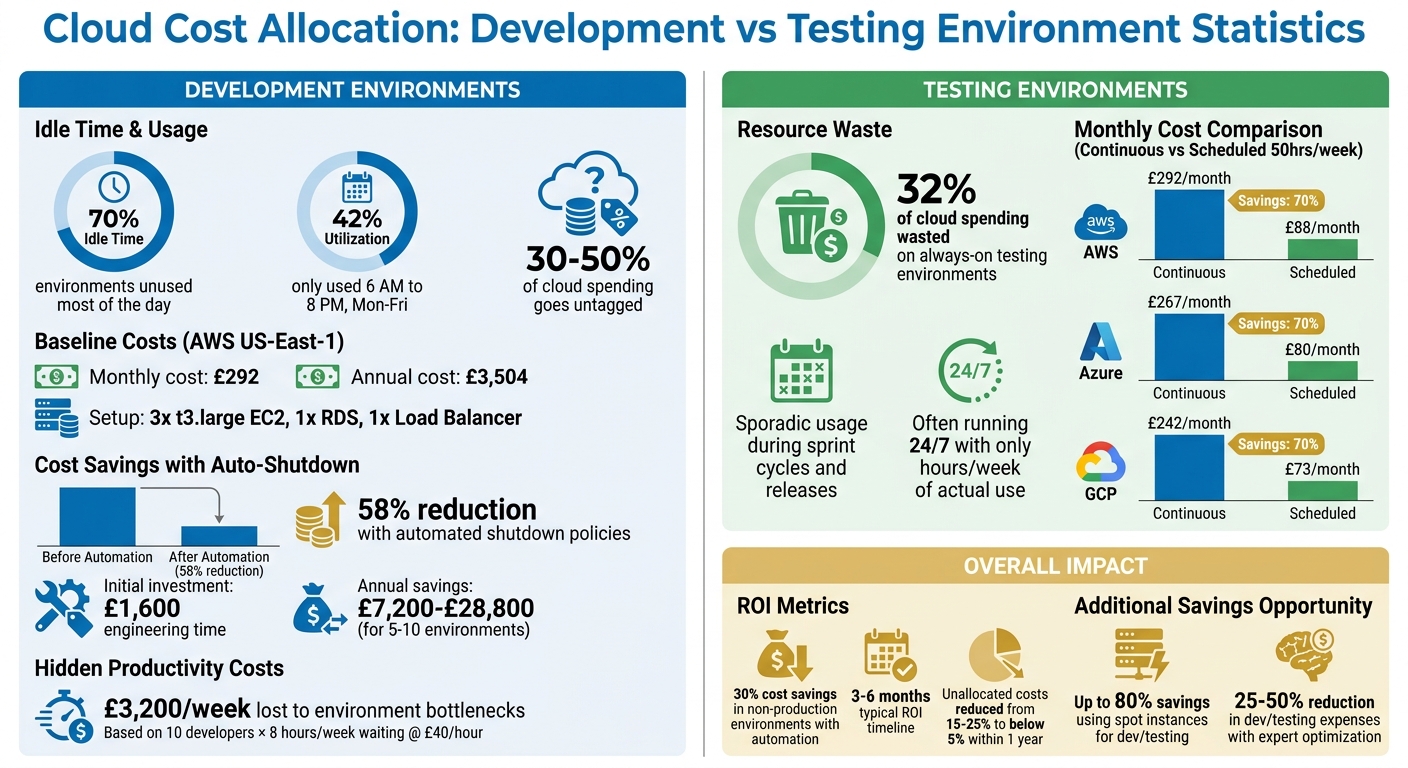 {Cloud Cost Allocation: Dev vs Testing Environment Savings Comparison}
:::
{Cloud Cost Allocation: Dev vs Testing Environment Savings Comparison}
:::
1. Development Environment Cost Allocation
Resource Usage Patterns
According to Falkenberg, development environments are idle roughly 70% of the time [2]. Most teams only use these resources during regular business hours - typically from 6 AM to 8 PM, Monday through Friday - resulting in just 42% utilisation. Despite this, organisations often pay for 24/7 availability [2]. This mismatch highlights a challenge in cost allocation, particularly in the context of shared infrastructure where ownership can be unclear.
The rise of ephemeral environments is starting to shift this pattern. Instead of relying on permanent staging setups that can create bottlenecks and leave behind unused state
issues, many teams now opt for on-demand ephemeral environments [3][4]. This change moves costs from fixed to variable, although it introduces the need for new tracking methods.
Another ongoing issue is the presence of zombie
resources - unused infrastructure left behind after tasks are completed. These forgotten resources drive up shared costs without clear accountability [2].
These usage trends play a crucial role in shaping cost-saving strategies, as explored below.
Cost Optimisation Strategies
In the AWS US-East-1 region, running a basic development setup - consisting of three t3.large EC2 instances, one RDS instance, and an Application Load Balancer - costs approximately £292 per month or £3,504 annually [2]. By implementing auto-shutdown policies to disable resources outside business hours, organisations can reduce these costs by about 58% [2].
Automating shutdown processes can lead to substantial savings. Although setting up such automation requires an initial investment of around £1,600 in engineering time, it has the potential to save between £7,200 and £28,800 annually for companies managing five to ten development environments [2]. One practical approach is to tag resources with AutoShutdown=true and enforce the policy using Lambda functions [2].
However, these cost-saving strategies must navigate the limitations of tagging, which are discussed in the next section.
Challenges in Allocation
While cost optimisation presents clear benefits, technical constraints - such as cloud tagging rules - add complexity to cost allocation. For instance, AWS allows up to 50 tags per resource with 128-character keys, Azure supports 50 case-insensitive tags with 512-character keys, and GCP permits 64 tags with 63-character limits. These restrictions make it harder to track costs at a granular level, especially for development resources, which often have unique tagging requirements.
Beyond infrastructure costs, shared environment bottlenecks also come with hidden expenses. For example, if 10 developers each lose 8 hours per week waiting for shared environments, the productivity loss can amount to £3,200 per week, assuming an hourly rate of £40 [3]. These indirect costs further emphasise the importance of efficient resource management.
2. Testing Environment Cost Allocation
Resource Usage Patterns
Testing environments often exhibit usage patterns that resemble those of development setups, with one notable difference: their activity is more sporadic and intense. While development work usually occurs during regular business hours, testing tends to peak during sprint cycles and releases. This results in periods of high resource demand followed by extended lulls, making it tricky to allocate costs fairly when multiple teams share the same infrastructure.
On average, 32% of cloud spending is wasted on always-on testing environments [5]. This happens because teams keep testing setups running 24/7, even though actual testing might only take place for a few hours per day - or even per week. This inefficiency mirrors the broader challenges of cost allocation in shared cloud environments, as discussed earlier.
These unpredictable usage patterns call for focused strategies to manage costs effectively.
Cost Optimisation Strategies
One of the simplest ways to reduce costs in testing environments is through scheduled shutdown policies. For example, running an AWS testing stack continuously costs around £292 per month. However, scheduling its use for just 50 hours per week can bring that cost down to approximately £88 per month [5]. Similar savings can be achieved with other providers: Azure setups drop from £267 to £80, while GCP configurations decrease from £242 to £73 [5].
To implement these savings, it's essential to follow the specific requirements of each platform. For instance, Azure virtual machines (VMs) need to be fully deallocated to avoid ongoing charges [5]. Tools like AWS EventBridge and Lambda make it easier to automate shutdowns during off-hours - typically between 6 PM and 8 AM - ensuring that teams aren't paying for idle resources [5].
Scalability and Flexibility
In addition to scheduled shutdowns, dynamic scaling offers a more advanced way to manage costs. Techniques like scale-to-zero are particularly effective for environments with unpredictable demand. Kubernetes Event-Driven Autoscaling (KEDA), for example, allows non-production deployments to scale down to zero replicas when not in use [5]. This approach goes beyond fixed schedules by dynamically adjusting resource allocation, ensuring that no costs are incurred during inactive periods while still enabling rapid scaling when activity picks up.
Cloud Cost Allocation Model that Actually Works!
Pros and Cons
Weighing the pros and cons of different cost allocation strategies is essential to finding the best fit for your shared environment.
Shared testing environments are easy to set up but often come with hidden drawbacks. As Ramiro Berrelleza, CEO & Co-founder of Okteto, aptly describes:
Testing code shouldn't feel like booking a conference room. And yet, in many engineering teams, that's exactly what it's like[3].
The main issue? Developers frequently face delays waiting for staging access, which can significantly impact productivity. These bottlenecks make shared environments less efficient than they might initially appear.
On the other hand, ephemeral development environments take a more dynamic approach. They spin up when needed and shut down immediately after, meaning you only pay for what you use. This eliminates issues like queuing or environment drift
- a situation where staging environments become misaligned with production, leading to unnecessary rework. However, this efficiency comes with a catch: ephemeral environments require well-developed automation and CI/CD pipelines, which not all teams have in place. This trade-off reflects the broader challenge of choosing the right allocation method.
When it comes to cost allocation, the method you choose can make a big difference. Equal allocation is the easiest to calculate but can feel unfair if some teams use far more resources than others [1]. Variable proportional methods, which track real-time usage, provide a more accurate picture but require advanced monitoring tools. Meanwhile, fixed proportional methods offer predictable costs for budgeting but rely on historical data, which can quickly become outdated.
For teams looking to cut costs, spot instances are worth considering. They can reduce development and testing expenses by up to 80%, as these environments are generally more tolerant of interruptions than production systems [6]. The key is to align your allocation strategy with your team's actual usage patterns, rather than defaulting to the simplest option. This alignment helps optimise cloud spending without sacrificing productivity.
Conclusion
Addressing the challenges of cost allocation in development and testing environments requires a thoughtful and tailored strategy. The key lies in aligning your approach with your organisation’s specific requirements and level of cloud maturity. For development environments, flexibility is crucial - usage-based allocation works well here, as it accommodates the unpredictability of experimentation. On the other hand, testing environments benefit from more structured, scheduled allocation methods that tie in with release cycles.
The benefits of effective allocation practices are clear. Organisations leveraging automated tools report 30% cost savings in non-production environments [8]. Additionally, those implementing comprehensive strategies often reduce unallocated costs from 15–25% to below 5% within a year [7]. Most businesses see a positive return on investment within just 3–6 months of adopting these practices [7]. These figures highlight the importance of not only selecting the right cost allocation strategy but also refining it over time based on performance and outcomes.
However, success in managing cloud costs goes beyond simply choosing a method. Core practices like automated tagging, frequent cost reviews, and well-defined governance policies are essential for long-term results. Whether you start with showback models to improve visibility or advance to chargeback systems for a more mature approach, the priority should always be aligning the strategy with your team’s skills and overall business goals.
For organisations looking to fast-track their savings, expert guidance can make a significant impact. Navigating the complexities of cost allocation is easier with specialised support. Hokstad Consulting, for example, offers cloud cost engineering services designed for UK businesses. They’ve helped companies cut development and testing expenses by 25–50% through a combination of DevOps transformation and automated allocation frameworks. Their expertise ensures that organisations implement effective tools and governance structures while avoiding common mistakes like poor tagging or overly complicated processes.
To get started, evaluate your current allocation methods, introduce automated tagging and monitoring, and schedule regular cross-functional cost reviews. With the right mix of strategy, tools, and expert support, managing shared cloud costs becomes not only achievable but also a source of measurable savings and efficiency for your business.
FAQs
How can we fairly split costs when dev and testing share a Kubernetes cluster?
Splitting costs fairly in shared Kubernetes clusters can be a challenge, but there are a few effective strategies to make it work. One popular approach is namespace-based allocation combined with resource quotas. This ensures each team or environment gets a fair share of resources while staying within defined limits.
Another key practice is using consistent tagging to track usage. By tagging resources based on teams or environments, you can accurately monitor who is using what.
Tools like Kubecost or OpenCost are incredibly helpful for keeping tabs on costs. They provide detailed insights into how resources are being used, making it easier to pinpoint areas for optimisation.
To promote transparency, consider implementing either a chargeback model, where teams are billed for their usage, or a showback model, which simply displays the costs without charging them. Both approaches ensure everyone understands their usage and its financial impact.
Finally, regular reviews of resource usage are essential. Adjusting quotas or refining labels over time helps maintain fairness as team needs evolve.
What’s the quickest way to stop paying for idle dev and test environments?
Automating the shutdown of idle development and testing environments is the quickest way to cut unnecessary costs. Features like environment sleeping, hibernation, or pause/resume ensure resources are active only when required, keeping expenses in check.
How can we track shared cloud costs when tagging limits get in the way?
When tagging limits hinder the accuracy of tracking shared cloud costs, there are alternative strategies to maintain transparency and fairness. For instance, showback strategies can help by providing visibility into resource usage without enforcing strict cost recovery. Regular audits are another effective approach, ensuring that resource allocation and spending align with organisational goals. Additionally, tools like AWS Cost Explorer or Microsoft Cost Management offer built-in features to monitor and manage cloud expenses, making it easier to allocate costs fairly without depending entirely on tags.