
Cloud storage pricing can be tricky, especially when choosing the right tier for your data. Picking the wrong option could cost 2–5 times more than necessary. This article breaks down storage costs for AWS, Azure, and Google Cloud, helping you make informed decisions. Here's what you need to know:
- AWS S3: Best for read-heavy workloads with low GET request costs (£0.0003 per 1,000 requests). Archive tiers start at £0.0008/GB/month, but retrieval fees can add up.
- Azure Blob: Offers cheaper archive storage (£0.0016/GB/month) but higher operational costs. Best for businesses already using Microsoft tools.
- Google Cloud: Provides millisecond access even for archive data (£0.001/GB/month), but has the highest egress fees (£0.095/GB).
Quick Comparison
| Tier | AWS S3 | Azure Blob | Google Cloud |
|---|---|---|---|
| Hot/Standard | £0.018/GB/month | £0.014/GB/month | £0.016/GB/month |
| Cool/Infrequent | £0.010/GB/month | £0.008/GB/month | £0.008/GB/month |
| Archive/Cold | £0.003/GB/month | £0.002/GB/month | £0.003/GB/month |
| Deep Archive | £0.0008/GB/month | £0.0016/GB/month | £0.001/GB/month |
| Data Egress | £0.071/GB | £0.069/GB | £0.095/GB |
Each provider has strengths: AWS excels in flexibility, Azure leads in low archive costs, and Google Cloud offers fast retrieval. To save money, focus on tiering data properly, automating lifecycle policies, and minimising egress fees.
::: @figure 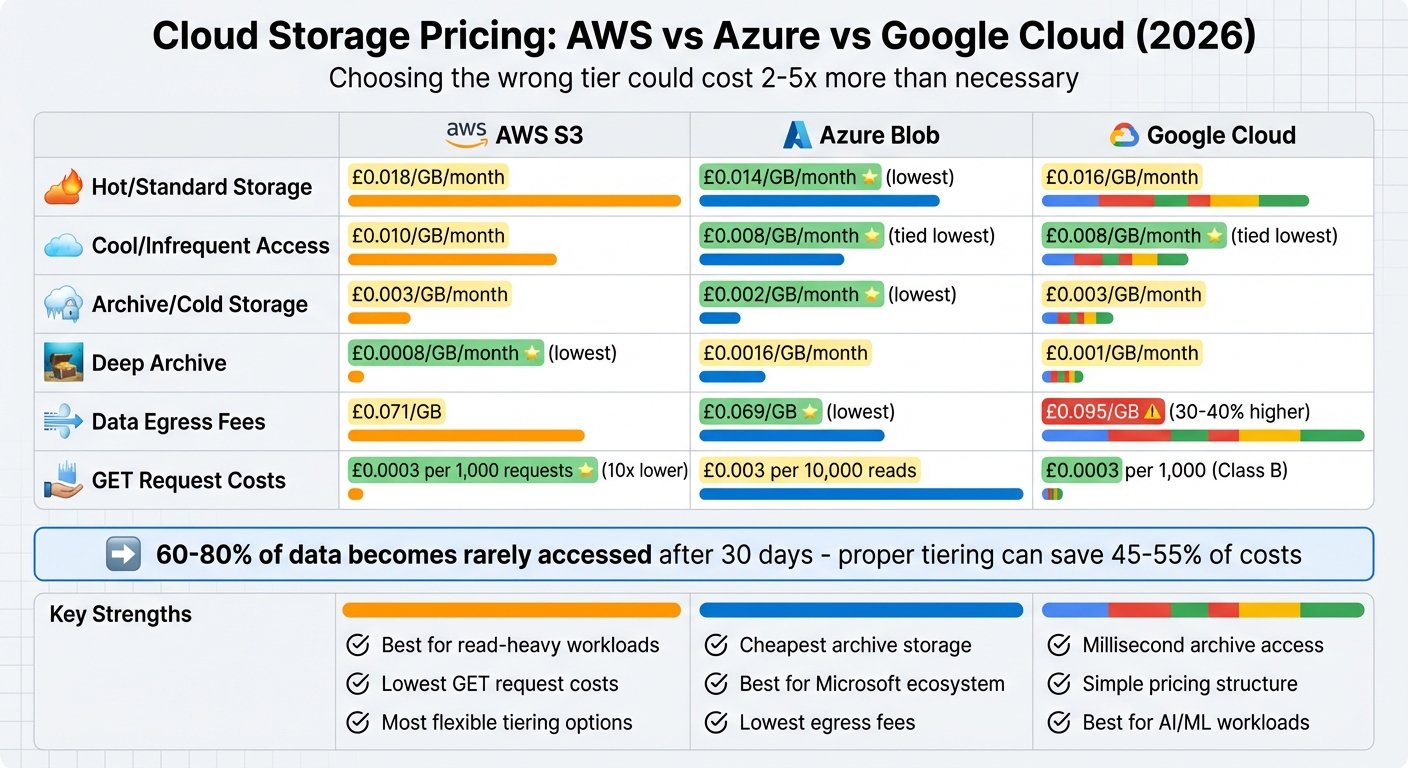 {Cloud Storage Pricing Comparison: AWS vs Azure vs Google Cloud 2026}
:::
{Cloud Storage Pricing Comparison: AWS vs Azure vs Google Cloud 2026}
:::
AWS S3 Storage Tier Pricing
AWS S3 provides seven storage tiers tailored to various access patterns. For frequently accessed data like active databases or content delivery, S3 Standard is the go-to option, costing about £0.018 per GB per month for the first 50 TB (converted from $0.023 USD). For less frequently accessed data with near-instant retrieval, S3 Standard-IA (Infrequent Access) is priced at approximately £0.010 per GB per month [4].
For even lower storage costs, the archive tiers are ideal. S3 Glacier Instant Retrieval, priced at around £0.003 per GB per month, is designed for data such as medical records or quarterly accessed assets. S3 Glacier Flexible Retrieval costs about £0.0028 per GB per month, with retrieval times ranging from minutes to hours. The most cost-effective option, S3 Glacier Deep Archive, comes in at roughly £0.0008 per GB per month, though retrieval can take up to 12 hours. For dynamic workloads, S3 Intelligent-Tiering automatically shifts objects between tiers, avoiding retrieval fees but incurring a £0.002 monitoring fee per 1,000 objects [4]. The table below outlines these pricing details.
Hidden Costs in AWS Pricing
While storage costs may seem straightforward, hidden fees can quickly add up. Lower storage costs often come with higher retrieval fees. For example, S3 Standard-IA charges about £0.008 per GB for data retrieval, while Glacier Instant Retrieval costs around £0.024 per GB. Expedited retrievals from Glacier Flexible Retrieval can cost £0.024 per GB, plus an additional £8.00 per 1,000 requests. Minimum storage durations also apply: objects in Standard-IA must remain for 30 days, while Glacier tiers require a minimum of 90 days (Instant and Flexible) or 180 days (Deep Archive) [4].
Smaller objects under 128 KB in IA or Glacier tiers are billed as 128 KB, with an additional 40 KB metadata overhead per object (split as 8 KB at Standard rates and 32 KB at Glacier rates). Request charges also vary: PUT and COPY operations cost about £0.004 per 1,000 requests, while GET requests are around £0.0003 per 1,000 requests. These fees can significantly impact costs for datasets with high activity [4].
S3 pricing still looks simple on the surface and gets expensive fast when usage patterns aren't understood.– Stephen Lucas, Chief Product Officer, Hyperglance [4]
AWS Pricing Table
| Storage Tier | Storage Cost (per GB/month) | Retrieval Fee (per GB) | Min. Duration | Best For |
|---|---|---|---|---|
| S3 Standard | £0.018 | £0.00 | None | Active data, web applications |
| S3 Standard-IA | £0.010 | £0.008 | 30 Days | Monthly backups, older sync files |
| S3 One Zone-IA | £0.008 | £0.008 | 30 Days | Re-creatable data, secondary copies |
| S3 Glacier Instant Retrieval | £0.003 | £0.024 | 90 Days | Quarterly-accessed archives |
| S3 Glacier Flexible Retrieval | £0.0028 | £0.008 (Standard) | 90 Days | Disaster recovery, offsite backups |
| S3 Glacier Deep Archive | £0.0008 | £0.016 (Standard) | 180 Days | Regulatory archives, long-term retention |
Prices converted from US East (N. Virginia) region rates [4].
Need help optimizing your cloud costs?
Get expert advice on how to reduce your cloud expenses without sacrificing performance.
Azure Blob Storage Tier Pricing
Azure Blob Storage pricing is designed to cater to various access patterns and redundancy needs, mirroring AWS's tiered approach. There are four distinct storage tiers, each with its own cost structure and ideal use cases.
The Hot tier is tailored for data that is accessed frequently. Storage costs here are about £0.015 per GB per month for Locally Redundant Storage (LRS). While this tier has the highest storage cost, access fees are minimal - £0.003 per 10,000 read requests, and data retrieval is free [6].
For data accessed less often (at least once every 30 days), the Cool tier offers a more economical option. Storage costs drop to roughly £0.008 per GB per month, but retrieval fees increase to £0.008 per GB and £0.008 per 10,000 read operations [5][6].
The Cold tier is ideal for data retained for at least 90 days. This tier provides even lower storage costs of £0.003 per GB per month, while maintaining fast millisecond-latency access. However, retrieval fees rise significantly to £0.024 per GB [5][6].
The Archive tier is the most cost-effective option at around £0.0016 per GB per month, but it comes with trade-offs. This offline tier requires a rehydration process before accessing data, which can take up to 15 hours for 10-GiB files. Retrieval costs include £0.016 per GB and £4.00 per 10,000 read operations for standard priority. Data must remain in Archive for at least 180 days to avoid penalties [5][7].
How Redundancy Affects Pricing
Azure offers different redundancy levels, which significantly influence costs. Locally Redundant Storage (LRS) keeps three copies of data within a single data centre, making it the most affordable redundancy option.
Zone-Redundant Storage (ZRS) replicates data across three availability zones, increasing Hot tier costs to approximately £0.018 per GB per month. Geo-Redundant Storage (GRS), which stores six copies across two regions, doubles LRS costs to about £0.029 per GB per month. GRS offers unmatched durability of 16 nines (99.99999999999999%), compared to LRS's 11 nines (99.999999999%) [5][9][11].
The Archive tier is limited to LRS, GRS, and Read-Access GRS (RA-GRS) configurations. It does not support Zone-Redundant or Geo-Zone-Redundant setups. Opting for LRS over GRS can lead to cost savings of 40–60% [9][10].
Azure Pricing Table
| Storage Tier | Storage Cost (per GB/month) | Retrieval Fee (per GB) | Min. Duration | Best For |
|---|---|---|---|---|
| Hot (LRS) | £0.015 | £0.00 | None | Active applications, frequently accessed data |
| Cool (LRS) | £0.008 | £0.008 | 30 Days | Short-term backups, infrequent access |
| Cold (LRS) | £0.003 | £0.024 | 90 Days | Quarterly-accessed archives |
| Archive (LRS) | £0.0016 | £0.016 (Standard) | 180 Days | Long-term compliance, regulatory archives |
| Hot (GRS) | £0.029 | £0.00 | None | Mission-critical data requiring geo-redundancy |
Prices are based on Azure Pay-As-You-Go rates for the first 50 TB of storage [5][8].
Next, we’ll take a closer look at Google Cloud Storage tier pricing.
Google Cloud Storage Tier Pricing
Google Cloud offers a tiered pricing structure similar to Azure, designed to balance storage costs with operational and network fees.
There are four main pricing tiers, each catering to different data access needs. The Standard tier is priced at about £0.016 per GB per month and is best for frequently accessed data like website content, interactive applications, and streaming media. This tier provides millisecond-latency access, no retrieval fees, and boasts 99.999999999% (11 nines) durability [14][15].
The Nearline tier reduces storage costs to approximately £0.008 per GB per month. This option is perfect for data accessed less than once a month, such as monthly reports or periodic backups. However, retrieval costs are £0.008 per GB, and data must remain stored for at least 30 days to avoid early deletion charges [14][17].
For less frequent access, the Coldline tier costs around £0.003 per GB per month. It’s ideal for things like disaster recovery copies or audit logs accessed quarterly or less. Retrieval fees increase to £0.016 per GB, and data must stay stored for 90 days minimum [14][17]. Lastly, the Archive tier offers the lowest storage cost at £0.001 per GB per month, with a 365-day minimum commitment. Unlike traditional archive storage, Google Cloud Archive provides millisecond access instead of requiring hours-long rehydration times [12][14].
Operational Costs and Retrieval Fees
Google charges for operations in two categories:
- Class A operations (e.g., uploads, object creation, and listings) cost about £0.004 per 1,000 requests.
- Class B operations (e.g., metadata reads and downloads) cost around £0.0003 per 1,000 requests for Standard storage.
These fees increase for colder storage tiers. For example, Archive storage charges roughly £0.04 per 1,000 operations for both Class A and Class B [3][1].
Network egress adds another layer of cost. While data transfers within the same region are free, moving data between continents or to the internet incurs fees ranging from £0.008 to £0.18 per GB, depending on the destination and volume [3][12]. For example, a 2026 analysis showed that a customer using 100 TB of Nearline storage across multiple regions and retrieving 10 TB incurred approximately £1,229 in storage costs and £82 in retrieval fees [13].
The biggest mistake I see organizations make is treating all data equally. A 5-year-old compliance document doesn't need the same retrieval speed as today's user-generated content, yet 80% of companies store both in S3 Standard.– Corey Quinn, Chief Cloud Economist at The Duckbill Group [16]
Google Cloud Pricing Table
| Storage Tier | Storage Cost (per GB/month) | Retrieval Fee (per GB) | Min. Duration | Best For |
|---|---|---|---|---|
| Standard | £0.016 | £0.00 | None | Active applications, streaming, websites |
| Nearline | £0.008 | £0.008 | 30 Days | Monthly backups, periodic reports |
| Coldline | £0.003 | £0.016 | 90 Days | Quarterly disaster recovery, audit logs |
| Archive | £0.001 | £0.040 | 365 Days | Regulatory archives, historical data |
Prices are based on US regions (us‑central1) and converted to GBP as of April 2026 [3][1][14].
This detailed breakdown sets the groundwork for comparing Google Cloud's pricing with AWS and Azure.
Tier Pricing Comparison Across Providers
Side-by-Side Pricing Comparison
This comparison provides a clear view of pricing differences among major cloud storage providers, helping businesses pinpoint the most cost-effective solutions. A direct look at the numbers shows Azure leading in raw storage costs for most tiers in 2026, while AWS stands out for read-heavy workloads, offering GET request costs that are up to 10 times lower [2].
| Tier | AWS S3 | Azure Blob | Google Cloud |
|---|---|---|---|
| Hot / Standard | £0.018/GB/month | £0.014/GB/month | £0.016/GB/month |
| Cool / Infrequent | £0.010/GB/month | £0.008/GB/month | £0.008/GB/month |
| Archive / Cold | £0.003/GB/month | £0.002/GB/month | £0.003/GB/month |
| Deep Archive | £0.0008/GB/month | £0.0008/GB/month | £0.001/GB/month |
| Data Egress | £0.071/GB | £0.069/GB | £0.095/GB |
Prices converted from USD to GBP as of April 2026 [18].
When it comes to retrieval fees, AWS emerges as the more budget-friendly option for applications with frequent read operations, while Google Cloud's fees are noticeably higher. Minimum storage duration requirements also vary, ranging from 30 days (AWS Standard-IA, Google Nearline) to 365 days (Google Archive) [3][16].
These details provide a foundation for understanding the broader cost trends and trade-offs.
Cost Trends and Observations
Several patterns emerge from the pricing data that can guide decisions about provider selection. Azure's strength lies in its archive tier pricing, where it offers storage at £0.002 per GB - lower than both AWS and Google Cloud, which charge £0.003 per GB [18][2]. However, this advantage diminishes when operational costs are factored in. For instance, AWS S3's GET request costs are just £0.0003 per 1,000 requests, making it a more economical choice for applications with frequent data reads, even in infrequent access tiers [2]. This makes AWS particularly appealing for businesses prioritising cost efficiency in read-heavy scenarios.
On the other hand, Google Cloud imposes the highest data egress fees, charging approximately 30–40% more than Azure or AWS [18]. For the hot/standard tier, Azure leads with £0.014 per GB per month, followed by Google Cloud at £0.016, while AWS comes in at £0.018 [18]. In the cool/infrequent tier, Azure and Google Cloud are tied at £0.008 per GB, with AWS slightly higher at £0.010 [18][2].
These comparisons underline the trade-offs between providers: Azure offers the lowest storage costs, especially for archival data with minimal access; AWS is the go-to for workloads with frequent read operations; and Google Cloud, while pricier for data egress, may still appeal to users with specific needs [18].
Additional Costs and Cost Reduction Strategies
Hidden Costs Across Providers
Cloud storage isn't just about the per-GB rate - it comes with a variety of additional charges that can quickly add up. Four main factors typically drive your total costs: storage capacity, API operations, data retrieval, and data egress [19][21]. For example, Google Cloud has the highest egress fees at roughly £0.095 per GB, compared to AWS and Azure, which charge around £0.07 per GB [18][19].
API operations are another expense to keep an eye on. Actions like PUT, GET, LIST, or DELETE requests are billed separately. Azure charges £5.20 per million for Class A operations, while AWS and Google Cloud charge £4.00 for the same [20]. If you're dealing with millions of small objects, especially during migrations or automated workflows, these costs can spiral. Additionally, removing data from cold or archive tiers before meeting the minimum retention period (30–365 days, depending on provider and tier) can result in hefty charges [19][23][17][3].
Egress fees are one of the most misunderstood and frustrating aspects of cloud pricing. Organizations often don't realize the true cost of moving data out of the cloud until they receive an unexpectedly large bill.
– Corey Quinn, Cloud Economist, The Duckbill Group [20]
Orphaned resources are another common source of waste. In one instance from 2025, an audit of an AWS setup revealed 87 unused EBS volumes totalling 4,300 GB. These volumes cost the organisation £344 per month, leading to £6,192 in unnecessary spending over 18 months before the issue was resolved [19]. Similarly, incomplete uploads and unmanaged versioning can silently rack up costs, as old versions are often billed at full rates indefinitely [19][21].
Cost Reduction Best Practices
It's estimated that 45–55% of cloud storage costs can be trimmed, largely because 60–80% of stored data is rarely accessed after the first 30 days but remains in pricey hot
storage tiers [19][21]. Tackling these inefficiencies can deliver substantial savings.
Automated tiering is a game-changer. Services like AWS S3 Intelligent-Tiering and Google Cloud's Autoclass use machine learning to shift data between storage tiers automatically, helping users avoid retrieval fees. Since their introduction, these tools have collectively saved customers over £5 billion [19][21]. For workloads with predictable patterns, Azure Storage Reserved Capacity offers up to 34% discounts for three-year commitments [19][21].
Lifecycle policies are another effective way to cut costs. By automating tasks like aborting incomplete multipart uploads after seven days, expiring outdated object versions, and deleting orphaned snapshots, you can eliminate unnecessary expenses [19][24]. Moving infrequently accessed data from hot to cold storage can also yield significant savings. If you're serving public-facing content, using a Content Delivery Network (CDN) can reduce egress and origin fetch costs by 60–80% [19][21]. Additionally, compressing log files (such as JSON or CSV) before storage can shrink data volumes by up to 80% [19].
Other strategies include placing storage buckets and compute resources in the same region to avoid cross-region charges entirely. For block storage users, migrating AWS EBS volumes from gp2 to gp3 can provide immediate savings of around 20% while separating IOPS from capacity [22][24]. Tools like Terraform or CloudFormation can also enforce cost-efficient defaults, such as Intelligent-Tiering and automated version cleanups, across new storage buckets [19][21].
Hokstad Consulting's Cost Engineering Services
Addressing these hidden costs often requires expert insight. Hokstad Consulting offers specialised cloud cost engineering services, helping businesses cut storage and infrastructure expenses by 30–50%. Their process starts with a detailed audit to uncover inefficiencies like orphaned resources, poorly chosen tiers, and high egress fees across AWS, Azure, and Google Cloud platforms.
They implement solutions such as automated lifecycle policies, right-sizing block storage, and deploying CDNs to reduce data transfer costs. Hokstad Consulting operates on a No Savings, No Fee
model, ensuring their fees are tied directly to the savings they generate - no upfront costs involved. Their services also include ongoing DevOps support, infrastructure monitoring, and cloud security audits, ensuring your storage remains both cost-effective and high-performing. Learn more about their approach at Hokstad Consulting.
Conclusion: Choosing the Right Provider and Tier
Lowest Cost Options Summary
For long-term storage of infrequently accessed data, AWS S3 Glacier Deep Archive stands out as the most affordable option, priced at just £0.0008 per GB/month. Comparatively, Google Cloud Archive Storage costs £0.0012 per GB/month, and Azure Archive Storage comes in at £0.0015 per GB/month. For frequently accessed data, AWS S3 Standard and Google Cloud Standard both charge £0.018 per GB, whereas Azure Hot Storage is notably higher at £0.037 per GB. When it comes to infrequent access tiers, AWS and Google Cloud are priced at £0.010 per GB, while Azure charges double at £0.020 per GB.
When to Choose Each Provider
- AWS: Ideal for those needing advanced lifecycle management and seamless integration, particularly when leveraging Graviton ARM compute savings.
- Azure: Best suited for organisations heavily invested in the Microsoft ecosystem, especially those in the UK public sector or requiring hybrid cloud solutions.
- Google Cloud: A strong choice for SMEs and AI/ML teams, offering simplicity, automatic discounts, and an 'Always Free' tier for cost-conscious users.
It’s essential to consider additional fees. For instance, Google Cloud’s egress fee is £0.095 per GB, higher than the £0.07 per GB charged by AWS and Azure. Additionally, API request costs can pile up quickly when managing large volumes of small objects. With studies showing that 60–80% of stored data becomes rarely accessed after 30 days, there’s significant potential for cost savings by optimising storage strategies [19].
The Benefits of Expert Guidance
As public cloud spending is projected to exceed £800 billion by 2026 [21], even small inefficiencies can lead to substantial costs over time. Hokstad Consulting specialises in helping businesses cut storage and infrastructure expenses by 30–50%. Their services include detailed audits, automated lifecycle policies, and strategic tier selection across AWS, Azure, and Google Cloud. With their 'No Savings, No Fee' model, you only pay when measurable savings are achieved. Plus, their ongoing DevOps support ensures your storage remains optimised as your data grows. Learn more about their approach at Hokstad Consulting.
FAQs
How do I choose the right storage tier for my access pattern?
When deciding on a storage tier, the frequency with which you access your data is key. If you need to access your data regularly, go for hot or standard tiers like AWS S3 Standard or Azure Hot. These tiers are designed for low-latency access, though they come with higher costs.
On the other hand, if your data is accessed less often, consider more cost-effective options. Choices like S3 Intelligent-Tiering (Infrequent/Archive) or Azure Cool/Cold tiers are tailored to reduce expenses while still meeting your occasional access requirements.
What 'hidden costs' most often make cloud storage 2–5× more expensive?
Hidden fees can quickly drive up cloud storage costs. Some common culprits include egress fees, over-provisioned performance tiers, orphaned snapshots, forgotten backups, incomplete multipart uploads, and version stacking. These often-overlooked factors can push monthly expenses far beyond expectations, sometimes inflating costs by as much as 2–5×.
How can I reduce data egress charges across AWS, Azure and Google Cloud?
To cut down on data egress costs with AWS, Azure, or Google Cloud, focus on reducing the amount of data leaving the provider's network. Here’s how you can do that:
- Use Content Delivery Networks (CDNs): CDNs cache your data closer to end users, reducing the need for cross-network transfers.
- Compress Data: Smaller data sizes mean less transfer cost. Apply compression techniques wherever possible.
- Optimise Regional Deployments: Keep your resources and data within the same region to avoid inter-region charges.
- Leverage Private Connections: Options like VPNs or Direct Connect can lower costs compared to public internet transfers.
Additionally, design your applications to favour same-region data access. Mapping out your data transfer costs can also help pinpoint and reduce expensive paths, such as inter-region or cross-zone traffic.