
Managing GDPR compliance in hybrid cloud environments is challenging but essential. Hybrid clouds combine on-premises and public cloud systems, offering flexibility but creating complex data protection responsibilities. Missteps in data transfers, shared responsibility gaps, and limited visibility into data flows can lead to fines of up to £17.5 million or 4% of annual global turnover. Here's what you need to know:
- Restricted Transfers: Data sent outside the UK requires strict safeguards like Standard Contractual Clauses or Adequacy Decisions.
- Shared Responsibility Model: Cloud providers secure infrastructure, but you're accountable for data security, configurations, and access controls.
- Common Issues: Unclear data storage locations, compliance gaps during audits, and risks from cross-border transfers.
- Consequences: Data breaches, reputational damage, and operational disruptions.
How to stay compliant:
- Map all personal data flows across systems.
- Formalise Data Processing Agreements (DPAs) with cloud providers.
- Use encryption (AES-256, TLS 1.3) and access controls (RBAC, MFA).
- Conduct Data Protection Impact Assessments (DPIAs) for new solutions.
- Automate monitoring to detect misconfigurations and unauthorised access.
With GDPR fines exceeding €4 billion since 2018, compliance isn't optional. Start by integrating safeguards into your infrastructure, and consider expert support to address gaps efficiently. Act now to avoid costly penalties and protect your business.
GDPR Challenges in Hybrid Cloud Data Transfers
GDPR Obligations for Data Controllers and Processors
Hybrid cloud architectures bring a unique set of challenges for organisations trying to meet GDPR requirements. Under Article 28, any cloud provider handling personal data on your behalf must operate under a Data Processing Agreement. This includes listing all sub-processors and ensuring you're informed whenever new sub-processors are added or existing ones are changed [2].
Article 32 adds another layer of complexity with the shared responsibility model. While cloud providers handle infrastructure security, you're responsible for securing operating systems, configuring networks, encrypting data, and managing access controls. This is especially critical when data moves between managed (public cloud) and unmanaged (private infrastructure) environments [2].
The hybrid nature of these setups heightens risks, particularly with data frequently crossing organisational and jurisdictional boundaries. For instance, when personal data shifts between private systems and public cloud regions - especially across borders - strong legal safeguards are necessary. This might involve using Adequacy Decisions, the EU-US Data Privacy Framework, or Standard Contractual Clauses [2]. Without these safeguards, organisations face significant exposure to compliance risks.
Beyond these legal requirements, hybrid environments also create operational difficulties, such as tracking data flows and ensuring data residency, which are explored further below.
Common Compliance Problems in Hybrid Cloud Setups
In addition to meeting GDPR obligations, organisations face practical challenges in ensuring compliance within hybrid cloud environments.
One of the biggest issues is limited visibility into data flows. Personal data often spreads across backups, CDN edge nodes, replicas, and logs. Even when a primary record is deleted, residual copies may remain in various parts of your infrastructure [2]. This complicates compliance with data erasure requests.
Unclear storage locations are another hurdle. Even if data residency is configured to keep primary data within the EU, transfers may still occur through logging services, metadata processing, or when non-EU support engineers access your systems [2]. These unnoticed transfers can surface only during audits, creating compliance risks. Additionally, hybrid architectures often face accountability gaps
, where fragmented ownership across different services and platforms makes it difficult to track data locations and assign responsibility [4].
Third-country transfers pose further challenges. When data moves across borders - especially to countries without adequacy decisions - organisations are required to perform Transfer Risk Assessments or Transfer Impact Assessments. These assessments must align with the Schrems II ruling and often require supplementary measures to ensure compliance [3]. Many organisations discover that numerous cross-border transfers demand individual risk assessments and thorough documentation, adding to the operational burden.
Need help optimizing your cloud costs?
Get expert advice on how to reduce your cloud expenses without sacrificing performance.
Risks of Non-Compliance in Hybrid Cloud Transfers
Data Security Risks
Failing to comply with GDPR in hybrid cloud environments opens the door to serious security vulnerabilities. For instance, transferring unencrypted data via cloud providers in third countries leaves it exposed to various risks, as such transfers often lack the technical safeguards regulators demand [3]. The problem becomes even more significant when data moves between private systems and public cloud regions without encryption or strict access controls.
Here’s what recent findings reveal:
- 98% of businesses reported at least one cloud-data breach in an 18-month period, yet only 13% had a clear understanding of their cloud-security responsibilities.
- The National Cyber Security Centre (NCSC) estimates that over 80% of cloud account breaches could have been avoided by implementing multi-factor authentication (MFA).
- Misconfigurations in cloud setups have led to massive breaches - such as the exposure of personal data for over 100 million US individuals and 6 million Canadians, resulting in a settlement of approximately £190 million.
Hybrid cloud environments heighten these risks. Data frequently moves between managed and unmanaged systems, and even a single misconfigured cloud firewall can cause breach costs to skyrocket - adding an average of £1.7 million to the overall damage. In 2023, the global average cost of a data breach reached £3.6 million, illustrating the steep financial consequences of inadequate security measures.
These security failures don’t just hit the bottom line - they also lead directly to legal troubles, as discussed below.
Legal and Financial Penalties
The legal ramifications of non-compliance are just as severe as the security risks:
Under GDPR, organisations face hefty fines and operational disruptions. Take the example of Google: in 2019, the French regulator CNIL imposed a €150 million fine for cookie consent violations, setting a global precedent for managing data flows [5]. Regulators have the authority to act swiftly. Article 46 of GDPR allows them to suspend data transfers immediately, potentially halting critical business operations overnight [5].
The damage doesn’t stop at fines. The reputational fallout from publicised enforcement actions can be devastating. Customers lose trust, and businesses may find themselves excluded from procurement opportunities or losing contracts with partners who prioritise strong privacy measures [5][1].
The cost of non-compliance is great. If you think compliance is expensive, try non-compliance.
Beyond fines and reputational harm, organisations also risk lawsuits from affected individuals and ongoing scrutiny from supervisory authorities. This creates a persistent legal grey area, adding to the uncertainty and challenges businesses must navigate [5].
Governance in the Cloud - Managing Data Regulation
Practical Solutions for GDPR Compliance
::: @figure 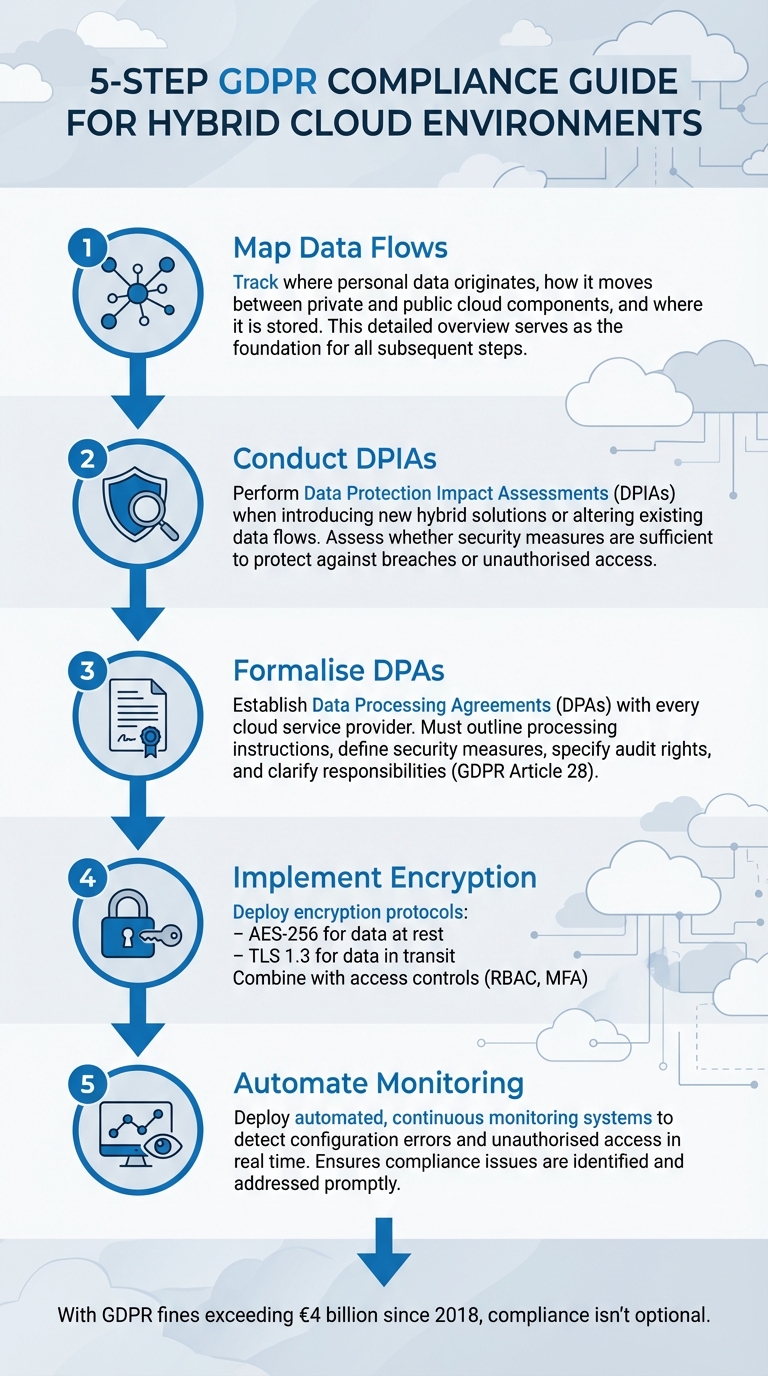 {5-Step GDPR Compliance Guide for Hybrid Cloud Environments}
:::
{5-Step GDPR Compliance Guide for Hybrid Cloud Environments}
:::
5-Step Compliance Guide
Navigating GDPR compliance in hybrid cloud environments requires a clear and systematic approach. Start by mapping all personal data flows - track where the data originates, how it moves between private and public cloud components, and where it is stored. This detailed overview serves as the foundation for all subsequent steps.
Conduct Data Protection Impact Assessments (DPIAs) whenever introducing a new hybrid solution or altering existing data flows[7][9]. These evaluations help uncover risks to individuals’ rights, allowing you to address vulnerabilities before they escalate. For each data transfer route, assess whether the security measures in place are sufficient to protect against breaches or unauthorised access.
Formalise Data Processing Agreements (DPAs) with every cloud service provider you work with[6][7]. GDPR Article 28 mandates these contracts, which must outline processing instructions, define security measures, specify audit rights, and clarify the responsibilities of each party. Without these agreements, you risk operating in a legally uncertain area that regulators are unlikely to ignore.
Strengthen your security measures by implementing encryption protocols like AES-256 for data at rest and TLS 1.3 for data in transit[10].
Finally, deploy automated, continuous monitoring systems to detect configuration errors and unauthorised access in real time. This proactive approach helps ensure compliance issues are identified and addressed promptly.
These steps lay the groundwork for more advanced technical measures to secure your hybrid cloud environment.
Technical Best Practices
After establishing a compliance framework, implement targeted technical measures to reinforce data protection. Start with Role-Based Access Control (RBAC), ensuring access is limited to only what is necessary. Tools such as AWS IAM, Azure AD, or Google Cloud IAM can help enforce these controls[10].
Use network segmentation techniques - such as Virtual Private Clouds (VPCs), subnets, and security groups - to isolate sensitive data. This strategy limits the potential damage if one part of the system is compromised, preventing attackers from spreading across your infrastructure. Combine segmentation with multi-factor authentication (MFA), leveraging hardware tokens or biometric verification for added security.
Centralised logging through Security Information and Event Management (SIEM) tools is another key step. Platforms like Splunk or Google Security Command Centre can consolidate logs across systems, providing a comprehensive audit trail to demonstrate compliance during inspections[10]. Additionally, adopt data minimisation techniques by anonymising personal data before processing and setting up automated lifecycle policies to delete data when it’s no longer needed[8][9].
| Technical Measure | GDPR Objective | Implementation Tool/Method |
|---|---|---|
| Encryption | Integrity and Confidentiality | AES-256 (Rest), TLS 1.3 (Transit) |
| RBAC / IAM | Access Control | AWS IAM, Azure AD, Google Cloud IAM |
| Segmentation | Risk Mitigation | VPCs, Subnets, Security Groups |
| SIEM / Logging | Accountability | Splunk, Google SCC, Chronicle |
| MFA | Security of Processing | Hardware tokens, Biometrics, SSO |
| DLP API | Data Minimisation | Sensitive Data Protection services |
Using Expert Support for Compliance
When in-house expertise is insufficient, external specialists can simplify the implementation of compliance measures. Hokstad Consulting, for example, offers tailored strategies that combine regulatory compliance with security and performance. Their services integrate compliance measures into existing workflows without disrupting operations.
These consultants assess your hybrid cloud architecture, identify compliance gaps, and design custom solutions to address specific data flows and obligations. They handle complex tasks such as implementing encryption, configuring secure networks, and setting up automated monitoring systems. This allows your internal teams to focus on business priorities while ensuring compliance, especially in environments where shared responsibility models - across SaaS, PaaS, and IaaS - require clear definitions of roles to avoid costly errors.
How Hokstad Consulting Supports Hybrid Cloud GDPR Compliance

Tailored Solutions for Hybrid Cloud Setups
Hokstad Consulting weaves GDPR requirements directly into your CI/CD pipelines, ensuring that encryption, access controls, and audit logging are part of the process. This approach helps maintain compliant data transfers without slowing down deployments.
Their cloud cost audits not only identify overspending but also highlight compliance gaps in your hybrid cloud environment. With their deep knowledge of hybrid and managed hosting environments, Hokstad Consulting addresses the unique challenges of protecting data across various infrastructure components. By breaking down siloes between on-premises and cloud systems, they close gaps that could compromise data protection.
Additionally, their custom-built monitoring systems automatically detect configuration drift and unauthorised access across both private and public clouds. This integration not only strengthens GDPR compliance but also sets the stage for better cost management.
Budget-Friendly Compliance Solutions
Hokstad Consulting pairs technical expertise with strategies designed to be cost-effective, making compliance improvements more accessible.
Their 'no savings, no fee' model ensures you only pay if they achieve cloud cost reductions, typically between 30–50%. By cutting unnecessary expenses like redundant storage, over-provisioned instances, and inefficient data transfer paths, they free up resources. These savings can then be reinvested into compliance measures such as stronger encryption, advanced monitoring, and effective network segmentation. This way, compliance upgrades enhance your operations without requiring additional investments, keeping your cloud infrastructure efficient and secure.
Conclusion
Achieving GDPR compliance in hybrid cloud environments is not a one-time task - it’s an ongoing process built into your infrastructure. Key challenges like data residency, encryption, access control, and erasure rights require precise, well-thought-out solutions. Since 2018, GDPR violations have resulted in total fines exceeding €4 billion, highlighting the serious consequences of non-compliance[11].
That said, compliance doesn’t have to mean skyrocketing costs or slower operations. By using Infrastructure-as-Code tools, automating monitoring processes, and enforcing strict access controls, you can embed compliance into your workflows seamlessly. The trick is to approach GDPR as an infrastructure issue rather than just a legal one. Incorporating practices like region-locking, encryption, and audit logging into your deployment processes ensures compliance becomes second nature, not an afterthought.
Companies like Hokstad Consulting offer a practical way forward. With a focus on reducing cloud expenses by 30–50%, their no savings, no fee
model allows businesses to reinvest those savings into improved compliance measures. This approach aligns cost management with the need for robust data protection, creating a balance between efficiency and security.
The regulatory landscape continues to evolve, adding new layers of complexity. For UK businesses, the post-Brexit environment introduces additional challenges, but there’s some good news: the EU adequacy decision has been extended until the end of 2031[11]. This extension simplifies cross-border data transfers for the foreseeable future. Regardless of whether you’re working with public, private, or hybrid clouds, the next steps are clear - conduct gap analyses, automate policy enforcement, and define clear roles and responsibilities between your team and your cloud providers.
Don’t wait for audits or penalties to force action. Start integrating GDPR compliance into your hybrid cloud strategy today. Partnering with experts who understand both the technical and financial aspects of compliance can make this process far smoother and more effective.
FAQs
How can I check if my hybrid cloud setup involves third-country transfers?
To determine whether your hybrid cloud setup involves transferring data to third countries, start by mapping your data flows. This will help you pinpoint if personal data is being shared with or accessed by providers located outside the UK or EU. To stay compliant, put safeguards in place, such as using Standard Contractual Clauses (SCCs) or depending on adequacy decisions. These measures are crucial for ensuring GDPR compliance when managing cross-border data transfers.
What should a GDPR-compliant cloud DPA include for hybrid environments?
A cloud Data Processing Agreement (DPA) that aligns with GDPR for hybrid environments needs to address several key areas. It should clearly define the roles involved in data processing, ensuring transparency about responsibilities. It must also specify security measures, such as encryption standards, to safeguard data. Additionally, the document should outline the obligations for data protection and provide detailed guidance on managing sub-processors. These elements are essential for meeting GDPR requirements while tackling the complexities of data flows in hybrid cloud setups.
What’s the quickest way to prove compliance in an audit?
Keeping detailed and up-to-date records of system activities is the quickest way to show compliance. These records should cover user actions, system events, and configuration changes. To ensure they remain secure, use encryption, implement access controls, and conduct regular reviews.
Utilising automated tools for continuous monitoring and compliance tracking can simplify this process. These tools not only help keep your records in order but also ensure you're always prepared for audits.