
Handling electronic Protected Health Information (ePHI) in private cloud environments comes with strict responsibilities under HIPAA. This guide summarises the key elements you need to know to ensure compliance, avoid penalties, and safeguard sensitive healthcare data.
Key Takeaways:
- Understand Your Role: If your cloud infrastructure processes ePHI, you're a Business Associate under HIPAA, with direct legal obligations.
- Follow the Shared Responsibility Model: Providers secure physical infrastructure; customers handle application-level controls and staff training.
- Focus on These Areas:
- Governance & Risk Management: Map ePHI data flows, conduct risk assessments, and maintain documentation for six years.
- Cloud Architecture: Implement physical security, network isolation, and disaster recovery measures.
- Technical Safeguards: Use AES-256 encryption, multi-factor authentication, and detailed logging.
- Incident Response: Create and test a response plan, and meet breach notification deadlines.
- Stay Updated: Regulatory changes, like the 2024 NPRM, may require semi-annual vulnerability scans and stricter network segmentation.
Quick Start Plan:
- First 30 Days: Map ePHI workflows and finalise Business Associate Agreements (BAAs).
- Next 30 Days: Conduct a full risk analysis.
- Final Phase: Strengthen server security and deploy monitoring systems.
This checklist ensures private cloud providers meet HIPAA requirements while minimising risks of data breaches or penalties.
Governance and Risk Management
HIPAA Scoping and Risk Assessment
The first step in managing HIPAA compliance is to identify and map out every system that deals with electronic protected health information (ePHI). This includes storage buckets, databases, backup systems, and SaaS applications [7]. A detailed data flow map is invaluable, as it reveals where sensitive data travels, who interacts with it, and where it ultimately resides [5].
Conducting a formal risk assessment is equally vital. This process involves identifying potential threats, assessing their likelihood and impact, and creating a prioritised plan to address them [5]. A sobering statistic shows that only 14% of covered entities have substantially met HIPAA's risk analysis requirements, according to an OCR audit [2]. In response to deficiencies, the HHS Office for Civil Rights introduced a Risk Analysis Initiative
in October 2024. By April 2025, this initiative had led to eight settlements totalling nearly £900,000, primarily related to ransomware cases where risk assessments were found lacking or non-existent [2].
Compliance isn't a once-and-done thing. It must be continually maintained by an organisation. It cannot be achieved by merely taking and passing an exam.- Gil Vidals, CEO, HIPAA Vault [5]
Additionally, a proposed Notice of Proposed Rulemaking (NPRM) from December 2024 may soon mandate vulnerability scans every six months and penetration testing annually [2].
To support your risk management strategy, ensure robust policies and procedures are in place and well-documented.
Policies, Procedures, and Documentation
A risk assessment alone is insufficient without actionable follow-through. HIPAA mandates written policies that address risk management, sanctions for non-compliance, security incident response, and contingency planning [2]. Furthermore, all documentation - whether policies, audit logs, or risk assessments - must be retained for at least six years from the date of creation or the last effective date [2][5].
Thorough documentation serves as the backbone of compliance efforts, providing clear evidence during audits. To stay prepared, schedule regular reviews rather than waiting for issues to arise. Many organisations are now adopting policy-as-code approaches, automating compliance checks for elements like firewall rules, encryption, and configuration changes. This reduces manual effort and helps catch potential issues before auditors do [4]. Assigning a compliance officer to oversee documentation, manage processes, and coordinate staff training is another practical measure to lower organisational risk [5].
With policies and documentation in place, the next critical step involves formalising vendor responsibilities.
Business Associate Agreements and Vendor Management
If you handle ePHI as a private cloud provider, HIPAA classifies you as a Business Associate. This designation brings direct legal responsibilities, not just contractual obligations [2][7]. Before any ePHI is processed or stored, a Business Associate Agreement (BAA) must be in place [1].
A valid BAA should clearly define the permitted uses of ePHI, outline your responsibilities for safeguarding the data, require breach reporting within 60 days, and specify the return or destruction of data once the agreement ends [1][7]. If your infrastructure relies on subcontractors who interact with ePHI, you must extend BAAs to cover them as well [7]. For example, Oregon Health & Science University faced a £2.7 million settlement after a breach involving cloud storage without a proper BAA [2].
It’s also essential to align your Service Level Agreements (SLAs) with BAA requirements. Ensure that commitments around data recovery, backup availability, and uptime in SLAs do not conflict with your compliance obligations under the BAA. Any gap between these agreements can lead to serious compliance risks.
Private Cloud Architecture and Physical Security
Facility and Environmental Controls
When it comes to HIPAA compliance, physical security often gets overlooked, but it’s the bedrock of protecting sensitive information. If someone gains physical access to a facility, they can bypass even the most advanced encryption safeguards.
Facilities housing ePHI (electronic Protected Health Information) demand strict access controls. For starters, there shouldn’t be any external signage identifying the building as a data centre. Entry points must be gated, with security personnel verifying photo IDs and maintaining detailed access logs[3]. Sensitive areas should require biometric authentication and individual access credentials[3]. On top of that, 24/7 CCTV coverage is essential, with cameras monitoring every cage, aisle, and door-access point to create a strong physical security framework[3].
Environmental controls are just as critical. Server cabinets and communication racks must remain locked and clearly marked with restricted-area signage[3]. A solid data backup strategy is also vital. A 3-2-1 approach is recommended: keep three copies of your data, store them on two different media types, and ensure one copy is offsite - ideally at least 80 kilometres away[2][5]. When hardware is retired, disposal should follow NIST SP 800-88 standards, which involve multi-pass drive wiping and maintaining a chain-of-custody record for every decommissioned device[5].
These measures complement the broader risk management strategies outlined in governance frameworks. Once physical security is in place, the next step is to focus on network segmentation to further safeguard ePHI.
Network and Cloud Segmentation
After securing the physical environment, the next challenge is isolating network resources to maintain compliance. A poorly designed infrastructure can jeopardise HIPAA compliance, so the principle here is simple: ePHI workloads must remain isolated. They should not share compute, storage, network, or management resources with other systems or organisations[6].
The defining characteristic from a compliance standpoint is tenant isolation - the guarantee that compute, storage, network, and management planes are not commingled with other organisations' resources.- Cloud Compliance Authority[6]
To achieve this, infrastructure should be divided into distinct layers. For example:
- The management plane (e.g., hypervisors, storage controllers, IAM tools) must be separate from the application plane (workload services) and the data plane (EHR databases and clinical data stores).
- At the network level, use tools like:
- Private VLANs for internal traffic
- A Demilitarised Zone (DMZ) for public-facing services
- Dedicated firewalls for each environment
- Virtual Routing and Forwarding (VRF) for additional separation on the network fabric[3]
To limit the spread of breaches, route all inter-service (east–west) traffic through dedicated inspection points. This is particularly important, as the December 2024 NPRM proposes making network segmentation a mandatory control rather than an optional one[2].
For administrative access, replace direct SSH or RDP logins with bastion hosts. These hosts enforce multi-factor authentication (MFA), session recording, and just-in-time (JIT) privilege elevation. Backup networks should also operate on isolated interfaces with restricted routes, ensuring they remain off the user path and are less vulnerable to ransomware attacks.
Here’s a comparison of basic and advanced approaches for key control areas:
| Control Area | Minimum Acceptable Approach | Preferred Healthcare-Grade Approach |
|---|---|---|
| Network Segmentation | Basic VLAN separation | VLANs + VRFs + distributed firewalls + host firewalls |
| Privileged Access | Direct SSH/RDP with shared accounts | Bastion host, MFA, JIT access, session recording |
| Backup Strategy | Nightly backups to a shared repository | Immutable backups, offsite copy, isolated backup plane |
| DR Readiness | Documented plan with no exercises | Quarterly tabletop exercises and an annual failover test |
These practices align closely with HIPAA’s requirements to protect ePHI at every layer of infrastructure. By combining physical security with robust network segmentation, organisations can build a strong, compliant environment for handling sensitive health information.
Is the Cloud REALLY HIPAA Compliant? - 10 Critical Questions Answered!
Technical Safeguards for HIPAA Compliance
::: @figure 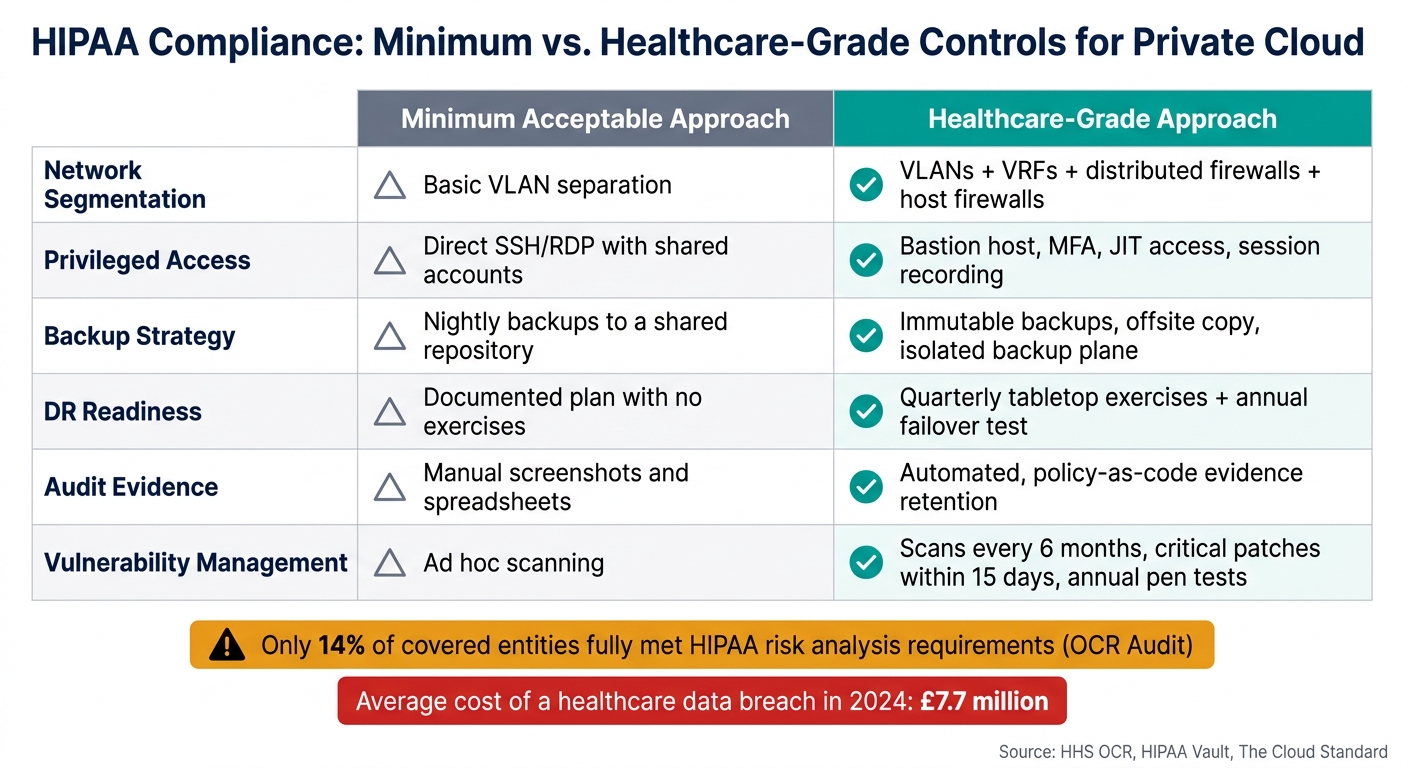 {HIPAA Compliance: Minimum vs. Healthcare-Grade Controls for Private Cloud}
:::
{HIPAA Compliance: Minimum vs. Healthcare-Grade Controls for Private Cloud}
:::
Identity and Access Management
Once physical and network protections are in place, the next step is managing who can access electronic Protected Health Information (ePHI) and under what conditions. Start by assigning each user a unique identifier - shared accounts should be avoided to ensure accountability. Implement Role-Based Access Control (RBAC) to restrict access to data based on job responsibilities. For added security, Just-in-Time (JIT) privilege elevation can be used to grant temporary elevated access, reducing the risk of misuse if credentials are compromised.
The February 2024 Change Healthcare breach serves as a stark warning: attackers exploited a Citrix portal that lacked multi-factor authentication, exposing 192.7 million patient records. By the end of 2024, the breach had incurred damages estimated at £2.26 billion [2].
Additional safeguards include automatically terminating inactive sessions to prevent unauthorised access. Regularly reviewing access permissions - ideally every quarter - helps ensure that users only have the access they need.
Encryption and Key Management
Controlling access is critical, but protecting the integrity of ePHI also requires robust encryption and key management. As of January 2025, HIPAA mandates AES-256 encryption for data at rest and TLS 1.2 or higher (preferably TLS 1.3) for data in transit. Internal service-to-service traffic should also be encrypted, and older protocols like SSL v2/v3 and TLS 1.0/1.1 must be disabled to close potential security gaps.
Encryption is the single control that turns a HIPAA breach into a non-event.- Garvita Amin, Healthcare Technology Expert [8]
Key management is equally important. Encryption keys should always be stored separately from the data they protect. Using a centralised Key Management Service (KMS), backed by a Hardware Security Module (HSM), is the recommended approach for managing root and high-value keys. High-sensitivity workloads benefit from automated key rotation every 90 days. Proper encryption of PHI offers a legal advantage under the Breach Notification Rule - if encrypted data is stolen but the keys remain secure, it may not be considered a reportable breach [8].
Logging, Monitoring, and Audit Controls
Strong access controls and encryption need to be paired with detailed logging and monitoring to ensure HIPAA compliance. Every access event should be logged with details such as the user ID, timestamp, transaction type (e.g., create, read, update, delete), system accessed, status, and source IP [2].
Logs should be centralised in a Security Information and Event Management (SIEM) platform and transmitted securely over encrypted channels. To ensure integrity, store logs in tamper-evident WORM storage or use digital signatures. Maintain 90 days of hot data for immediate access and archive logs for six years to meet compliance requirements.
Automated alerts are essential for turning audit logs into proactive defences. These alerts can identify unusual activity, such as repeated failed login attempts, bulk data downloads, or access during odd hours. Accurate event correlation during investigations also depends on time synchronisation across all systems. The stakes are high - healthcare data breaches in 2024 had an average cost of approximately £7.7 million [2].
Compliance isn't overhead - it's infrastructure. Build it in from day one, or pay exponentially more when OCR investigates your breach.- The Cloud Standard [2]
Incident Response and Continuous Improvement
Incident Response and Breach Notification
Having a clear and well-rehearsed incident response plan can make all the difference between a quick recovery and severe penalties. Start by defining roles and responsibilities across key areas like networking, virtualisation, and identity management. Without clear ownership, critical tasks can easily be overlooked. It's also vital to align your internal response timelines with the obligations set out in your Business Associate Agreement (BAA), rather than relying solely on HIPAA's minimum requirements [7].
If a breach occurs, HIPAA requires notifying affected individuals and the Department of Health and Human Services (HHS) within 60 days of discovery. For breaches impacting 500 or more individuals, media notification is also mandatory [7]. Proposed changes in the 2024 NPRM add further urgency, requiring Business Associates to notify Covered Entities within 24 hours of activating contingency plans, with systems needing to be recoverable within 72 hours after a disaster or security incident [2]. To stay compliant, ensure these timelines are reflected in your BAAs and incorporated into your broader HIPAA compliance checklist.
The financial consequences of poor incident response are steep. For example, in early 2024, Montefiore Medical Centre faced a £3.76 million settlement with the OCR due to an insider threat incident. Under the HITECH Act, civil monetary penalties can reach £1.5 million per violation category annually [2].
In healthcare, a 'successful' platform is one that stays boring during normal operations and highly legible during incidents.- Healthcare Private Cloud for EHR & Telehealth [4]
These response measures lay the groundwork for continuous improvement, as outlined in the next section.
Testing, Audits, and Ongoing Compliance
Incident response plans are only as effective as their testing. Without regular evaluation, they remain theoretical [4]. Conduct quarterly tabletop exercises that include all relevant stakeholders - not just IT teams - and carry out at least one full failover drill each year. Simulations should cover realistic scenarios like ransomware containment, site failures, or identity provider outages.
For vulnerability management, schedule scans every six months, address critical vulnerabilities within 15 days of detection, and perform penetration tests annually using recognised standards such as NIST SP 800-115 or OWASP [2].
Here’s a quick comparison of baseline and advanced compliance practices:
| Control Area | Minimum Acceptable | Healthcare-Grade Approach |
|---|---|---|
| DR Readiness | Documented plan without exercises | Quarterly tabletop exercises and an annual failover test |
| Privileged Access | Direct SSH/RDP with shared accounts | Bastion hosts, multi-factor authentication, just-in-time access, and session recording |
| Audit Evidence | Manual screenshots and spreadsheets | Automated, policy-as-code evidence retention |
Automated compliance checks streamline audit preparation, ensuring evidence is always up-to-date for reviews. Alarmingly, only 14% of covered entities fully met HIPAA risk analysis requirements during OCR audits [2].
Bringing in experts like Hokstad Consulting can further enhance your incident response and compliance efforts, helping to secure your private cloud environment while maintaining regulatory alignment.
Conclusion
HIPAA compliance for private cloud providers requires consistent effort and attention to detail. This article outlined four key areas to focus on: governance and risk management, private cloud architecture, technical safeguards, and continuous improvement. These components are deeply interconnected. For example, strong encryption won't protect data if access controls are weak, and even the most comprehensive policies fall short without regular testing.
Healthcare data breaches in 2024 and upcoming regulatory updates, like the December 2024 NPRM, highlight the financial risks of non-compliance. The cost of investing in compliance is far less than the expense of dealing with a breach [2].
The checklist presented integrates governance, architecture, safeguards, and ongoing improvement into a well-rounded compliance approach. If you're unsure where to start, consider a 90-day roadmap:
- First 30 days: Map ePHI data flows and finalise Business Associate Agreements (BAAs).
- Days 31–60: Conduct a full risk analysis.
- Final phase: Harden servers using CIS Benchmarks and deploy intrusion detection systems [2].
It's also crucial to appoint a Compliance Officer early in the process. Without clear leadership, efforts can lose momentum.
For organisations managing complex private cloud setups, working with a specialist like Hokstad Consulting can simplify the shift from manual processes to automated, continuously validated controls. This approach not only reduces risks but also speeds up implementation across all aspects of private cloud infrastructure.
FAQs
What HIPAA requirements apply to a private cloud provider?
Private cloud providers are required to comply with HIPAA by putting in place several layers of safeguards. These include technical safeguards like access controls, encryption, and audit and integrity controls to secure electronic health information. Additionally, administrative safeguards such as risk analysis, contingency planning, and Business Associate Agreements are crucial for maintaining compliance. On top of that, physical safeguards ensure the infrastructure is protected from unauthorised physical access.
To meet HIPAA standards, providers must also adhere to breach notification rules, maintain documented policies, conduct regular monitoring, and ensure secure log management. Together, these measures help protect sensitive health information and maintain compliance with HIPAA regulations.
How do we split HIPAA responsibilities with the customer?
The responsibilities under HIPAA are shared between the customer and the cloud provider. Customers are in charge of managing security measures like access control, monitoring activities, and conducting risk assessments. On the other hand, the cloud provider takes care of securing the underlying infrastructure, as specified in the terms of a Business Associate Agreement (BAA).
What evidence should we keep to pass a HIPAA audit?
To successfully navigate a HIPAA audit, it's essential to keep thorough and well-organised evidence. This includes configuration baselines, immutable logs, key usage records, restore test reports, access reviews, encryption configurations, and audit logs detailing user activity.
Additionally, ensure you have evidence of backup and restore processes, change management records, and log retention for a minimum of six years. Don't forget to maintain detailed documentation of your security policies and procedures to demonstrate compliance effectively.