
If I had to cut this article down to one point, it would be this: hybrid cloud segmentation is how I stop one weak point turning into an estate-wide problem. It helps me keep production away from dev/test, put regulated data in tighter zones, limit lateral movement after a breach, split external access paths by trust level, and protect performance for critical apps.
In simple terms, I’m not treating my on-premises network, private infrastructure and public cloud as one open space. I’m drawing clear trust boundaries and allowing only the traffic that has a stated reason to exist. That matters for security, audit work, and day-to-day service stability.
Here’s the article at a glance:
- Use case 1: keep production apart from development and test
- Use case 2: isolate regulated and sensitive workloads
- Use case 3: limit lateral movement after an incident
- Use case 4: separate internet-facing, partner and remote access paths
- Use case 5: reduce congestion and protect app performance
One stat stands out: 44.7% of 489 security incidents involved lateral movement. That alone shows why a flat hybrid estate is a bad idea.
::: @figure 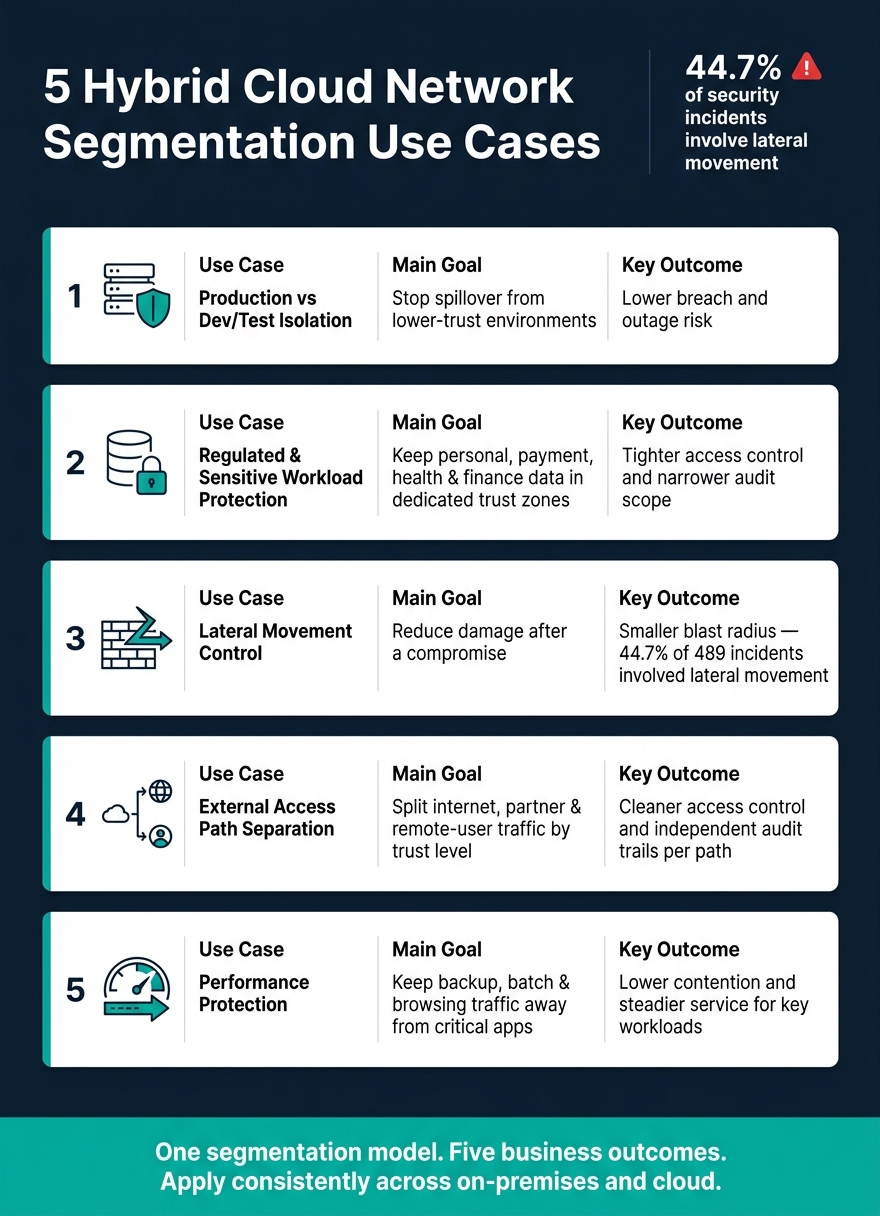 {5 Hybrid Cloud Network Segmentation Use Cases: Goals, Controls & Outcomes}
:::
{5 Hybrid Cloud Network Segmentation Use Cases: Goals, Controls & Outcomes}
:::
Zero Trust Microsegmentation for Hybrid Cloud
Quick comparison
| Use case | Main goal | What I’m isolating | Main outcome |
|---|---|---|---|
| Production vs dev/test | Stop spillover from lower-trust environments | Live systems from change-heavy environments | Lower breach and outage risk |
| Sensitive workloads | Protect high-risk data | Personal, payment, health, or finance data | Tighter access and easier audit scope |
| Lateral movement control | Reduce damage after compromise | Workloads and admin paths inside the estate | Smaller blast radius |
| External access separation | Split entry points by trust | Internet, partner, and remote-user traffic | Cleaner access control and logging |
| Performance protection | Keep noisy traffic away from key services | Backup, batch, browsing, and app traffic | Lower contention and steadier service |
What I like about this model is that it’s one approach used in five common situations, not five disconnected fixes. The theme is simple: segment by risk, data sensitivity, and business service, then apply the same policy intent across cloud and on-premises.
Why Segmentation Is Harder in Hybrid Cloud
Before the use cases, it helps to understand why hybrid estates are tougher to segment than single-platform networks.
On paper, hybrid segmentation sounds straightforward. In practice, it gets messy fast. You’re not dealing with one consistent platform. You’re dealing with on-premises infrastructure, one or more public cloud environments, and the interconnects that tie them together. Each part comes with its own controls, its own teams, and its own pace of change.
Different Control Models Across Environments
On-premises segmentation usually depends on network-interface and IP-based controls such as VLANs, VRFs and firewalls. Cloud segmentation, by contrast, leans on security groups, ACLs, VNets/VPCs and tags.
The problem is that these models don’t line up neatly. Rules often need to be translated by hand from one environment to another. A production web zone might sit in a VRF and firewall zone on-premises, but live inside a VNet or VPC with subnets and security groups in the cloud. Same intent, different setup.
That means a policy that works as expected in one place can behave quite differently somewhere else.
Visibility and Policy Consistency Gaps
Policy drift is the gap between what your segmentation policy says should happen and what is actually configured across firewalls, security groups and interconnects.
This gap tends to grow over time, especially when teams work in parallel. One side updates a firewall rule. Another tweaks a security group. Someone else changes an interconnect path. Bit by bit, the live estate starts drifting away from the policy on paper.
Visibility doesn’t help much either. Overlay networks can hide traffic from older monitoring tools, and cloud flow logs often aren’t enabled by default or kept long enough to help when something goes wrong. The result is patchy enforcement and slower incident response.
Overlapping IP ranges add another layer of pain. It’s common for on-premises networks to reuse private address ranges that cloud teams have also picked for their VNets. Once that happens, IP-based rules stop being dependable, and teams end up leaning on NAT or policy-based workarounds.
That complexity is why the five use cases below matter.
1. Isolating Production from Development and Test Environments
Dev/test should have no direct network path into production. If access is needed, it should go through tightly controlled services. In hybrid estates, that line has to hold across both on-premises and cloud setups.
Hybrid Control Points
The safest approach is to use layers of control across the full estate. On-premises, many organisations split production and non-production with separate VLANs or VRFs, then use firewalls to enforce strict rules between them. In the cloud, separate accounts or subscriptions for production and non-production create a stronger governance boundary. That split can then be backed up with separate VPCs or VNets, distinct CIDR ranges, security groups, and network ACLs [2][5].
Put simply, isolation gets stronger as the boundary moves higher up the stack:
| Approach | Isolation Strength | Operational Overhead |
|---|---|---|
| Separate cloud accounts/subscriptions | Strongest - strong governance boundary | Higher |
| Separate VPCs/VNets within one account | Good network isolation | Moderate |
| Subnet-level segmentation only | Quick to implement | Lower, but weaker boundary |
Links between environments, such as VPN, Direct Connect, or ExpressRoute, should also be filtered at the routing layer so dev/test networks can't directly reach production subnets. If developers need production access, they should use a hardened bastion host or jump server with MFA instead of having standing direct access [3][6].
Compliance and Audit Impact
This separation doesn't just help security. It also gives auditors a clear trail to review.
UK GDPR and the Data Protection Act 2018 require appropriate technical and organisational measures to protect personal data. PCI DSS requires segmentation around cardholder data environments and tight control over any test and development systems that touch production. ISO/IEC 27001 Annex A also stresses the separation of development, test, and live operational environments [3][4].
In practice, auditors usually want to see:
- Zone diagrams
- Firewall rules with a clear business reason
- Separate roles for production and non-production access
Performance Benefit
Segmentation also helps protect production performance. Dev and test workloads often create sharp bursts of traffic during testing, bulk data imports, and deployment activity. If those workloads share gateways, firewalls, or interconnect links with live services, they can end up competing with user traffic.
A segmented setup avoids that problem. Production links can be sized and monitored against live demand, without test activity distorting capacity planning or creating congestion during busy periods. It also makes non-production traffic far easier to contain without affecting live workloads.
2. Protecting Regulated and Sensitive Workloads
Beyond isolating production, the next job is simpler to say and harder to do: keep regulated data inside its own trust zone.
Primary Security Objective
Access should be limited to the users, systems and services that actually need it. The usual way to do that is to place regulated workloads in dedicated trust zones, separate from general corporate traffic and from lower-trust environments.
A practical starting point is to classify workloads by sensitivity:
- public
- internal
- confidential
- restricted
Then apply the tightest segmentation to the highest-risk tiers.
Hybrid Control Points
Once sensitive workloads are grouped, controls need to sit at every boundary. In a hybrid setup, that usually means mixing on-premises firewalls and VLANs with cloud-native controls such as security groups, network ACLs and private links.
Where it makes sense, add workload-level controls too. That includes host firewalls, service-to-service authentication and identity-based policy enforcement. Each layer has a different job:
| Control Type | Enforcement Point | Best Used For |
|---|---|---|
| Network firewall / ACL | Subnet or zone boundary | Broad east–west and north–south filtering |
| Cloud security groups | Individual instance or service | Granular workload-level access rules |
| Microsegmentation / host firewall | OS or hypervisor layer | Default-deny between specific workloads |
| Identity-aware policy (Zero Trust) | Access request layer | Least-privilege enforcement across hybrid paths |
The hybrid link should be treated as a controlled corridor, not as an extension of the internal network. That distinction matters. A cloud-hosted application front end talking to an on-premises database should connect over a private link, use only specific ports, come from verified source addresses and rely only on identity-verified service accounts.
Compliance and Audit Impact
UK GDPR and the Data Protection Act 2018 require appropriate technical measures to protect personal data [13][14]. FCA-regulated firms and NHS organisations also face added access control, encryption and data-handling requirements [13][14].
Segmentation helps in two clear ways. First, it narrows compliance scope. If you isolate a cardholder data environment or patient record systems into dedicated segments, fewer systems sit under the full burden of PCI DSS or NHS security requirements. Second, it makes audit evidence less painful to produce. Auditors usually want to see network diagrams with clear trust boundaries, rule sets with documented business justification, and proof that blocked paths are in fact blocked [7][8][9][10][11].
Sensitive-data segments should be reviewed quarterly to confirm that isolation still holds and that access remains authorised.
Those same boundaries also limit how far an attacker can move if one segment is breached.
3. Limiting Lateral Movement After a Security Incident
The first two use cases are about stopping exposure in the first place. This one is different. It’s about reducing the damage once an attacker is already in.
Primary Security Objective
Segmentation matters most after a breach. Its job is simple: stop an attacker from moving too far. In one study of 489 incidents, 44.7% involved lateral movement.[16] Without tight east–west controls, one compromised VM or user account can turn into a route to production databases or management planes.
NCSC frames segmentation as blast-radius control, not a single outer wall.[15] That means splitting the estate into zones that do not trust each other, then allowing only explicit, monitored paths between them. Those controls also need to work the same way across on-premises and cloud environments.
In a hybrid estate, one weak rule can spoil the whole setup.
Hybrid Control Points
Hybrid estates often break down when the same policy is enforced differently on each side. Take a rule like: production web tier can only call the production API tier on TCP 443. On-premises, that may be enforced with firewall ACLs. In the cloud, it may rely on network security groups or VPC security groups. If one side is looser, that’s the path an attacker will take.
The main controls here are fairly clear:
- Default-deny east–west traffic
- Route admin access through bastions or just-in-time access
- Tie policy to identity and workload tags, not only IP addresses
That last point matters more than it may seem. IP-based rules can drift as workloads scale or move. Identity- and tag-based rules are more likely to stay in place when the environment changes.
Compliance and Audit Impact
Auditors usually want proof, not just intent. They need to see that one compromised zone cannot reach critical data. That means keeping zone diagrams, baseline rules, and records of tested containment exercises.
The same separation also helps stop internet-facing, partner, and remote-access paths from turning into a route into internal systems.
4. Separating Internet-Facing, Partner and Remote Access Paths
Earlier examples focused on splitting internal workloads. This one deals with external entry points and separates them by trust level.
Internet-facing, partner and remote-user traffic do not carry the same risk. Each one should sit in its own trust zone.
Primary Security Objective
The aim is simple: each external path should terminate in its own isolated segment, with no implied trust between them. If one route is breached, it should not give an attacker a path into the others.
The UK NCSC makes this clear: private services should not be exposed straight to the internet. Access should pass through a hardened, internet-facing component - such as a connector, proxy, or VPN endpoint - built to handle untrusted traffic, with access decisions controlled by a central policy engine.[17] If remote access sits on one flat path, a single stolen credential can go far too far.
So each route needs its own boundary, its own policy, and its own log trail.
Hybrid Control Points
In practice, that means setting up three separate zones:
- one for internet-facing workloads, such as public APIs and customer portals
- one for partner and supplier connectivity
- one for remote user access
Each zone should use its own subnets, security groups and firewall rules.
For partner connections, dedicated private links such as ExpressRoute circuits or IPsec site-to-site VPNs should end in a separate partner zone. Rules there should be tightly scoped, granting access only to documented services and ports. For remote users, Zero Trust Network Access (ZTNA) is a better fit than a full-tunnel VPN because it grants access at the application level instead of placing users broadly on the internal network.[19][20][21] A published Zero Trust secure landing zone reference also splits VPN zones by user type - corporate staff, privileged admins, third-party contractors, partners and SOC analysts - with different inspection and monitoring policies for each group.[18]
This kind of separation also makes access easier to prove. You can see who can reach what without digging through one tangled setup.
Compliance and Audit Impact
Separate access paths make audits much easier. PCI DSS expects cardholder data environments to remain isolated, while NHS and FCA controls also rely on approved and monitored access routes.
Keeping separate logs for each path - internet ingress, partner links and remote access gateways - gives auditors a clear record they can trace. It is much easier to show least-privilege access when each route has its own audit trail, instead of one mixed log for everything.
Performance Benefit
Segmentation can help performance too, as long as the design is sensible. For high-volume or latency-sensitive partner integrations, such as payment processing and supply chain platforms, routing partner traffic over a dedicated private connection into its own zone gives more predictable throughput than pushing it through shared internet paths.
Remote access improves as well when you use regional points of presence. UK-based ZTNA or VPN endpoints cut latency for remote workers compared with backhauling all traffic through a single data centre. It also helps to monitor each path on its own, so you can scale internet, partner and remote access capacity separately instead of oversizing one route to cover every traffic type.
5. Reducing Congestion and Protecting Critical Application Performance
Segmentation does more than tighten access. It also protects performance by keeping noisy, low-priority traffic away from the paths that matter most. In many cases, performance issues come from contention rather than raw capacity. Backup jobs, bulk data transfers, and employee web browsing can end up competing with payment systems, electronic patient records, and trading platforms. Segmentation keeps those traffic types apart.
Performance Benefit
In AWS hybrid deployments, dynamic VPC segmentation kept throughput high and latency low during peak traffic. Static designs, by contrast, ran into congestion and latency spikes.[23][25] But this depends on one thing: routing, prioritisation, and workload boundaries have to be enforced the same way across the estate.
Hybrid Control Points
The best approach is layered control.
On-premises, QoS policies on WAN edge routers and VRFs on core switches help mark and prioritise critical traffic before it crosses the hybrid link. In the cloud, dedicated VNets or VPCs with their own subnets and routing tables keep critical workloads separate from bulk or background traffic. At the connectivity layer, SD-WAN platforms can steer latency-sensitive flows over better links, whilst backups and batch jobs use standard internet paths.
As services spread across microservices and application tiers, east–west traffic can become a major share of network load. That’s where microsegmentation and Kubernetes network policies matter. They should limit flows to only what is needed.[24][12]
Compliance and Audit Impact
Segment-level logs and performance metrics also help show availability and resilience controls during finance and healthcare audits.
Building Blocks for Hybrid Segmentation
Hybrid segmentation uses the same controls across on-premises and cloud zones. The job is to apply them in the same way, every time. These controls are what make the five use cases above possible.
Core Network and Cloud Controls
On-premises, use VLANs and VRFs to split zones, then use firewalls to control traffic between them. In regulated or sensitive settings, VRFs keep routing tables fully separate. That makes them useful for separating regulated workloads, such as cardholder data or NHS records, from general office traffic [22][1]
In the cloud, use VPCs and VNets as the main isolation boundary. Then add subnets, route tables, security groups and NACLs for tighter control. Direct Connect and ExpressRoute should be treated as controlled links, not trust boundaries.
Broad Zones and Workload-Level Controls
Use these controls at two levels: broad zones and workload-level controls.
Broad zones, such as Production, Non-production and Partner, group systems by risk profile and control north-south traffic. Workload-level controls, such as security groups, host firewalls and Kubernetes network policies, restrict individual services and tiers. That helps limit lateral movement inside a zone. A sensible starting point is broad zones first, then workload-level controls where the risk justifies it [26][27]
The practical question isn't whether to segment. It's how far to take it.
| Level | Primary Controls | Traffic Focus | Best For |
|---|---|---|---|
| Broad zones | VLANs, VRFs, subnets, firewalls | North-south (zone entry/exit) | Separating production from development, isolating partner access |
| Workload-level | Security groups, host firewalls, Kubernetes network policies | East-west (inter-service) | Protecting regulated data, limiting lateral movement |
The next question is whether broad segmentation is enough, or whether microsegmentation is needed for specific workloads.
Macro-Segmentation vs Microsegmentation
These controls work on two levels: broad zone separation first, workload-level restriction second. The broad zones above are the starting point. This section explains when that baseline is enough and when you need to go deeper.
Macro-segmentation separates zones. Microsegmentation controls specific workloads, ports and services inside those zones. In hybrid estates, where control models already vary across on-premises and cloud environments, picking the right level of control for each use case matters just as much as picking the controls themselves.
Key Differences in Scope and Operations
At heart, this is a choice between coarse control and fine control. Macro-segmentation sets clear, auditable boundaries that help with compliance and keep day-to-day work manageable. The downside is simple: once traffic gets inside a macro zone, east-west movement may still be too open.
Microsegmentation tightens control inside those zones, right down to individual services, containers or VMs. Instead of relying on static IP addresses, policies point to workload identity, tags and labels. That fits hybrid environments well, especially when workloads autoscale or appear and disappear quickly. The upside is much tighter control. The catch? More overhead. Rule sets get larger, they change more often, and they need solid automation plus consistent tagging if you want to keep things under control.
| Dimension | Macro-Segmentation | Microsegmentation |
|---|---|---|
| Scope | Coarse trust boundaries | Specific runtime identities |
| How specific the rules are | Coarse - IP ranges, ports, protocols | Fine - identity, labels, service accounts |
| Enforcement point | Firewalls, VPCs/VNets, subnets | Host firewalls, Kubernetes network policies and service mesh |
| Operational overhead | Lower - smaller rule sets, infrequent changes | Higher - requires automation and consistent tagging |
| Traffic focus | north-south (between zones) | east-west (between services within zones) |
| Regulatory alignment | PCI DSS zone separation, data residency boundaries | UK GDPR data isolation, zero trust per service |
In practice, most hybrid estates use macro-segmentation to draw the main boundaries, then apply microsegmentation only where traffic inside those boundaries needs tighter control.
When Each Model Fits Best
For most hybrid deployments, macro-segmentation is the right place to start. It gives you clear, auditable boundaries that line up with regulatory needs and keeps the workload on operations teams at a level they can handle. Microsegmentation then adds tighter attack containment where the risk is highest.
Microsegmentation tends to pay off most in high-risk areas, such as crown-jewel applications or zero trust enforcement between services in payments or clinical systems. Cloud-first organisations use microsegmentation more often than estates that are led mainly by on-premises infrastructure [28].
The sensible approach is to layer them. Use macro-segmentation as the base, then add microsegmentation where the risk justifies the extra operational effort. If you try to microsegment everything in one go, you usually end up with rule overload and change fatigue.
The hard part is getting the control level to match the risk without piling on more operational burden than the estate can handle.
Common Mistakes to Avoid
Even a good segmentation model can fall apart if it becomes too complex, drifts over time, or doesn't match the actual risk.
Design Mistakes That Add Complexity
One of the biggest mistakes is microsegmenting before the zone model is stable. On paper, lots of small VNets, VPCs and subnets can look neat. In practice, they often create rule sprawl and make fault-finding much slower. When something breaks, engineers end up tracing traffic across on-premises firewalls, VPNs and cloud security groups. That's where time disappears.
Too few segments can be just as dangerous, but that problem often stays hidden until there's a breach or a major outage. In many cases, the issue starts with isolated design choices made by network, security, DevOps and cloud teams without a shared model.
A better approach is to anchor the design to a small set of business-aligned zones, enforce them with infrastructure-as-code, and assign every shared component a named owner. Exceptions shouldn't drift forever either. Each one needs an expiry date and a named owner.
Once the design gets tangled, the next problem usually follows fast: the wrong paths stay open.
Security and Compliance Gaps
The next set of mistakes shows up in day-to-day operations: management access left too open, and zoning that ignores the sensitivity of the data involved.
Management interfaces are often exposed more than they should be, especially bastions, jump hosts and admin APIs. If an attacker gets into the management plane, they can change security policies, open new access routes and move sideways fast. The NCSC's guidance on securing cloud services specifically highlights remote access and cloud management-plane misconfigurations as active targets for UK-focused threat campaigns. Put all management paths in a restricted zone, then enforce MFA and just-in-time access.
Another common mistake is zoning by technical tier instead of by data sensitivity. A design built around web, application and database layers might seem tidy, but it can still leave payment card data, NHS patient records or UK GDPR-regulated personal data sharing zones with lower-risk workloads. That misses the point. Controls should map to data classification and regulatory duty, not only to the application layer.
| Mistake | Impact | Fix |
|---|---|---|
| Too many segments | Rule sprawl and slower troubleshooting | Start with broad, business-aligned zones; refine only where risk justifies it |
| Inconsistent rules across environments | Policy gaps and bypass paths | Define policy intent in business terms; translate consistently using common tagging |
| Exposed management interfaces | High-impact attack vector if a single credential is compromised | Place all management paths in a restricted zone; enforce MFA and just-in-time access |
| Controls misaligned to data risk | Regulated workloads under-protected | Map segmentation to data classification and specific regulatory obligations |
| Stale exceptions with no owner | Temporary rules become permanent | Require expiry dates and named owners; automate removal on expiry |
Conclusion
When it’s done properly, segmentation cuts the blast radius, makes audit evidence easier to show, and helps protect application performance. And those gains don’t come from five separate fixes. They come from one model applied with care.
These five use cases are simply different ways of putting the same idea into practice: set risk-based boundaries and apply them across hybrid environments in a consistent way. Taken together, they make up one segmentation model.
The practical takeaway is simple. Start with one business-critical service, define its zones, and enforce them the same way across on-premises and cloud. Segmentation should map to business services and data sensitivity, not to infrastructure convenience or old network boundaries. And that link needs to stay in place as your hybrid footprint grows.
For complex hybrid estates, Hokstad Consulting can help turn these principles into policy that can be enforced.
FAQs
Where should I start with hybrid cloud segmentation?
Start by mapping your full architecture: on-premises and cloud assets, applications, databases, and every connection point between them. After that, rank each part by business value and data sensitivity.
From there, put broad VPC-level boundaries in place between major functions like production and development. Once that’s done, tighten control with subnets or microsegmentation around sensitive workloads.
Before you roll any policy into production, test it in non-critical environments first. It’s a simple step, but it can save you a lot of pain later.
When is microsegmentation worth the extra effort?
Microsegmentation is worth the extra work when your organisation needs advanced security around highly sensitive workloads, such as financial records, personal information, or intellectual property.
It’s especially useful in containerised environments and Kubernetes clusters, where old network boundaries just don’t go far enough. By putting tighter controls around each workload, microsegmentation helps shrink the attack surface, block lateral movement, and support strict regulatory compliance.
How do I stop segmentation rules drifting over time?
Keep a single source of truth in place, then back it up with regular audits and continuous monitoring so policies are applied the way you expect.
Use identity- or tag-based policies so rules stay with workloads across on-premises and cloud. Automate policy updates and synchronisation, so your intended settings are reapplied if they drift. Then document and test changes segment by segment to spot problems early, before they spread.