Managing risks in multi-cloud environments is critical for security, compliance, and cost control. Organisations using platforms like AWS, Azure, and Google Cloud face challenges such as misconfigurations, inconsistent practices, and operational complexity. Without a unified strategy, vulnerabilities often go unnoticed, leading to breaches and financial losses.
Key takeaways:
- Security Risks: Misconfigured permissions and dormant accounts are common vulnerabilities.
- Compliance Issues: Differences in data residency and encryption across platforms complicate regulatory adherence.
- Operational Challenges: Fragmented policies, alert fatigue, and inconsistent monitoring tools hinder response times.
- Solutions: Use a mix of top-down governance and bottom-up scanning, automate risk detection, and integrate security into DevOps pipelines.
Tools to consider: Cloud-native services like AWS Security Hub and third-party platforms such as Wiz or Prisma Cloud provide centralised visibility and automation. For tailored solutions, firms like Hokstad Consulting offer bespoke frameworks and cost optimisation services.
To stay ahead, prioritise centralised monitoring, regular audits, and automated detection tools. A strong risk management strategy can save millions in breach costs and improve operational efficiency.
AWS re:Invent 2025 - Multicloud security best practices (HMC318)
Need help optimizing your cloud costs?
Get expert advice on how to reduce your cloud expenses without sacrificing performance.
Common Multi-Cloud Risks and Challenges
::: @figure 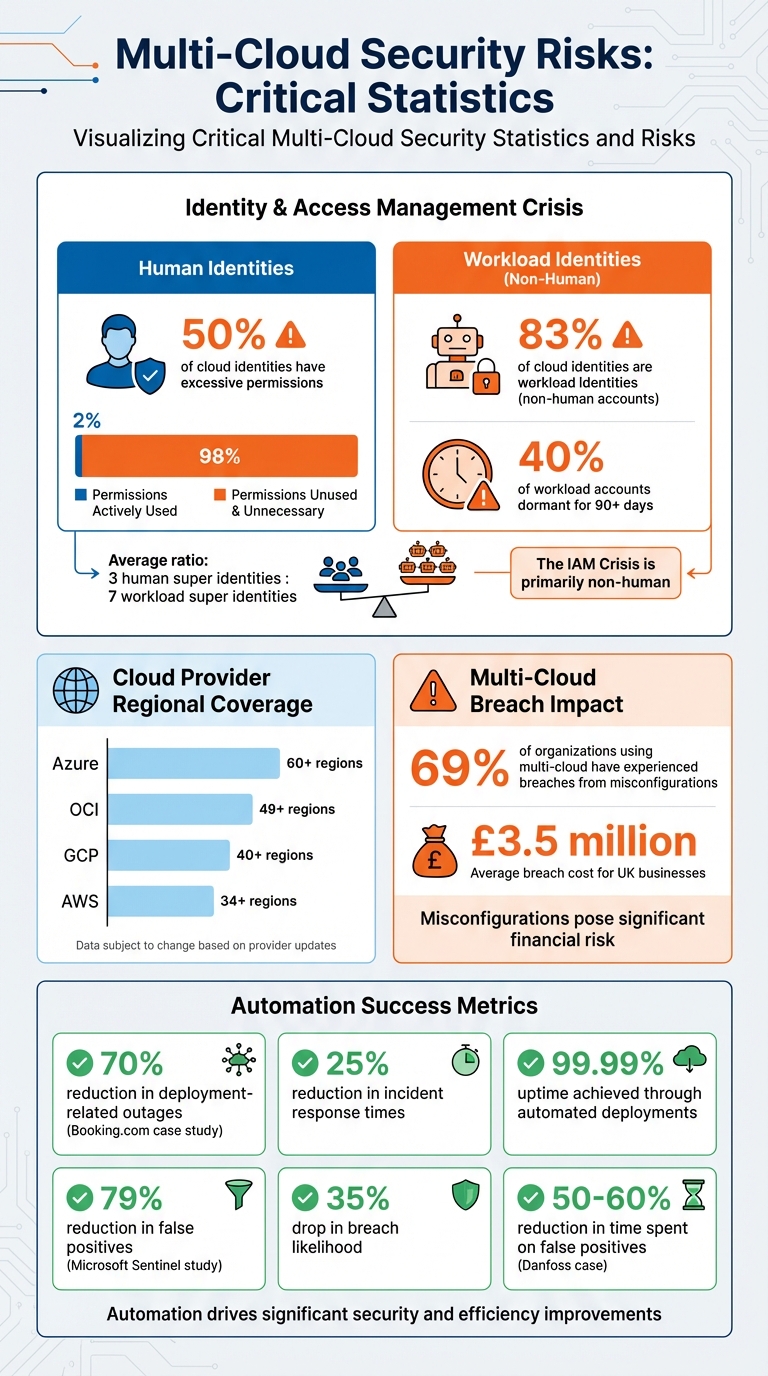 {Multi-Cloud Security Risks: Key Statistics and Vulnerabilities}
:::
{Multi-Cloud Security Risks: Key Statistics and Vulnerabilities}
:::
Identity and Access Management Security Risks
Managing access across multiple cloud platforms can open the door to security vulnerabilities. In 2023, a staggering 50% of cloud identities were found to have permissions far beyond what was necessary, with only 2% of those permissions actively being used by human and workload identities. This leaves an overwhelming 98% as unused and unnecessary, creating potential security risks [2].
Workload identities - non-human accounts used by applications, containers, and automated services - make up 83% of cloud identities [2]. Alarmingly, 40% of these accounts had not been used in over 90 days, turning them into dormant accounts that could easily become a target for attackers [2].
The situation becomes even more concerning when looking at privileged accounts. On average, organisations have a ratio of three human super identities to seven workload super identities [2]. Christian Koberg-Pineda, Principal Security DevOps Engineer at S.A.C.I. Falabella, highlights the importance of addressing this issue:
One of the most relevant characteristics of cloud computing is that you can scale things on demand. As cloud security expert, you must think in scale too. You need to implement a security tool that is also capable of scaling together with your infrastructure or your services [2].
This highlights the need for scalable security solutions to keep up with cloud infrastructure demands. Next, let’s look at how these risks intersect with data protection and compliance.
Data Protection and Compliance Challenges
Ensuring consistent data protection across multiple cloud providers is no easy task. Each platform has its own approach to data residency, encryption, and compliance. For example, Azure operates in over 60 regions, while OCI covers 49+, GCP has 40+, and AWS provides 34+ regions [3]. These differences directly affect compliance with regulations like UK GDPR, as organisations must carefully choose where their data is stored.
Encryption key management is another tricky area. If encryption keys are stored in a different jurisdiction than the data they protect, whoever controls the keys effectively controls the data [3]. GCP tries to tackle this with its Key Access Justifications
feature, which provides an audit trail and allows users to veto provider access to encryption keys - something not offered by other major providers [3]. Additionally, Azure's EU Data Boundary and GCP's Assured Workloads ensure that metadata stays within the EU, preventing situations where primary data remains in the UK but metadata ends up on US servers [3].
These challenges underline the complexity of maintaining both compliance and operational efficiency when working across multiple cloud environments.
Managing Operational Complexity
The operational demands of managing multiple cloud providers can quickly become overwhelming. Each platform has its own policy frameworks, monitoring tools, and security systems. For instance, AWS uses Service Control Policies (SCPs) and AWS Config for guardrails and drift detection, while Azure relies on Azure Policy, and Google Cloud uses Organisation Policies to enforce constraints at various levels. This lack of standardisation can lead to inconsistent policy naming, misconfigured endpoints, and siloed data, all of which reduce visibility and increase the likelihood of false alerts.
Alert fatigue is another major issue. With each cloud platform generating its own notifications, teams can find themselves drowning in hundreds of alerts daily. Without a centralised system to manage and deduplicate these alerts, important incidents may go unnoticed, and team members risk burnout. Additionally, the absence of standardised quotas and limits across platforms means that a single misconfigured service could lead to performance problems or unexpected cost spikes.
These operational hurdles highlight the importance of a unified approach to risk detection and management across multi-cloud environments.
How to Detect Risks in Multi-Cloud Environments
Effectively identifying risks in multi-cloud setups requires a combination of policy-driven oversight and detailed scanning techniques. Let's explore the methods and tools that can help organisations stay ahead of potential threats.
Top-Down vs Bottom-Up Detection Methods
Choosing the right detection method depends on your organisation's structure and security needs. Top-down detection begins with governance frameworks and compliance standards, working its way down to individual resources. This approach is ideal for meeting regulatory requirements like the UK GDPR or PCI DSS, as it ensures uniform policy application across all cloud platforms. However, it may miss vulnerabilities specific to individual resources.
On the other hand, bottom-up detection focuses on scanning specific workloads, containers, and services for misconfigurations or vulnerabilities. While it’s great for catching technical issues quickly, this method might struggle to maintain consistent governance across multiple cloud providers. Many organisations find that combining both approaches offers the best results - ensuring broad compliance while addressing resource-specific risks.
| Feature | Top-Down Approach | Bottom-Up Approach |
|---|---|---|
| Starting Point | Governance policies and compliance frameworks | Individual resources and workloads |
| Best For | Regulatory compliance, policy consistency | Resource misconfigurations, immediate threats |
| Coverage | Broad organisational view | Detailed resource-level insights |
| Implementation Speed | Slower due to initial setup | Faster; scanning starts immediately |
| Risk of Gaps | May overlook resource-specific issues | Can miss governance violations |
To manage these risks effectively, centralised tools and systematic scanning are essential.
How to Assess Cloud Risks
A structured approach is crucial for identifying and addressing risks in multi-cloud environments. Start by creating centralised visibility across all cloud platforms through a unified system. This eliminates the inefficiencies of juggling multiple monitoring tools and provides real-time oversight [1].
Deploy Cloud Security Posture Management (CSPM) solutions to automatically detect misconfigurations, excessive permissions, and unencrypted data. This is especially important given that 69% of organisations using multi-cloud architectures have reported breaches caused by misconfigurations [1][4][5].
Additionally, continuous scanning for vulnerabilities and secrets in applications and code repositories is critical. This helps flag outdated software and hardcoded credentials before they lead to breaches [1][5]. Use attack simulation tools to understand how vulnerabilities can be exploited together. For example, in November 2024, CYE researchers demonstrated how attackers could escalate from basic domain access to full control over Azure, AWS, and GCP environments by exploiting a series of weaknesses, including plaintext credentials and an unpatched domain controller [4][5].
By combining these strategies, organisations can better assess and mitigate risks.
Using Automation for Risk Detection
Manual risk detection simply cannot keep up with the pace of modern cloud environments. Automation not only speeds up response times but also reduces human error and scales effortlessly with growing infrastructure.
For instance, in June 2023, Booking.com adopted blue-green deployments and canary releases across AWS and Azure under the guidance of DevOps expert Maria Ivanova. This move cut deployment-related outages by 70% and reduced incident response times by 25% [2].
Automation tools use techniques like statistical detection (e.g., Z-scores) to identify obvious spikes, while machine learning excels at recognising subtle patterns with fewer false alarms. Though machine learning requires more resources, its adaptability to historical trends makes it ideal for environments with seasonal or gradual changes.
Real-world examples highlight the impact of automation. A European e-commerce platform led by CTO Maria Jensen implemented ArgoCD for GitOps across Google Cloud and Azure, achieving 99.99% uptime through automated deployments and rollbacks [2]. Similarly, a global fintech company used Kubernetes and Crossplane to manage workloads across AWS and Azure, slashing downtime from 2 hours to under 5 minutes while improving resource efficiency by 30% [2].
Tools and Technologies for Multi-Cloud Risk Detection
When managing multi-cloud security, having the right tools is essential. Here’s a breakdown of the options to consider:
Cloud-Native Security Tools
Major cloud providers offer their own built-in security solutions. For example:
- AWS Security Hub: Aggregates findings from services like GuardDuty and Inspector. Pricing is approximately £0.0008 per security check per account per region.
- Microsoft Defender for Cloud: Includes basic CSPM features for free, with advanced workload protection starting at about £12 per server per month.
- GCP Security Command Center: Provides similar security features.
- OCI Cloud Guard: Comes at no additional cost and is included with your tenancy [6].
These tools are great for quick, provider-specific detection without incurring data egress charges. However, they often create visibility silos
because each platform uses unique terminology, policy structures, and severity ratings [7]. While they work well for organisations focused on a single cloud, they need to be paired with cross-platform solutions for effective multi-cloud risk management.
Third-Party Monitoring and Analytics Platforms
Third-party tools solve the fragmentation issue by offering a unified view across all cloud environments. Platforms like Wiz, Orca Security, and Prisma Cloud fall under the category of Cloud-Native Application Protection Platforms (CNAPP). These combine CSPM, CWPP, and CIEM features into a single dashboard, with pricing ranging from £4,000 to £80,000 annually, depending on resource usage [6].
One standout feature of these platforms is attack path analysis, which maps out how an attacker could exploit vulnerabilities to access critical assets. Many of these tools use AI to filter out over 90% of false positives by assessing whether a vulnerability is actually accessible from the internet [7]. For example:
- A 2024 Forrester study revealed that organisations using Microsoft Sentinel saw a 79% reduction in false positives and a 35% drop in breach likelihood [8].
- Danfoss, under IT Monitoring and SOC Director Chunqui Chen, implemented Microsoft Sentinel in 2024. This reduced time spent on false positives by 50%–60% after integrating logs from 20 applications and thousands of devices [8].
Modern platforms often include agentless scanning, simplifying deployment across diverse environments. They also offer automated remediation options like one-click fixes or automated pull requests to address issues such as public S3 buckets or unencrypted volumes.
With these tools, integrating risk detection into DevOps workflows becomes seamless.
Integrating Risk Detection with DevOps
Embedding security into CI/CD pipelines from the start is crucial. This early-stage security integration
approach catches issues such as misconfigurations in Infrastructure as Code (IaC) templates and container images during the build phase [5][9].
Most CNAPP platforms now offer plugins for popular CI/CD tools, enabling automatic scans of IaC templates and container registries. High-severity findings can trigger alerts to tools like Slack, Jira, or PagerDuty, ensuring teams are notified immediately [11]. Event-driven workflows add another layer of automation - for example, using AWS EventBridge to activate Lambda functions that isolate compromised instances or revoke suspicious IAM credentials [10].
The goal is to establish feedback loops that connect production risks back to their source code. If a misconfiguration is detected in a live resource, developers should be able to trace it to the specific IaC template or container image, fix the issue, and prevent it from happening again. This approach transforms security from a potential bottleneck into a seamless part of the deployment process.
Best Practices for Multi-Cloud Risk Detection
Centralised Monitoring and Alerting
Having unified visibility is crucial for detecting risks across multi-cloud environments. Without it, security teams often struggle with switching between dashboards from AWS, Azure, GCP, and other platforms - each using its own terms and severity levels. The solution? Consolidate all alerts into a single system. This allows you to correlate events, enforce consistent policies, and respond faster.
Start by directing logs and security findings to a centralised SIEM or monitoring platform. This creates a single source of truth for incidents, no matter if they come from AWS GuardDuty, Microsoft Defender, or GCP Security Command Center. To stay on top of risks, set alert thresholds based on severity, giving priority to critical issues like unauthorised changes to IAM roles or public data exposure. Integrating these alerts with tools like Slack or PagerDuty ensures teams are notified immediately, cutting down response times. This centralised approach also supports ongoing audits and fine-tuned risk detection strategies.
Regular Security Audits and Compliance Checks
With cybercrime costs rising and breaches becoming more frequent, automated security audits and manual compliance reviews are now essential.
Use Cloud Security Posture Management (CSPM) tools to scan for misconfigurations across all cloud platforms before they turn into vulnerabilities. Complement this with Cloud Infrastructure Entitlement Management (CIEM) to analyse permissions and flag overly permissive IAM roles that could be exploited [12]. Schedule quarterly manual reviews to confirm automated findings and ensure your organisation meets standards like ISO 27001, GDPR, or other relevant regulations. For consistent results, rely on provider-neutral tools that can map controls across different IAM frameworks and policy mechanisms effectively.
Custom Solutions with Hokstad Consulting
Sometimes, standard tools just aren’t enough for hybrid setups, legacy systems, or tight budgets. This is where Hokstad Consulting steps in. They specialise in creating bespoke risk detection frameworks tailored to your infrastructure and operational needs. Their cloud cost engineering services can lower expenses by 30–50% while maintaining strong security, and their expertise in DevOps ensures security fits seamlessly into CI/CD pipelines without slowing down deployments.
Whether you need automation scripts, ongoing security audits, or a smooth cloud migration with zero downtime, Hokstad Consulting offers flexible engagement options. Their no savings, no fee
model for cost optimisation projects means you only pay if you see results. With experience spanning public, private, hybrid, and managed hosting environments, Hokstad Consulting is well-equipped to help organisations tackle the complexities of multi-cloud risk management. Check out hokstadconsulting.com to see how their tailored solutions can enhance your security while keeping costs in check.
Building a Multi-Cloud Risk Management Strategy
Key Takeaways
Managing risks in a multi-cloud environment demands proactive measures and consistent oversight. A centralised monitoring setup for platforms like AWS, Azure, and Google Cloud is crucial. Relying on separate dashboards can leave up to 30% of risks undetected [14]. Automating tasks such as log analysis and real-time alerts is essential, while regular compliance audits ensure your organisation meets standards like UK GDPR and ISO 27001. Incorporating risk detection into DevOps pipelines helps minimise deployment vulnerabilities and maintains continuous security.
To create an effective strategy, start by assessing your current risk landscape. Use a combination of top-down policy reviews and detailed log analysis to identify gaps. Implement tools that provide real-time insights and automate both audits and alerts to catch problems early. Regularly review your approach - quarterly updates can help you address new threats. Track metrics like a mean time to detect (MTTD) under 24 hours and a mean time to respond (MTTR) under one hour [15]. Early detection isn't just about avoiding breaches; it also prevents incidents that could cost UK businesses an average of £3.5 million per breach [13].
Consider these real-world examples: A UK financial services company cut IAM risks by 60% by consolidating AWS and Azure monitoring into a single SIEM tool integrated with CI/CD workflows. Meanwhile, a manufacturing firm avoided £200,000 in potential GDPR fines by using automated compliance scans that flagged data protection issues as they arose. These cases show how combining the right tools with a strong governance framework leads to measurable improvements and sets the foundation for tailored risk management solutions.
Next Steps with Hokstad Consulting
Addressing multi-cloud risks often requires customised solutions, especially if you’re dealing with hybrid setups, legacy systems, or budget constraints. Standard tools might not meet your needs. Hokstad Consulting specialises in building bespoke risk detection frameworks suited to any hosting environment. Their cloud cost engineering services can lower expenses by 30–50% while maintaining robust security and ensuring seamless integration with your CI/CD pipelines.
Start with a risk maturity assessment and let Hokstad Consulting implement Policy-as-Code using tools like Open Policy Agent or Terraform Sentinel. Their no savings, no fee
model ensures you only pay if you see concrete results, making it a low-risk way to optimise both security and costs. Visit hokstadconsulting.com to learn how their tailored solutions can help you create a resilient and cost-efficient multi-cloud risk management strategy.
FAQs
What should I monitor first across AWS, Azure and GCP?
To create a solid foundation, begin with a well-rounded policy framework aimed at security, compliance, and cost control across your platforms. Focus on consistent rules for encryption, access controls, and logging. This approach helps close security loopholes while ensuring adherence to regulations like GDPR in the UK.
Keep an eye on critical metrics such as cost anomalies, resource usage, and performance. Implement alerts for unexpected cost increases or unusual activity. This proactive monitoring ensures you can address problems quickly and maintain control.
How do I reduce IAM risk from excessive and dormant identities?
To reduce risks in Identity and Access Management (IAM), focus on maintaining a robust identity lifecycle management process. Automating tasks like provisioning and de-provisioning is crucial to avoid privilege creep, where users accumulate unnecessary permissions over time. Make it a habit to regularly review and eliminate unused identities and permissions - this helps to clear out dormant accounts that could pose security threats.
Additionally, adopting the principle of least privilege ensures that users only have access to what they absolutely need. Enforcing multi-factor authentication (MFA) adds an extra layer of security, making it harder for unauthorised access to occur. Finally, centralising identity management through federation simplifies oversight and strengthens control over user identities and permissions. These steps together create a more secure and efficient IAM environment.
How can I cut alert noise without missing real incidents?
To cut down on unnecessary alert noise while still catching critical issues, implement real-time alert correlation and use a centralised monitoring system across all your cloud platforms. By bringing together logs and alerts into a single platform, you gain a clearer, more unified view of potential threats, making it easier to pinpoint real risks.
Incorporating AI-driven anomaly detection and automated threat hunting can take this a step further. These tools help security teams zero in on high-priority alerts, ensuring their attention is directed towards genuine incidents that require immediate action.