
Managing a multi-cloud environment offers flexibility but comes with challenges. Key risks include security gaps, limited visibility, cost overruns, and compliance issues. To mitigate these, businesses can adopt tools like Infrastructure-as-Code, centralised monitoring, and unified security policies. Regular audits, automated cost management, and expert support can also help address these challenges effectively. Below are the seven key risks and their solutions:
- Configuration Errors: Automate settings with tools like Terraform and conduct regular audits.
- Limited Visibility: Use centralised platforms for unified monitoring and AI-driven anomaly detection.
- Inconsistent Security Policies: Standardise rules with tools like Open Policy Agent and enforce them via automation.
- Complex Identity Management: Centralise IAM systems and implement zero-trust measures with MFA.
- Compliance Challenges: Employ automated compliance tools and work with experts for regulatory alignment.
- Vendor Lock-In: Use open-source tools and plan for portability with cloud-agnostic designs.
- Cost Management: Optimise resources with cloud cost engineering and automated scaling solutions.
These strategies help reduce risks, improve security, and control costs in multi-cloud setups.
::: @figure 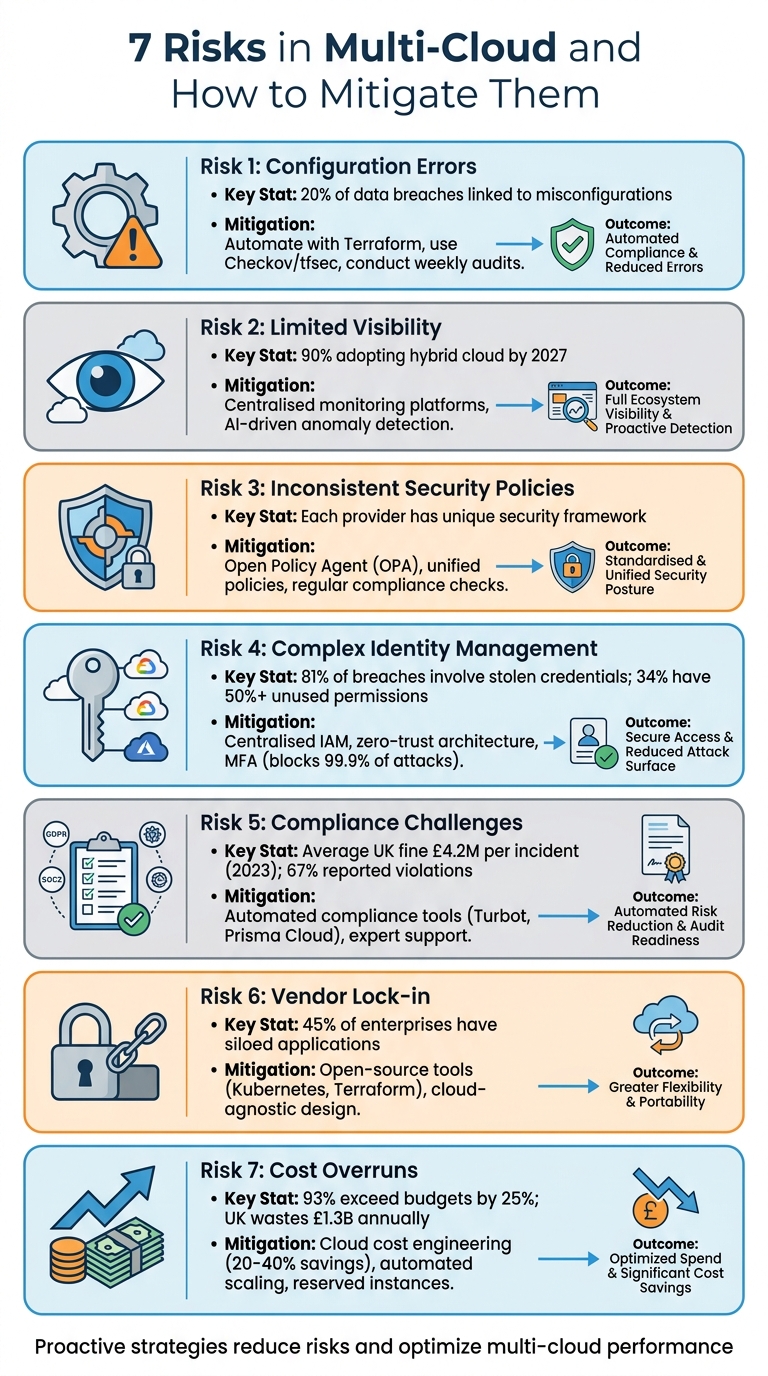 {7 Multi-Cloud Risks and Mitigation Strategies}
:::
{7 Multi-Cloud Risks and Mitigation Strategies}
:::
AWS re:Invent 2025 - Multicloud security best practices (HMC318)
Need help optimizing your cloud costs?
Get expert advice on how to reduce your cloud expenses without sacrificing performance.
Risk 1: Configuration Errors Across Cloud Providers
Configuration errors are a frequent and impactful challenge in multi-cloud environments. Each cloud provider - whether it’s AWS, Azure, or Google Cloud - comes with its own unique syntax, default settings, and management tools. For instance, an S3 bucket in AWS might default to being public unless explicitly set to private, whereas Azure Blob Storage requires specific access control list (ACL) settings. These differences can easily lead to unintended exposure, especially when teams manage infrastructure across multiple platforms without consistent processes. The lack of standardisation not only complicates management but also increases the risk of security vulnerabilities.
The effects of such errors can be devastating. In 2019, Capital One suffered a breach caused by an AWS API misconfiguration, exposing 100 million customer records. Similarly, in 2022, a UK retailer running multi-cloud infrastructure accidentally exposed its network to the public. This resulted in a service outage that cost the company approximately £1.2 million in downtime. A 2023 industry report highlighted that 20% of data breaches in multi-cloud environments were directly linked to misconfigured permissions, such as overly broad IAM roles in AWS or Azure AD groups, which allowed unauthorised access to sensitive data.
To address these risks, automated tools and regular audits are crucial.
Mitigation: Automated Configuration Management
Adopting Infrastructure-as-Code (IaC) tools like Terraform or Ansible can make a significant difference. By defining infrastructure settings as code, organisations can avoid manual configuration for each provider, reducing human error by up to 70%, according to Gartner. These tools allow you to version changes and use state backends like Terraform Cloud to track modifications. Commands like terraform plan can detect configuration drift before it becomes an issue.
Pre-deployment validation tools - such as Checkov, tfsec, or KICS - are another line of defence. These tools scan IaC templates to catch common issues, like public S3 buckets or open security groups, before resources are deployed. Integrating these scans into your CI/CD pipeline ensures non-compliant resources never reach production. For runtime protection, tools like Cloud Custodian can automatically fix low-risk issues, such as unencrypted storage volumes or missing tags, in real time.
Mitigation: Regular Audits and Unified Policies
Weekly configuration scans using tools like Cloud Custodian or Scout Suite can identify vulnerabilities and configuration drift early - preventing roughly 85% of errors from escalating into serious incidents. Native services like AWS Config, Azure Policy, and GCP Security Command Center provide continuous monitoring, but a centralised dashboard can ensure consistent oversight across all platforms.
To enforce consistency, Policy-as-Code frameworks like Open Policy Agent (OPA) can be implemented. These frameworks allow you to establish unified rules - such as prohibiting public storage buckets - across all cloud providers. Regular reviews of your governance framework ensure it stays aligned with your evolving infrastructure. Combining provider-native tools with centralised policy engines helps close security gaps and create a more secure multi-cloud environment.
For UK organisations needing expert advice on standardising multi-cloud configurations, Hokstad Consulting offers tailored solutions to address these challenges effectively.
Risk 2: Limited Visibility and Monitoring
Managing resources across multiple cloud platforms can feel like trying to piece together a puzzle with mismatched pieces. Each provider - AWS, Azure, and GCP - has its own unique dashboards, logging systems, and metrics formats. For example, AWS CloudWatch presents performance data one way, Azure Monitor another, and Google Cloud Operations adds its own twist. This lack of standardisation makes it incredibly tough to get a clear, unified view of your entire infrastructure. As a result, critical alerts often go unnoticed, buried within separate consoles, leading to delayed responses and extended outages. To address these challenges, centralised platforms and AI tools can simplify management and improve response times.
But the problem doesn’t stop at performance monitoring. Tracking costs across providers is equally challenging due to differing billing structures. AWS combines compute and memory costs, while GCP separates them. Azure, on the other hand, imposes restrictions on tags - for instance, characters like <, >, or / aren’t allowed - making it harder to categorise and track spending consistently. Industry data shows that 90% of organisations are expected to adopt a hybrid cloud setup by 2027, yet many still rely on manual processes to piece together data from various platforms [5]. This fragmented approach leads to inefficiencies, with teams spending hours each week just trying to understand their infrastructure's current state.
Mitigation: Centralised Management Platforms
Centralised platforms offer a way out of this maze by pulling together logs, metrics, traces, and cost data from all cloud providers into one cohesive interface. These platforms provide a single pane of glass
view, allowing teams to monitor everything from one dashboard instead of juggling multiple consoles. By standardising data formats and automating financial operations (FinOps), they eliminate the manual work that eats up time and often results in errors.
While tools like AWS CloudWatch and Azure Monitor are excellent for their respective ecosystems, they create silos. A centralised platform bridges these gaps, enabling automated policy enforcement across all environments. This becomes even more critical as global public cloud spending is projected to exceed £1.05 trillion by 2027 [5]. Unified cost tracking isn’t just a nice-to-have - it’s essential for keeping expenses under control. Additionally, these platforms support advancements like AI-driven cloud operations (AIOps), which allow for automated scaling and predictive optimisation - all managed from a single location.
Mitigation: AI-Driven Anomaly Detection
AI-driven tools take monitoring to the next level by identifying unusual patterns in real time. Traditional monitoring systems rely on fixed thresholds - for instance, sending an alert when CPU usage goes above 80%. AI-powered tools, on the other hand, learn what normal
looks like across your multi-cloud setup and flag anything out of the ordinary. This means you’ll get notified about potential issues - such as a sudden surge in API calls or unexpected data transfers - before they turn into major problems or security breaches.
The move towards unified observability platforms is accelerating this shift [6]. Tools like Datadog and Grafana now bring together data from multiple clouds into a single AI-ready view, enabling more advanced anomaly detection. Instead of scrambling to fix problems after they occur, AI helps you stay ahead of the curve. For UK organisations grappling with the complexities of multi-cloud monitoring, Hokstad Consulting offers tailored solutions, implementing both centralised platforms and AI-driven tools to fit your infrastructure’s unique needs.
Risk 3: Inconsistent Security Policies and Controls
Managing workloads across AWS, Azure, and Google Cloud introduces a major challenge: each cloud provider operates with its own distinct security framework. For example, AWS uses Service Control Policies (SCPs) to define guardrails, Azure relies on Azure Policy for actions like deny, audit, and remediation, and Google Cloud employs Organisation Policy Constraints as preventive measures. This lack of standardisation forces security teams to juggle three separate systems, each with its own syntax, enforcement mechanisms, and integration points. The outcome? Inconsistent security measures. A rule that works seamlessly in AWS may not translate effectively to Azure or Google Cloud, leaving exploitable gaps.
Identity management further complicates matters. AWS integrates with IAM Identity Center, Azure uses Entra ID, and Google Cloud has its own IAM system. Without a unified approach, roles and permissions can vary significantly between platforms, making audits harder and increasing the risk of unauthorised access. Tools like AWS Config, Azure Policy Compliance, and Google Cloud Security Command Center operate independently, making it challenging to detect when security configurations drift away from your standards. For organisations in the UK, adhering to UK GDPR and the Data Protection Act 2018, these inconsistencies can lead to compliance issues and even regulatory penalties. To address this, a unified approach is essential.
Mitigation: Unified Security Policies
One way to tackle this fragmentation is by creating a policy abstraction layer that standardises security across all platforms. Tools like Open Policy Agent (OPA) allow you to write a single set of rules in the Rego language, which can then be applied consistently across AWS, Azure, and Google Cloud. This approach helps prevent policy drift, ensuring updates or patches don’t inadvertently create uneven security configurations. By integrating these unified policies into your CI/CD pipelines, you can block non-compliant resources before they reach production, eliminating the need for manual, provider-specific checks.
Using Infrastructure as Code (IaC) tools like Terraform or Bicep can help enforce security baselines automatically as resources scale. For example, you can mandate encryption at rest with customer-managed keys across all platforms: AWS S3 and RDS via SCPs and Config rules, Azure storage through Policy initiatives and Key Vault, and Google Cloud resources via Organisation Policies for CMEK. For identity management, centralising through a single Identity Provider (IdP) with SAML or OIDC federation ensures consistent multi-factor authentication and conditional access policies across all cloud environments. Initially, adopting a soft-fail
approach - alerting teams to violations before enforcing strict compliance - can help ease the transition.
Pairing these unified policies with proactive verification processes can further strengthen your security framework.
Mitigation: Regular Compliance Checks
Unified policies are only effective if you actively verify their enforcement. Conduct regular compliance checks across all platforms to ensure security standards remain intact. Centralising audit logs from AWS CloudTrail, Azure Activity Logs, and GCP Audit Logs into a single platform simplifies demonstrating consistent enforcement during regulatory reviews - particularly important for UK organisations following NCSC cloud security principles and data residency requirements. Tools like Cloud Custodian can automate remediation for low-risk issues, such as unencrypted storage volumes or missing tags, resolving these problems across all platforms without manual effort.
Combining unified policies with automated compliance checks transforms security from a reactive process to a proactive, streamlined operation, significantly reducing the risk of inconsistencies and vulnerabilities.
Risk 4: Complex Identity and Access Management
Managing identity and access in multi-cloud environments can quickly become a tangled web. Each platform - whether it’s AWS IAM, Azure Entra ID (formerly Azure AD), or Google Cloud IAM - operates its own system, creating a patchwork of identity management. This fragmentation opens the door to serious security risks. Without a unified system, you may face duplicate accounts, mismatched role assignments, and wildly inconsistent permissions across platforms. Here’s a sobering statistic: 81% of data breaches involve stolen or weak credentials. On top of that, fragmented identity management makes it harder to comply with regulations like UK GDPR and the Data Protection Act 2018.
The risks only grow when these systems are poorly managed. Take orphaned accounts, for example - accounts belonging to former employees or contractors. These often remain active on one cloud platform while being deactivated on another. A 2024 Gartner report highlighted that 34% of multi-cloud users have more than half of their accounts holding unused permissions. Meanwhile, the 2024 Verizon Data Breach Investigations Report found that identity misconfigurations were behind 20% of cloud incidents, with unrevoked service accounts becoming gateways for ransomware attacks.
Machine identities add another layer of complexity. These include service accounts and API keys, which are often over-privileged, static, and lack proper lifecycle management. By 2025, machine identities are expected to outnumber human identities by a staggering 45 to 1, creating an enormous attack surface. For UK organisations, this fragmented environment makes it nearly impossible to maintain a unified audit trail, a critical requirement for regulatory compliance. Addressing these challenges requires a unified approach to identity management, as outlined in the following strategies.
Mitigation: Centralised IAM Systems
The first step is centralising identity management by using a single Identity Provider (IdP) to handle authentication across all cloud platforms. Solutions like Okta Workforce Identity Cloud, Ping Identity, or SailPoint IdentityNow can act as a unified control centre, leveraging standards like SAML 2.0, OAuth, and OIDC. Gartner reports that these tools can cut IAM complexity by 50–70% through automated processes that handle provisioning and de-provisioning. This means when someone joins or leaves your organisation, their access is updated across all platforms automatically - no more manual updates in multiple systems.
Start by auditing all identities and permissions across your cloud environments. Once you’ve mapped everything, integrate your chosen platform via APIs to enable automated user provisioning. Use policy templates to enforce least privilege principles and monitor activity from a centralised dashboard. To tighten security further, connect IAM systems to HR tools, ensuring an employee’s access is revoked within minutes of their departure. For sensitive tasks, adopt Just-In-Time (JIT) access, which grants temporary elevated privileges only when needed and automatically removes them after a set period. While centralising IAM simplifies management, maintaining strong access controls remains a top priority.
Mitigation: Zero-Trust and Multi-Factor Authentication
Traditional security models often assume that users inside the network perimeter are trustworthy. Zero-trust architecture flips this logic, requiring verification for every access request, regardless of where it originates. It considers factors like user identity, device health, location, and behaviour before granting access. NIST recommends zero-trust for hybrid and multi-cloud setups, as it blocks lateral movement even when permissions are misconfigured. Organisations using zero-trust have seen breach costs cut in half and experience 60% fewer cloud security incidents, according to a 2024 Ponemon study.
Multi-factor authentication (MFA) is a cornerstone of zero-trust. Microsoft data shows that MFA prevents 99.9% of account compromise attacks by adding an extra layer of verification, such as an authenticator app, SMS code, or biometric scan. Use centralised tools like Duo or Auth0 to enforce MFA for all users. Adaptive measures can also be applied for high-risk scenarios, such as access requests from unusual locations or new devices. Conditional access policies, based on device compliance or network location, add another layer of security. Regularly auditing MFA compliance - ideally on a quarterly basis - helps identify and fix any gaps before attackers exploit them. When combined with centralised IAM, this approach transforms identity management into a strong defence, reducing identity-related incidents by 40%.
For organisations finding multi-cloud IAM implementation overwhelming, starting with a maturity assessment and phased rollout can ease the process. Hokstad Consulting offers tailored solutions, including zero-trust integration and automation for IAM in multi-cloud environments, helping to reduce deployment times and security risks with bespoke strategies designed for your infrastructure.
Risk 5: Compliance and Regulatory Challenges
Managing compliance across multiple cloud providers is no small feat, especially when juggling conflicting regulations from different jurisdictions. Take a UK business, for example, storing customer data in AWS (US regions) and Azure (EU regions). It must adhere to UK GDPR, the Data Protection Act 2018, and potentially the US CLOUD Act - all at the same time. These rules often clash. One region might demand data localisation, while another insists on free data flow. The result? Legal risks and operational headaches. A GDPR breach could lead to fines as high as 4% of global annual turnover, and audit costs can rise by as much as 30% due to the added complexity. In 2023, the average fine for non-compliance in multi-cloud setups in the UK hit £4.2 million per incident, a 20% jump from the previous year.
For financial services, the stakes are even higher. They need to comply with DORA in the EU, SOX in the US, and PCI DSS v4.0 for payments - each with its own rules for logging, encryption, and reporting. A 2024 survey revealed that 82% of organisations using multi-cloud strategies ranked compliance as a top challenge, with 45% pointing to regulatory differences as the main issue. A stark example came in Q2 2023, when British Airways faced a £20 million GDPR fine after a data breach exposed 400,000 customer records. The issue? Inconsistent encryption policies between AWS (US) and Azure (EU). This case underscores how fragmented compliance approaches can lead to costly gaps.
Day-to-day, businesses face hurdles like mismatched encryption standards across providers and deployment delays of 2–4 weeks as they navigate jurisdictional checks. Without unified oversight, service disruptions become common when regulations clash. In 2023, 67% of multi-cloud users reported at least one compliance violation due to inconsistent policies. For UK organisations, maintaining audit trails across providers is nearly impossible without the right tools and expertise. These challenges highlight the pressing need for streamlined compliance management.
Mitigation: Compliance Management Tools
Automated compliance tools can help tackle these challenges head-on. Platforms like Turbot Guardrails, Prisma Cloud by Palo Alto Networks, and built-in services such as AWS Config, Azure Policy, and Google Cloud Security Command Center continuously monitor your infrastructure. They map regulatory requirements by jurisdiction and automatically fix issues, such as encrypting unprotected S3 buckets or blocking non-compliant data transfers. By using policy-as-code, these tools can reduce compliance drift by as much as 70%.
Another major advantage is the ability to generate audit-ready reports on demand. Tools like Drata and Vanta compile logs and produce essential documents like SOC 2 Type II reports, GDPR Records of Processing Activities (RoPAs), and audit trails. They also provide dashboards that track data flows across providers, cutting audit preparation time from months to just days. Many organisations see a return on investment within six months, avoiding fines that often exceed £500,000. To get started, map regulations to your cloud regions, integrate these tools via APIs for unified dashboards, define custom policies, and schedule daily scans with alerts.
Mitigation: Expert Support
Sometimes, internal teams simply don’t have the bandwidth or expertise to manage multi-cloud compliance. That’s where external consultants like Hokstad Consulting step in. They offer services such as regulatory gap assessments, custom policy frameworks for UK GDPR and DORA, and automated compliance pipelines using tools like Terraform. For instance, they recently helped a UK retailer migrate to a hybrid AWS-Azure setup while maintaining PCI DSS v4.0 compliance, reducing risk exposure by 50% and cutting audit costs by 25%. In another case from 2024, they assisted a UK healthcare provider in aligning HIPAA and GDPR requirements for patient data across AWS (US) and Azure (UK), avoiding a potential £2.5 million fine with federated identity mapping.
Expert consultants can also conduct simulated audits, implement continuous monitoring systems that catch 95% of issues before audits, and reduce mean time to remediate (MTTR) to under 24 hours. For businesses overwhelmed by the complexity of multi-cloud compliance, this kind of support transforms compliance from a reactive burden into a proactive strategy. It ensures regulatory requirements are met while keeping operations running smoothly, reinforcing the broader risk management strategies outlined in this article.
Risk 6: Vendor Lock-in and Integration Problems
Vendor lock-in and integration challenges present significant hurdles in a multi-cloud strategy, even when earlier risk mitigation efforts are in place.
One of the biggest risks in multi-cloud environments is vendor lock-in. Relying too heavily on proprietary tools and APIs ties businesses to a single provider's ecosystem. This creates silos, making applications harder to migrate and driving up costs. By 2022, 89% of companies had embraced multi-cloud strategies, yet 45% of enterprises reported that their applications remained siloed across different clouds [8]. This dependency turns what should be a straightforward workload redistribution into a lengthy, complex process.
The crux of the issue lies in the distinction between interoperability and portability. Interoperability allows two environments to communicate, but portability ensures applications can move between them. Vendor lock-in is essentially a failure in portability, leaving businesses exposed to price hikes, degraded services, and reduced negotiation leverage.
To address this, it's crucial to act early. Regular portability audits can help identify potential lock-in risks. Warning signs include applications dependent on provider-specific services, data locked in proprietary formats, or infrastructure configurations that can't be replicated elsewhere. Without these proactive checks, businesses might find themselves stuck with costly services they can't easily leave, unable to leverage better pricing or features from other providers.
Mitigation: Open-Source Tools
Leveraging open-source tools and standardised APIs is one of the most effective ways to combat vendor lock-in. By using containerisation and orchestration, businesses can decouple their applications from proprietary platforms. Tools like Google Anthos allow workloads to run across AWS, Azure, and Google Cloud without modification [8]. For infrastructure management, solutions like Terraform or Pulumi enable you to define resources in a provider-neutral format, making deployments adaptable across different platforms.
OpenStack offers open-source cloud infrastructure software, helping manage multi-cloud environments while avoiding proprietary constraints [8]. For policy enforcement, Open Policy Agent (OPA) provides a versatile policy engine that works across major providers, ensuring compliance with rules like GDPR and data residency. Service meshes such as Istio or Linkerd simplify integration by providing a unified interface that abstracts cloud-specific APIs and networking models.
API abstraction is another key strategy. Network-as-a-Service platforms offer unified API endpoints, reducing the complexity of managing individual cloud provider APIs [8]. By adopting containerisation, orchestration (e.g., Kubernetes), and vendor-neutral APIs like OpenTelemetry or Prometheus, businesses can maintain portability. Consistent resource naming conventions and cross-platform tagging (e.g., cost_centre and environment) further simplify tracking and migration. These methods minimise reliance on any single provider and make it easier to move workloads based on cost, performance, or compliance needs.
Mitigation: Planned Cloud Migration
Achieving seamless integration while avoiding lock-in requires a carefully planned migration strategy. Hokstad Consulting specialises in strategic cloud migration, helping businesses transition to public, private, hybrid, or managed hosting environments with minimal disruption. Their approach focuses on building cloud-agnostic architectures from the outset, using containerisation, standardised deployment pipelines, and provider-neutral frameworks to align universal requirements with specific cloud controls.
Their services include detailed portability audits to uncover dependencies on proprietary tools, refactoring applications for multi-cloud compatibility, and setting up automated CI/CD pipelines with GitOps tools like Argo CD or Flux CD. By implementing policy-as-code with tools like OPA or HashiCorp Sentinel, they ensure consistent enforcement of governance rules, such as data residency requirements, across all providers. This planned approach transforms migration into a controlled, repeatable process that not only reduces risks but also cuts costs by 30–50% through optimised workload placement and efficient cloud cost management.
Risk 7: Cost Management and Overspending
Managing costs in a multi-cloud environment is a constant struggle. A staggering 93% of enterprises using multi-cloud setups report exceeding their budgets, with an average overspend of 25% on cloud expenses [4]. The complexity stems from fragmented billing systems, differing pricing models, discount structures, and hidden charges across providers like AWS, Azure, and Google Cloud. For instance, data transfer costs between clouds can be up to 2.5 times higher than in single-cloud configurations [3]. In the UK alone, businesses waste an estimated £1.3 billion annually on unused cloud resources [7].
Wasted resources are a major contributor, accounting for 30–50% of cloud spending in many organisations [2]. Examples include idle virtual machines, unattached storage volumes, and abandoned development environments, all of which continue to incur charges. For a mid-sized company, this inefficiency could lead to over £100,000 in annual losses from just 20% of compute resources being underutilised. Without a unified view of expenses, tracking expenditure becomes a daunting task, making it difficult to forecast budgets accurately. However, there are effective strategies to tackle these issues head-on.
Mitigation: Cloud Cost Engineering
Cloud cost engineering provides a structured way to manage and reduce multi-cloud expenses. Regular audits using tools like AWS Cost Explorer, Azure Cost Management, and Google Cloud Billing help identify anomalies and pinpoint major cost drivers. For instance, databases alone often consume up to 40% of total cloud bills. The process involves exporting billing data, normalising it (e.g., converting to £/GB/month), benchmarking against industry standards, and recommending actions such as removing unused resources.
Automation is another game-changer. Dynamic auto-scaling groups can align resources with demand, cutting costs by 30%, while spot instances for non-critical workloads can yield savings of up to 90% on platforms like AWS and Azure [1]. HSBC, for example, achieved a 28% reduction in multi-cloud costs - saving £4.2 million annually - by rightsizing 1,200 idle EC2 instances and optimising data transfers between AWS and Azure. This initiative, led by Cloud Finance Director Mark Reynolds, took just six months to implement [Cloudability Case Study, April 2024]. Similarly, Siemens saved 32% (equivalent to £7.8 million per year) by consolidating 500 over-provisioned virtual machines across Azure and Google Cloud, while also cutting shadow IT spend by 40% under IT Cost Lead Anna Patel’s guidance [Flexera Customer Success Stories, October 2023].
Other effective measures include enforcing strict tagging policies for accurate cost allocation, using Kubernetes for workload consolidation, and leveraging reserved instances or savings plans. Canva partnered with AWS to roll out a blended purchasing model, reducing total computing costs by 46% within two years. Meanwhile, ASOS used Azure’s optimisation tools to achieve a 25–40% reduction in cloud expenses.
For organisations looking to maximise savings, external expertise can provide an additional layer of support.
Mitigation: Working with Experts
Partnering with specialists can significantly enhance cost management efforts. Hokstad Consulting, for instance, offers cloud cost engineering services with a No Savings, No Fee
guarantee, ensuring clients only pay for realised savings. Their approach typically delivers 20–40% reductions through detailed audits, automated tagging, and resource optimisation across public, private, and hybrid cloud setups. In one case, they helped a SaaS company save £96,000 annually by implementing automated rightsizing and reserved instance planning.
To make the most of such partnerships, businesses can follow these steps: start with a free audit to assess current spending; set clear performance metrics, such as pounds saved per month; implement expert recommendations like reserved instances or committed use discounts; monitor spending through shared dashboards; and schedule quarterly reviews to maintain momentum. This structured approach transforms cost management from a reactive exercise into a proactive strategy, delivering measurable returns while ensuring performance and compliance are not compromised.
Conclusion
Using multi-cloud environments brings flexibility and resilience, but they also come with challenges that can undermine these benefits. Issues like configuration errors, limited visibility, complex identity management, and overspending highlight the need for a structured and proactive approach. The seven risks discussed - ranging from security and compliance to integration and financial management - make it clear that reactive measures simply don’t cut it in today’s cloud landscape. Taking deliberate steps to address these challenges is key to maintaining operational stability.
Strategies such as automation and seeking expert guidance are effective ways to tackle these risks. Beyond technical fixes, having access to specialised expertise ensures strong multi-cloud governance.
Managing the complexity of multi-cloud systems often calls for professional support. For example, Hokstad Consulting offers a unique approach to cloud cost engineering. Their services include detailed audits, automation, and a No Savings, No Fee
guarantee, often achieving 30–50% reductions in cloud spending. They also provide support for DevOps transformation, strategic migration, and custom automation, addressing multi-cloud challenges comprehensively. This kind of expert assistance reinforces the strategies discussed, helping to secure and optimise your multi-cloud operations.
FAQs
What’s the best way to enforce the same security rules across AWS, Azure and GCP?
A unified, policy-driven approach is key to enforcing consistent security rules across AWS, Azure, and GCP. By defining platform-neutral security, compliance, and access policies, you can ensure uniformity across these cloud platforms. Tools like Open Policy Agent (OPA) or Terraform Sentinel make it easier to automate enforcement, reducing manual errors and streamlining processes.
Centralising governance, continuously monitoring compliance, and using automated configuration checks are also vital. These steps help maintain consistent security standards and align with UK regulations like GDPR, ensuring your cloud environment remains secure and compliant.
How can we get a single, reliable view of logs, alerts and costs across multiple clouds?
To keep track of logs, alerts, and costs across various cloud platforms, it's essential to establish a provider-neutral policy framework and adopt centralised monitoring tools. By creating universal policies for security, compliance, and cost management, you can ensure consistent oversight no matter which cloud provider you're using.
Automating these policies with tools like Open Policy Agent can simplify enforcement and help maintain compliance effortlessly. Meanwhile, centralised dashboards bring all your data together in one place, providing real-time visibility. This setup not only cuts down on complexity but also speeds up decision-making in multi-cloud environments.
Which multi-cloud cost controls deliver the fastest savings without hurting performance?
In multi-cloud environments, achieving fast cost savings without compromising performance is entirely possible with a few straightforward strategies:
- Auto-scaling: This adjusts resources in real-time based on demand, ensuring you're only using what you need. It keeps systems responsive while significantly reducing costs.
- Shutting down idle resources: By identifying and turning off unused resources, you can cut expenses by as much as 70%.
- Leveraging reserved instances or savings plans: Commitments like these can provide predictable savings of up to 75%, all without impacting system performance.
These approaches allow you to trim expenses quickly while keeping your systems running smoothly.