US Copyright Office: AI Authorship Report Explained
Explains when human input makes AI outputs copyrightable, and what records and disclosures to keep for registration.
Read moreBlog posts in the Model Evaluation category

Explains when human input makes AI outputs copyrightable, and what records and disclosures to keep for registration.
Read more
Use clustering to inspect suspicious groups and spectral analysis to rank suspect records — treat both as triage, not proof.
Read more
Measure AI coding impact: track full costs, compute net hours saved, separate cash savings from capacity, and report monthly.
Read more
Compare parallel voting and limited debate for multi-agent decisions—use voting for fixed outputs and bounded debate for disputes.
Read more
Low reconstruction error doesn't prove data is clean — auto-encoder scores can hide label or backdoor poisoning.
Read more
Find and confirm the first contract breach across multi-agent AI using traces, controlled replay, boundary tests and regression checks.
Read more
Version, test and release prompts safely: setup, aliases, application loading, approvals and rollback best practices.
Read more
Measure verified results, enforce windowed progress checks and block further calls when AI agents show no measurable improvement.
Read more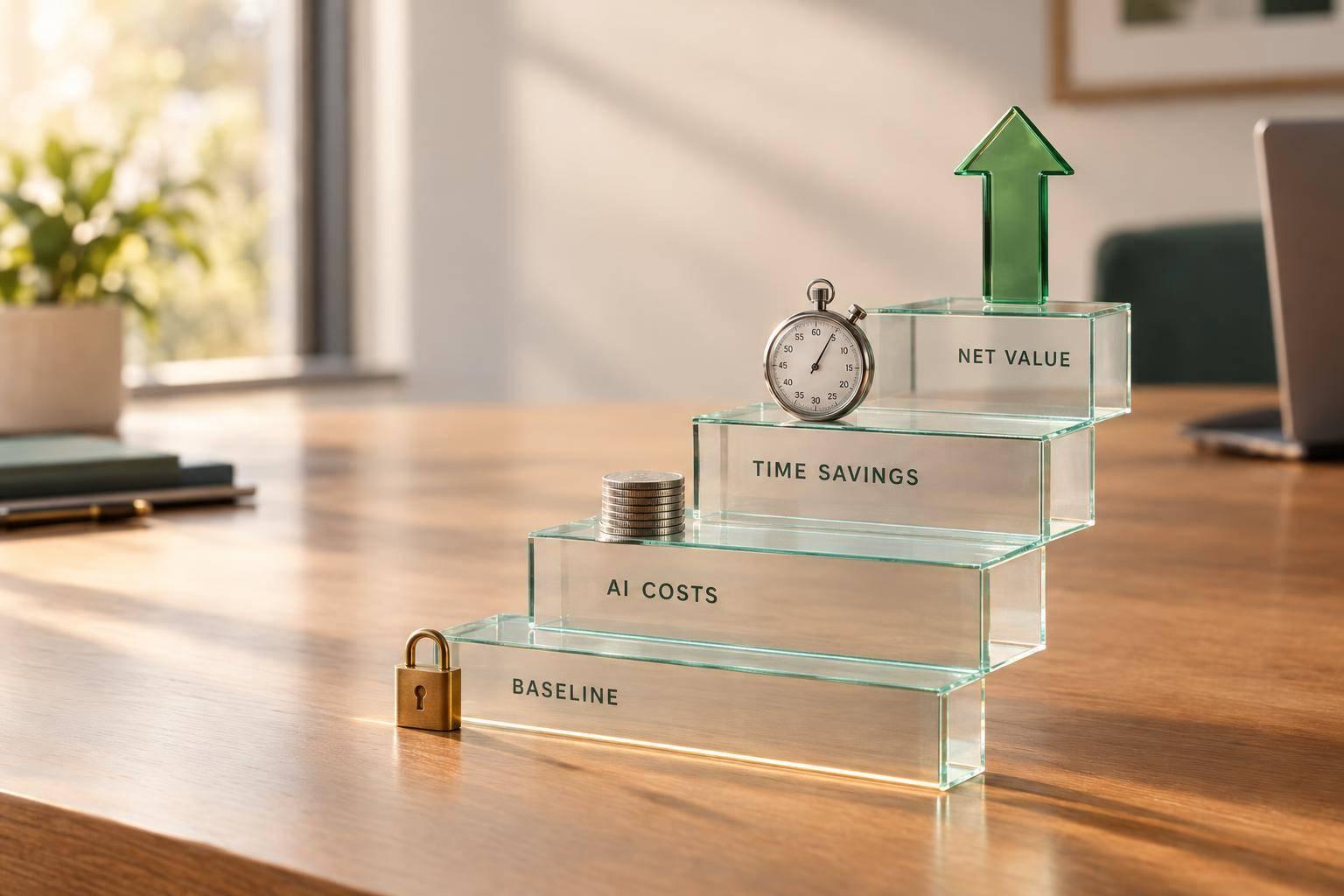
Measure AI-agent ROI by attributable cash: set a locked baseline, count full AI costs, separate time savings and model monthly payback.
Read more
Microsegmentation blueprint for AI: map assets, deny-by-default, approve narrow agent access, assign owners and test policies.
Read more
Compare extractive trimming and generated summaries in RAG pipelines, balancing token cost, latency and evidence fidelity.
Read more
Flag potential poisoned training samples with controlled, label‑preserving perturbations, calibrated on clean data and routed for human review.
Read more