Compliance Controls for Hybrid Cloud Security
Hybrid cloud compliance holds when every control is defined, owned, logged and reviewed on a fixed cycle.
Read moreBlog posts in the Disaster Recovery category

Hybrid cloud compliance holds when every control is defined, owned, logged and reviewed on a fixed cycle.
Read more
Use Terraform to codify private-cloud HA and DR: repeatable modules, remote state, resilient pipelines and tested failover.
Read more
Automating hybrid cloud disaster recovery cuts downtime, hands-on recovery and infrastructure costs while improving RTO and RPO.
Read more
Pay only for the multi-region resilience and speed you need: limit replication, keep writes local, optimise routing and test failover.
Read more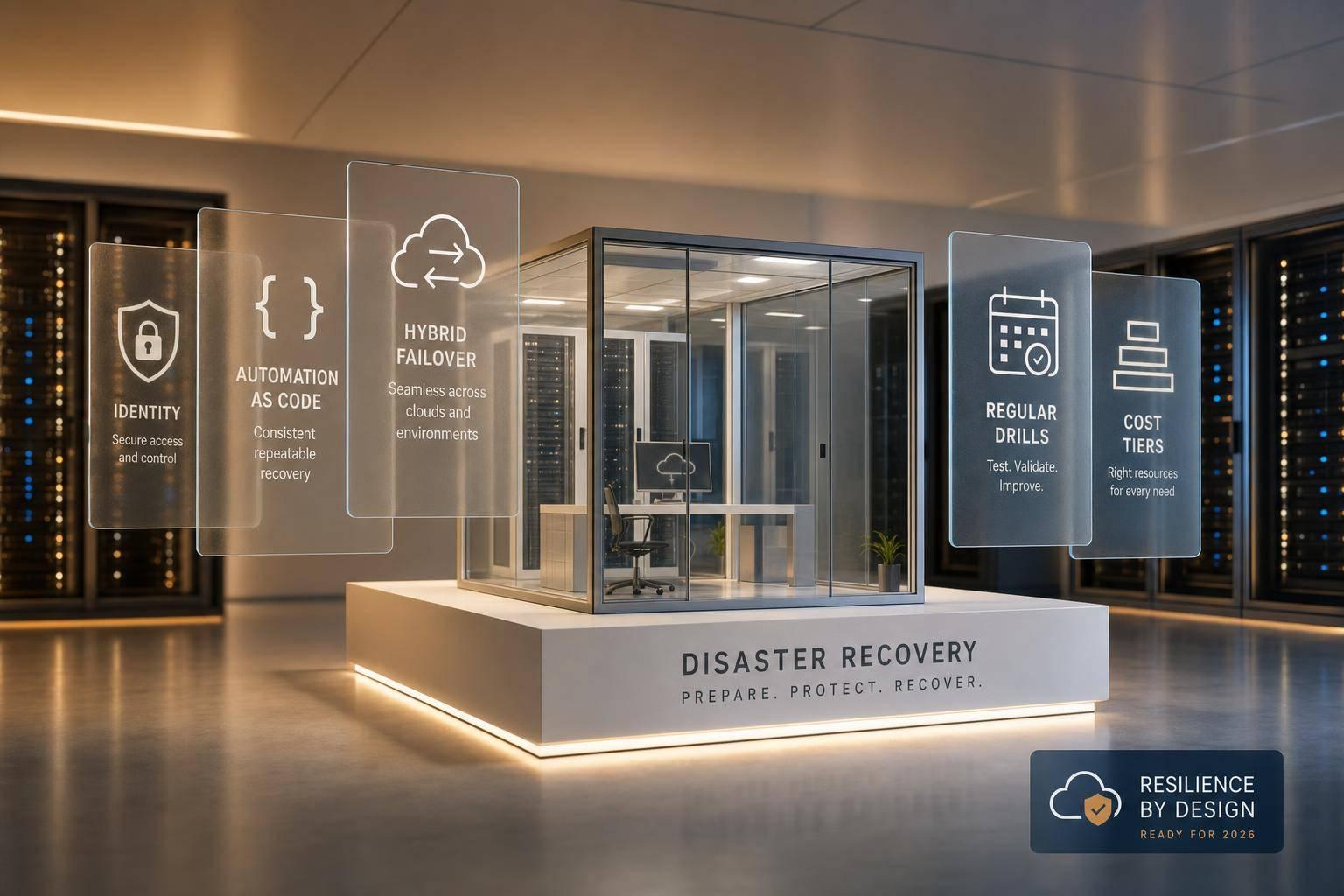
Hybrid cloud DR now prioritises identity and service recovery, uses DR-as-code, ransomware-safe clean rooms, frequent drills and cost-tiering.
Read more
Set RTO/RPO, sync clusters with GitOps, auto-switch traffic for stateless apps, and promote data first for stateful failover.
Read more
Compare data sync and replication: use two‑way sync for shared live records; use one‑way replication for uptime, failover and read scaling.
Read more
Checklist for private cloud providers covering governance, BAAs, encryption, network segmentation, incident response and testing.
Read more
Active-Active offers near-zero downtime; Active-Passive reduces cost. Compare uptime, RTO/RPO, failover speed and when to use each.
Read more
Federated Kubernetes lets you treat multiple clusters as one, trading added complexity for cross-region resilience, compliance and burst-to-cloud capacity.
Read more
Practical five-step guide to plan, create, automate and test GCP snapshots for reliable, cost‑aware disaster recovery.
Read more
Reduce disaster-recovery expenses by tiering data, matching sync methods, optimising storage, testing affordably and monitoring costs.
Read more