Chargeback vs Showback: Choosing the Right Model
Showback vs chargeback explained: when to use each cloud cost model, their pros and cons, and how to move from transparency to billed accountability.
Read moreBlog posts in the Cloud Optimization category

Showback vs chargeback explained: when to use each cloud cost model, their pros and cons, and how to move from transparency to billed accountability.
Read more
Automate DevOps with CI/CD, IaC, containerisation and AI to speed delivery, reduce failures and lower IT costs.
Read more
Step-by-step guide to identify, score and control organisational risks, integrate controls into DevOps and enable continuous monitoring.
Read more
Practical guidance on forecasting, regional allocation, load balancing, multi‑CDN and real‑time monitoring to optimise CDN capacity, performance and cost.
Read more
Practical tips to cut AWS Elastic Disaster Recovery costs: optimise disks, choose cheaper EBS types, right-size failover instances and monitor costs.
Read more
11 practical strategies to cut audit log storage costs—tiering, compression, filtering, sampling, retention policies and automated archiving.
Read more
For Kubernetes platforms, favour control‑plane reconciliation for Day‑2 automation and CLI IaC for Day‑0 bootstrapping — often a hybrid approach wins.
Read more
Manage GDPR risks in hybrid cloud: map data flows, formalise DPAs, encrypt data, run DPIAs and automate monitoring to prevent fines and breaches.
Read more
A practical framework to evaluate cloud cost tools: set goals, run a 30‑day PoC, and assess forecasting, tagging, automation and integrations to reduce cloud spend.
Read more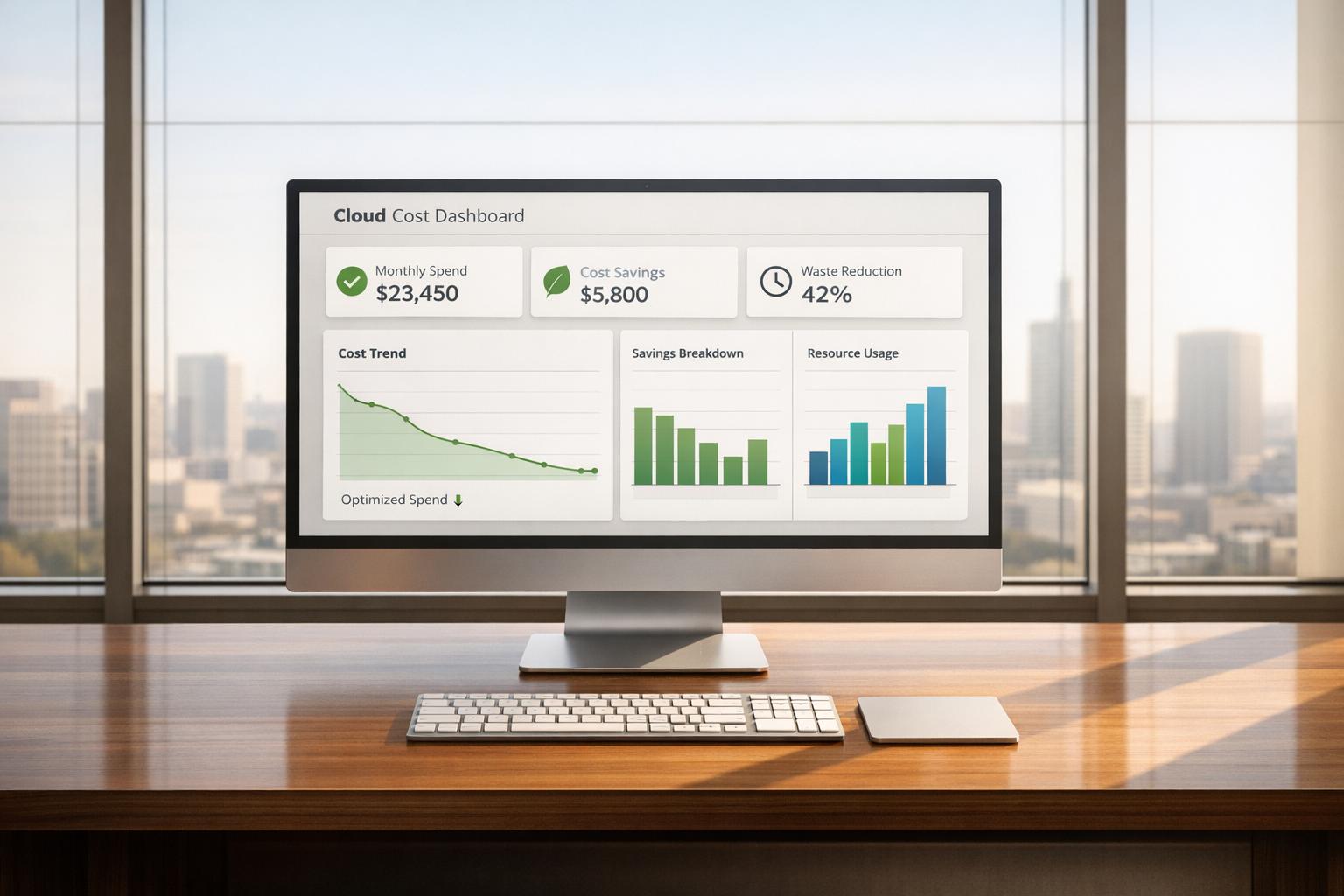
Automated cloud cost reporting stops costly errors, uncovers waste, and provides real-time control so teams can focus on high-value work.
Read more
How predictive analytics and DevOps can forecast cloud spend, optimise resources and cut waste — compares native tools, enterprise platforms and custom ML.
Read more
Use 12–18 months of normalised billing data, identify cost drivers, build driver-based forecasts, monitor continuously and review to cut variance to 5–12%.
Read more